
The honest answer on UAE free zone VAT is the one nobody selling you a licence leads with: being in a free zone does not make you VAT-exempt. Only zones named in a Cabinet Decision as Designated Zones get special treatment, that treatment covers goods and never services, and even inside those zones your company still registers, files and pays like anyone else.
UAE free zone VAT is not a separate regime — most zones sit inside the tax net
VAT arrived on 1 January 2018 at a standard rate of 5% and applies across the territory of the UAE. Free zones sat outside the country for customs purposes historically, and much setup advice still leans on that. For VAT it is not true by default.
The FTA’s Designated Zones guide is blunt: both fenced and unfenced free zones are within the territorial scope of the UAE, and therefore subject to normal VAT rules, unless they meet the Designated Zone criteria. Where a free zone is not a Designated Zone, it is treated like any other part of the UAE.
Cabinet Decision No. 59 of 2017 set the original schedule and has been amended since; published tallies run to roughly 27 to 29 zones. If your zone is not on it, everything below about goods is irrelevant — for VAT you are a mainland business with a nicer address.
A Designated Zone has to pass four tests before it counts as outside the UAE
Being named in the Cabinet Decision is necessary but not sufficient. Article 51(1) of the Executive Regulations (Cabinet Decision No. 52 of 2017) requires all four of the following:
- a specific fenced geographic area;
- security measures and Customs controls monitoring entry and exit of people and movement of goods;
- internal procedures for keeping, storing and processing goods;
- an operator that complies with FTA procedures.
Two consequences catch people out. Where a zone has qualifying and non-qualifying areas, it is outside the UAE only to the extent the requirements are met — a warehouse plot and a nearby office in the same branded zone can land on opposite sides of the line. And under Article 51(2), a zone that changes how it operates or stops meeting a condition is treated as inside the UAE. Designated status is a live test, not a permanent badge.
Your company is UAE-resident for VAT whichever zone you are in
This is the most misunderstood point in UAE free zone VAT. Article 51(9) deems any person established, registered or resident in a Designated Zone to have a place of residence in the UAE. The FTA states it plainly: Designated Zone businesses are established “onshore” for VAT, with the same obligations to register, report and account for VAT.
So the thresholds apply to you, the deadlines apply to you, the penalties apply to you, and you may join a VAT group with mainland or other Designated Zone companies on the usual control conditions. Input VAT recovery follows ordinary rules, and you recover nothing unless you are registered with the FTA.
Services in a Designated Zone are taxed exactly as they are anywhere in the UAE
Article 51(6) overrides the place-of-supply rules for services: where the place of supply would be the Designated Zone, it reverts to the UAE, in all circumstances. Services are then standard-rated at 5%, or zero-rated where they qualify as exports to a recipient resident and located outside the GCC implementing states.
For most free zone companies that is the whole story. A consultancy, agency, software studio or recruitment firm supplies services, so the Designated Zone rules give it nothing — even sitting inside JAFZA. Picking a zone for VAT status only makes sense if you move physical goods; otherwise weigh the real cost of forming a UAE free zone company instead of a benefit you will never use.
Real estate is the exception. Selling or leasing it is a supply of goods and is not consumption, so it stays outside the scope inside a Designated Zone, as do raw materials bought to construct that building in the same zone. But granting a right to use property — a licence to occupy, a contractual right, hotel accommodation — is a service, and taxable.
Goods that will be consumed inside the zone fall back into UAE VAT
This is where UAE free zone VAT gets genuinely favourable. Because place of supply follows where goods are, a supply of goods within a Designated Zone is made outside the UAE and is outside the scope.
Article 51(5) overrides that whenever goods are supplied to a person to be consumed by them or another person. “Consumed” is read broadly — any utilisation, application, employment, deployment or exploitation. Critically, resale is not consumption, so trading stock stays outside the scope. Nor does the override bite where goods are incorporated into, attached to or form part of another good in the same zone that is not itself consumed, or are used in producing such a good. The connection must be direct:
- Outside the scope: trading stock bought for resale; steel used to build equipment the manufacturer then sells; work tools used to manufacture goods for sale.
- Within the scope: office computers, food, stationery, a company car, fuel, furniture — anything for the general running of the business; a computer bought to design goods manufactured later (design is one step removed from production); any purchase by an individual for private use.
The obligation sits with the supplier, who should not treat goods as outside the scope unless satisfied there is no risk of non-qualifying use. The FTA expects a written statement from the recipient that the goods will not be consumed to suffice in most arm’s length cases. Sell inside a Designated Zone without collecting those statements and the exposure is yours.
Two provisions close the loop. Under Article 51(8), goods in a zone on which the owner has not paid VAT are treated as imported if the owner consumes them or if they are unaccounted for — stock losses carry a tax cost. Under Article 51(7), water and energy supplied for consumption are standard-rated even when used to produce other goods, though oil and gas traded as stock can still be outside the scope.
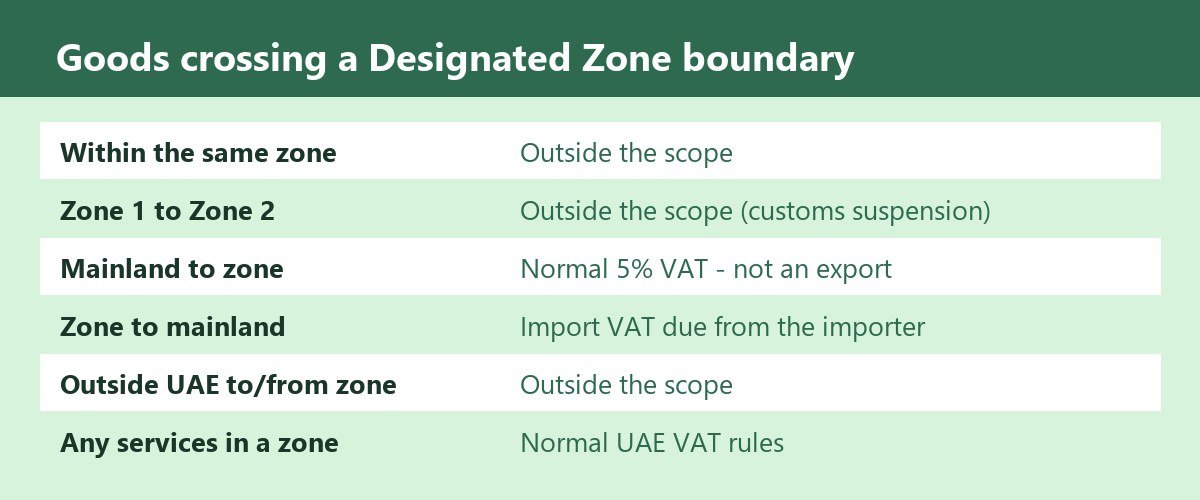
What happens when goods cross a Designated Zone boundary
| Movement | VAT treatment | Conditions |
|---|---|---|
| Within the same Designated Zone | Outside the scope | Only if not consumed — see the Article 51(5) override. |
| Designated Zone 1 to Designated Zone 2 | Outside the scope | Goods not released into circulation, used or altered in transit; transfer under GCC Common Customs Law suspension. FTA may require a financial guarantee. |
| Mainland UAE to a Designated Zone | Normal VAT rules | Expressly not an export (Article 30(3)). An ordinary local supply, so your supplier charges 5%. |
| Designated Zone to mainland UAE | Import | Import VAT due from the importer — via the return if registered, before release if not. |
| Outside the UAE to a Designated Zone | Outside the scope | Subject to correct controls, processes and records. |
| Designated Zone to outside the UAE | Outside the scope | Subject to correct controls, processes and records. |
| Any services in a Designated Zone | Normal UAE VAT rules | Article 51(6). Zero-rated only if they qualify as exports. |
The mainland-to-zone row surprises importers: bringing stock in from your Dubai supplier is not an export. This bites hardest in the logistics zones — see our guides to JAFZA and DAFZA.
There is relief for double taxation. Where a registered person paid VAT buying goods inside a zone and then import VAT on the same goods with no intervening transaction, they recover that import VAT in full on their return, regardless of their normal recovery percentage, provided they keep the evidence. Branches work similarly: head-office-to-branch supplies are disregarded, but moving goods from a zone branch to a mainland head office still triggers import VAT. Cabinet Decision No. 88 of 2021 amended Article 51 from 30 October 2021 so qualifying goods are outside the scope where conditions are met, including where goods are delivered outside the UAE or import VAT was paid — removing a registration trap for non-resident suppliers.
UAE free zone VAT registration thresholds are identical to a mainland company’s
There is no separate UAE free zone VAT threshold. Registration is mandatory once taxable supplies and imports exceeded AED 375,000 over the previous 12 months, or you expect to exceed that within the next 30 days. Voluntary registration starts at AED 187,500 of taxable supplies or expenses, which is why pre-revenue companies with real costs often register early to recover input tax.
Watch what counts. Out-of-scope supplies do not push you towards the mandatory threshold, but standard-rated and zero-rated supplies do — so a Designated Zone trader with a services line, or one selling consumables in-zone, crosses AED 375,000 sooner than expected.
UAE free zone VAT filing and deregistration deadlines are where penalties accrue
UAE free zone VAT returns follow the standard calendar. Tax periods are quarterly below AED 150 million annual turnover and monthly at or above it, though the FTA can assign a different period. Returns and payment are due within 28 days of the period end.
Deregistration has its own clock: apply within 20 business days of ceasing taxable supplies, or once supplies have been below AED 187,500 for 12 consecutive months. The final return must account for business assets still held as a deemed supply where input tax was recovered — routinely missed when founders are closing a UAE free zone company and assume cancelling the licence ends the tax obligations.
- Failure to register on time: AED 10,000.
- Late deregistration application: AED 1,000, repeating monthly up to AED 10,000.
- Late return: AED 1,000 first time, AED 2,000 for a repeat within 24 months.
The common UAE free zone VAT failure mode is a slow-trading company that lets VAT filings and the free zone licence renewal lapse together, then finds the arrears on reactivation.
VAT and the 0% corporate tax rate are two separate tests
UAE free zone VAT and corporate tax get conflated constantly. Qualifying Free Zone Person status and the 0% rate are tested under the corporate tax law; Designated Zone status under the VAT law. They share no criteria and no list. Sitting in a Designated Zone does not make you a QFZP, and being a QFZP does not exempt you from VAT. Paying 0% corporate tax while remitting 5% VAT quarterly is the normal case — our UAE free zone corporate tax and QFZP guide covers that side.
One change touches both. A voluntary e-invoicing pilot opened in July 2026; mandatory Wave 1 covers large VAT-registered businesses for B2B and B2G from 1 January 2027, and Wave 2 all remaining VAT-registered businesses from 1 July 2027. The threshold defining “large” has not been publicly confirmed, so treat specific figures with caution. It runs on a Peppol-based five-corner model through accredited service providers, so PDF and scanned invoices will not qualify — if you invoice from spreadsheets, that is the 2026 fix.
Which well-known free zones actually are Designated Zones
The pattern is consistent: port, airport and industrial zones are listed; commercial and professional-services zones are not.
| Free zone | Designated Zone? | In practice |
|---|---|---|
| JAFZA (Jebel Ali) | Yes | Goods relief; services still taxed. |
| DAFZA (Dubai Airport Free Zone) | Yes | Air-freight trading benefits; in-zone consumables still carry VAT. |
| Hamriyah Free Zone | Yes | Industrial and storage operations qualify on goods. |
| SAIF Zone | Yes | Relief for trading and warehousing. |
| Ajman Free Zone | Yes | Goods relief; consumption override applies. |
| UAQ Free Trade Zone | Yes | Listed areas only — check your site. |
| Fujairah Free Zone | Yes | Port-linked movements can be outside the scope. |
| KEZAD / Khalifa Industrial Zone | Yes | Manufacturing inputs often covered by the production carve-out. |
| Dubai CommerCity | Yes | E-commerce stock held for resale can be outside the scope. |
| DMCC | No | Normal UAE VAT — no goods relief. |
| IFZA | No | Normal UAE VAT; a consultancy here gains nothing. |
| Meydan Free Zone | No | Normal UAE VAT throughout. |
| Dubai Silicon Oasis | No | Normal UAE VAT throughout. |
| DIFC | No | Financial free zone, ordinary VAT territory. |
| ADGM | No | Financial free zone, ordinary VAT territory. |
Treat this UAE free zone VAT table as orientation, not authority. The Cabinet Decision schedules geographic areas, not brand names — entries like “Free Zone Area in Al Quoz” do not map neatly onto how zones market themselves, and the schedule has been amended more than once since 2017. Check your exact plot against the current list under the Legislation tab on the FTA website before treating a single invoice as outside the scope, and remember only the part of a zone meeting the Article 51(1) conditions gets the treatment.
Explore UAE Freezone options today →
Frequently Asked Questions
Do free zone companies in the UAE have to register for VAT?
Yes, on the same terms as mainland companies. A business established or registered in a Designated Zone is deemed resident in the UAE for VAT, so registration is mandatory once taxable supplies and imports pass AED 375,000 in the previous 12 months, or are expected to within 30 days. Voluntary registration opens at AED 187,500 of supplies or taxable expenses.
Is my free zone a Designated Zone?
For UAE free zone VAT purposes, only if it appears in the Cabinet Decision schedule, and only for the parts that are fenced, customs-controlled and operated to FTA procedures. Broadly, port, airport and industrial zones such as JAFZA, DAFZA, Hamriyah, SAIF Zone and KEZAD are listed, while DMCC, IFZA, Meydan, DIFC and ADGM are not. Verify your premises against the FTA Legislation page.
Do I charge VAT on services supplied from a Designated Zone?
Almost always. Article 51(6) pushes the place of supply of services back into the UAE in all circumstances, so services are taxed under normal rules at 5%. The only common relief is zero-rating where the service qualifies as an export to a recipient resident and located outside the GCC implementing states. Designated Zone status gives services no special treatment.
Do I pay VAT moving goods from my free zone into mainland Dubai?
Yes. Moving goods from a Designated Zone into the mainland is an import, and import VAT is payable by the importer — through the VAT return if registered, or before release if not. If you already paid VAT buying those same goods inside the zone, with no intervening transaction, you can recover the import VAT in full on your return.
Does being in a Designated Zone give me 0% corporate tax?
No. Designated Zone status is a VAT concept; the 0% rate depends on qualifying as a Qualifying Free Zone Person under the corporate tax law, which has separate criteria and its own list. The two frequently do not overlap. Many companies pay 0% corporate tax as a QFZP while charging and remitting 5% VAT every quarter.
What happens if I register for UAE free zone VAT late?
The published penalty for failing to register on time is AED 10,000, and it does not remove the underlying liability — you still owe the VAT you should have charged from the date registration became mandatory. Late returns attract AED 1,000 first time and AED 2,000 for a repeat within 24 months, so arrears compound quickly.