

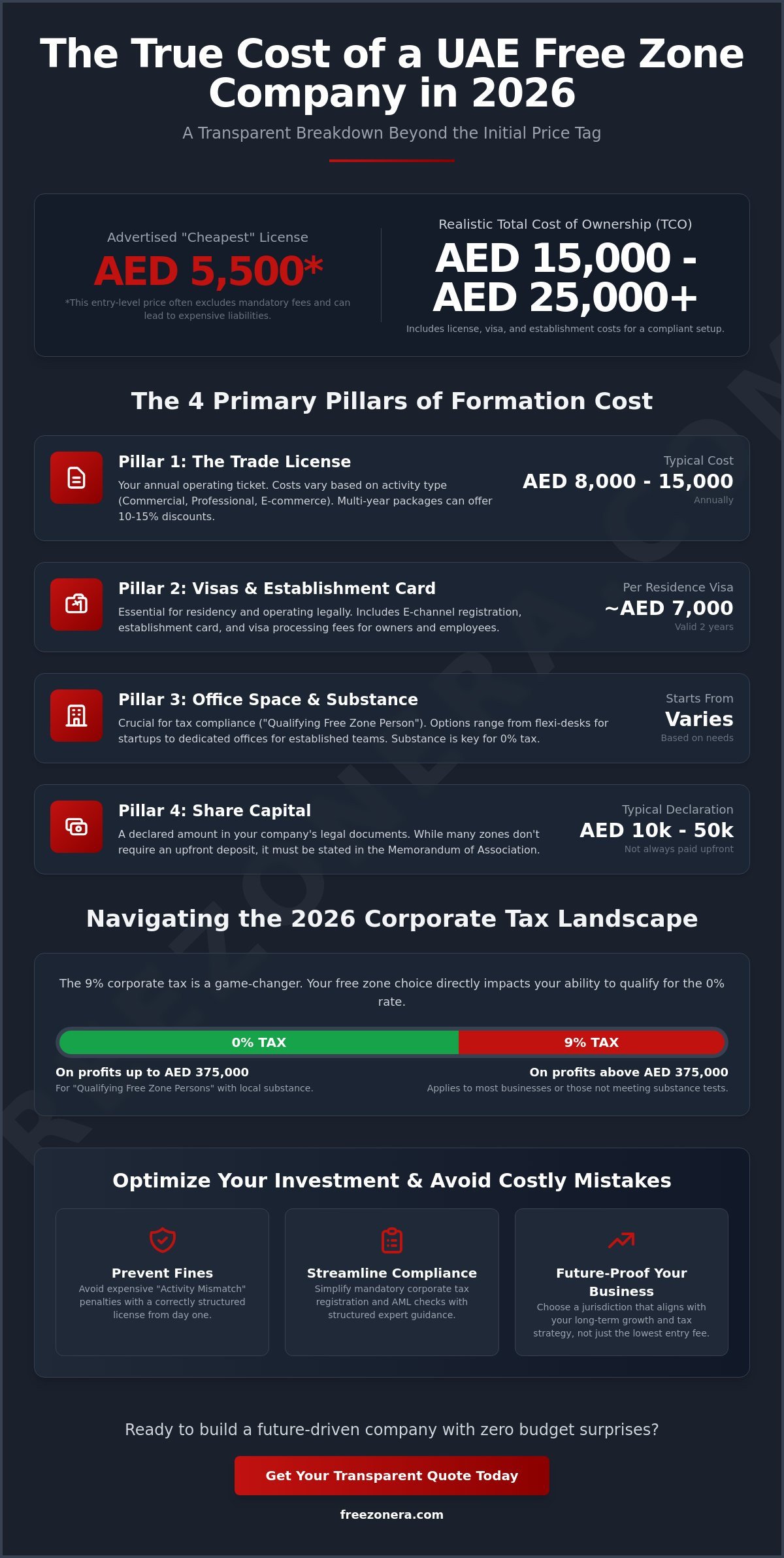
The cheapest trade license you find today might become your most expensive liability by December. While an entry-level package starting at AED 5,500 looks attractive, the true UAE free zone company formation cost 2026 involves much more than an initial registration fee. You’re likely feeling the pressure of calculating the total cost of ownership while trying to understand how the 9% corporate tax on profits above AED 375,000 impacts your bottom line. It’s a complex environment where hidden administrative add-ons often surprise even the most seasoned investors.
At FreezonEra, we believe in clarity and compliance from day one. We’ll show you exactly where your capital goes, from the AED 8,000 to AED 15,000 license fees to the AED 7,000 residence visa requirements. This guide provides a transparent breakdown of 2026 pricing across different emirates, ensuring you don’t overpay for “extras” you don’t need. We’re simplifying UAE business setup for entrepreneurs by mapping out every financial milestone, helping you build a future-driven company with zero budget surprises.
Key Takeaways
- Identify the four primary financial pillars that define your Total Cost of Ownership, moving beyond basic registration to long-term operational viability.
- Master the UAE free zone company formation cost 2026 by calculating the specific impact of E-channel fees, establishment cards, and residency visa multipliers.
- Evaluate the strategic trade-offs between premium jurisdictions like DMCC and budget-friendly hubs like RAKEZ to align your setup with your business scale.
- Understand the critical compliance requirements for “Qualifying Income” to ensure your entity benefits from the 0% corporate tax rate where applicable.
- Discover how professional structured guidance prevents expensive “Activity Mismatch” fines and streamlines the mandatory corporate tax registration process.
The 2026 UAE Business Landscape: Why Setup Costs Have Evolved
The UAE economy in 2026 isn’t just about low entry costs; it’s about long-term fiscal health. For years, entrepreneurs looked for the cheapest sticker price. Today, the UAE free zone company formation cost 2026 must be viewed through the lens of Total Cost of Ownership (TCO). This calculation includes the 9% corporate tax on income exceeding AED 375,000, which fundamentally changes how you choose your jurisdiction. You’re no longer just buying a trade license; you’re investing in a tax-compliant ecosystem.
Free zones aren’t just administrative silos anymore. They’re strategic partners. If your business model relies on the 0% tax rate, you must meet the criteria for a Qualifying Free Zone Person. This requires physical substance and local operations. Choosing a zone purely for a AED 5,500 license is a mistake if that zone lacks the infrastructure to support your tax compliance. The shift toward “Substance over Savings” means authorities prioritize businesses that contribute to the local economy. In 2026, regulators expect to see real offices and real employees. This shift is reflected in the 50+ UAE Free Trade Zones, where compliance costs are now a predictable part of the budget.
Regulatory Changes Impacting Your 2026 Budget
Federal Tax Authority (FTA) registration is now a standard part of the setup flow for almost every new entity. Anti-Money Laundering (AML) checks have become more stringent, ensuring every dirham is accounted for. While these audits protect the financial system, they can add 48 to 72 hours to your setup timeline and involve minor administrative fees for document verification. Additionally, 2026 brings updated requirements for mandatory health insurance and expanded pension scheme contributions for local employees, which must be factored into your operational runway from day one.
Free Zone vs. Mainland: A 2026 Cost Perspective
Free zones remain the gold standard for 100% foreign ownership and specialized industry clusters. While the mainland offers access to the local market, free zones provide a stable regulatory framework that protects international investors. When comparing jurisdictions, look at renewal stability. Some zones have maintained consistent pricing for five years, while others fluctuate. For a deep dive into these strategic choices, explore our guide on UAE Company Setup 2026 to see which path fits your growth model. 2026 is also a landmark year for sustainability. Many jurisdictions now offer “Green Licenses” with reduced first-year fees for startups focused on renewable energy. These incentives can lower your UAE free zone company formation cost 2026 by 15% to 20% compared to traditional commercial licenses.
Breaking Down the 4 Primary Cost Pillars of Formation
Understanding the UAE free zone company formation cost 2026 requires looking past the glossy brochures. Most setups rely on four distinct financial pillars. These aren’t just administrative hurdles; they’re the foundation of your legal standing in the Emirates. Government registration fees are your first entry point. These are typically one-time payments made directly to the Free Zone Authority to establish your corporate entity. While these fees are fixed, the other three pillars, licenses, office space, and capital, vary significantly based on your specific business activity.
Share capital is the final pillar often overlooked until the final stages. While many zones don’t require you to deposit capital in a bank account upfront, you must declare a minimum amount in your Memorandum of Association. This declaration typically ranges from AED 10,000 to AED 50,000. Some specialized jurisdictions still require physical proof of funds before issuing the final license. If you’re unsure which zone matches your budget and activity, our team can help you evaluate your setup options for maximum efficiency.
The Trade License: Your Yearly Operating Ticket
Your license type dictates your operational scope and your annual renewal obligations. A professional service license serves consultants and freelancers, while a commercial license is necessary for those trading physical goods. If you’re planning to scale, multi-year license packages often offer 10% to 15% discounts, though they require more upfront liquidity. A service-based startup should budget between AED 8,000 and AED 15,000 for its initial license and registration fees in 2026. Specialized e-commerce licenses may carry additional costs for third-party approvals, depending on the products you intend to sell.
Office Space and Legal Address Costs
You cannot legally operate a UAE entity without a registered address. For many entrepreneurs, a flexi-desk is the most efficient solution. In premium zones like DMCC, a flexi-desk costs between AED 15,000 and AED 20,000 annually. These desks aren’t just furniture; they provide the “Economic Substance” required to satisfy tax authorities and facilitate corporate bank account openings. If you require facilities for smart manufacturing or logistics, warehouse rates will depend on square footage and utility requirements. High-demand hubs often require a 5% to 10% security deposit on physical leases, which adds to your initial UAE free zone company formation cost 2026.
Visas, Banking, and Hidden Essentials: The “Real” Invoice
The sticker price of a trade license is rarely the final amount on your bank statement. To get your business fully operational, you must account for the infrastructure that supports your legal presence. This is where the UAE free zone company formation cost 2026 often scales beyond initial expectations. Two mandatory requirements frequently missed in early budgets are the Establishment Card and E-Channel registration. These digital portals are essential for managing your visa quotas and interacting with immigration authorities. Without them, your trade license is essentially a dormant document.
Document attestation and legal translations represent another layer of necessary expenses. If your parent company is based outside the UAE, you’ll likely spend between AED 2,000 and AED 5,000 on notarizing and legalizing corporate documents at the Ministry of Foreign Affairs. These administrative steps are non-negotiable for bank account openings and corporate registrations. Every document must be in Arabic or officially translated, adding a methodical cost to your setup timeline. We help simplify these complex processes by managing the bureaucracy on your behalf.
The 2026 UAE Residency Visa Breakdown
A standard residence visa in 2026 typically costs between AED 3,000 and AED 7,000. This range covers the entry permit, status adjustment, medical fitness test, and the issuance of your Emirates ID. It’s vital to differentiate between investor visas and employee visas, as insurance requirements and bank guarantees vary. For those seeking long-term stability and a reduction in renewal overhead, we recommend reviewing our Dubai Golden Visa Guide 2026 to see if you qualify for a 10-year residency path.
Corporate Banking and Compliance Fees
Opening a corporate bank account remains a significant hurdle for new entities. Banks have intensified their KYC (Know Your Customer) protocols, often requiring minimum monthly balances between AED 50,000 and AED 200,000 for premium jurisdictions. If your nationality is categorized under enhanced due diligence, expect additional compliance fees ranging from AED 1,000 to AED 3,000. Professional guidance is no longer a luxury here; it’s a strategic necessity to avoid rejected applications that can stall your operations for months. Our structured guidance system ensures your documentation meets every banking standard from the first submission.
Comparative Analysis: Top Free Zones for 2026 Budgets
Selecting a jurisdiction is the most consequential decision in your business roadmap. While the UAE free zone company formation cost 2026 varies significantly across the seven emirates, your choice should align with your operational needs rather than just the lowest price tag. For many, the decision is a strategic balance between the prestige of a Dubai address and the aggressive cost-efficiency found in the Northern Emirates. Each zone offers a unique value proposition that impacts your long-term scalability and banking success.
If you’re unsure which jurisdiction fits your specific industry, you can request a personalized 2026 cost comparison from our consultants. We’ll help you weigh the immediate savings of a remote zone against the logistical benefits of a central hub.
RAKEZ vs. SPC: Finding the Best Value in 2026
For entrepreneurs prioritizing capital preservation, Sharjah Publishing City (SPC) and Ras Al Khaimah Economic Zone (RAKEZ) are the primary contenders. SPC has gained a reputation as the “Digital Favorite” due to its ability to issue licenses in as little as 24 hours. Their zero-visa packages are some of the most competitive in the market, starting around AED 5,750 for basic registrations. This makes it an ideal entry point for e-commerce and consultancy startups that don’t require immediate physical staff.
RAKEZ remains the budget leader for manufacturing and trading entities. While it’s located further from Dubai’s center, the cost savings on warehouse leases and industrial land are substantial. RAKEZ has also shown remarkable price stability, with renewal fees remaining consistent over the last three years. The logistical trade-off involves a longer commute for face-to-face meetings in Dubai, but the lower UAE free zone company formation cost 2026 in Ras Al Khaimah often justifies the distance for heavy-industry players.
DMCC: Is the Premium Price Justified?
Dubai Multi Commodities Centre (DMCC) sits at the top of the market in terms of both cost and prestige. A setup here often ranges from AED 35,000 to AED 50,000 in the first year, but the ROI is found in the ecosystem. Located in the heart of Jumeirah Lakes Towers (JLT), DMCC provides unparalleled networking opportunities for tech, commodities, and energy sectors. The authority offers world-class real estate options, from shared desks to entire office floors, which are essential for businesses needing to prove high economic substance.
If your business model depends on high-value international contracts or specialized banking facilities, the DMCC “stamp of approval” can accelerate your growth. Banks often view DMCC-registered entities with a higher degree of trust, which can simplify the KYC process. For tech-focused founders who need flexibility without the full DMCC investment, IFZA in Dubai Silicon Oasis offers a middle ground. IFZA provides highly customizable visa packages that allow you to scale your team size up or down as your 2026 revenue grows.
Optimizing Your Investment: Why Professional Guidance Saves Money
Applying directly to a free zone portal might seem like a way to shave off expenses, but it often leads to the most expensive mistakes. In the 2026 regulatory environment, an “Activity Mismatch” can result in significant fines from the Ministry of Economy. If your trade license doesn’t precisely mirror your daily operations, you risk more than just a penalty; you risk having your corporate bank account frozen or rejected. Professional guidance ensures your UAE free zone company formation cost 2026 remains a controlled investment rather than an escalating debt.
Streamlining your corporate tax registration is another area where expertise pays for itself. Since the 9% tax rate applies to income over AED 375,000, your initial setup must be structured to capture every available exemption for “Qualifying Free Zone Persons.” We help you navigate these financial sectors with precision. Our model focuses on fixed-fee transparency, eliminating the “add-on” culture that plagues many variable-fee consultancies. We don’t just hand you a license; we open the door to a functional banking relationship by ensuring your KYC profile is bulletproof from day one.
The Freezonera Strategic Roadmap
We don’t look at your business as a one-time transaction. Our team identifies the specific jurisdiction that matches your five-year growth trajectory. Whether you’re scaling into smart manufacturing or digital services, our future-driven approach ensures your compliance and digital presence are ready for the next decade. We simplify complex processes by acting as your steady hand in a shifting administrative landscape. If you’re ready to move beyond generic estimates and secure a tailored financial breakdown, Reach Us for a Custom Quote to see how we can secure your commercial future.
Your 2026 Setup Checklist
To avoid re-submission fees and administrative delays, follow this “Smart Navigator” protocol for a successful launch. Timing your application is critical. Aligning your submission with the start of a UAE fiscal quarter can simplify your first tax filing and audit requirements. Use the following checklist to ensure your capital is deployed efficiently:
- Document Verification: Ensure all international parent company documents have been attested by the Ministry of Foreign Affairs to avoid AED 2,000 re-submission penalties.
- Visa Quota Planning: Confirm your visa requirements against your 12-month hiring forecast to avoid expensive mid-year quota expansions.
- Substance Audit: Verify that your chosen office solution meets the 2026 Economic Substance Test for your specific business activity.
Navigating the UAE free zone company formation cost 2026 is about precision. By following a structured guidance system, you transform a bureaucratic hurdle into a strategic launchpad for your enterprise. We bridge the gap between traditional administrative setup and modern business strategy, ensuring your investment is protected by clarity and compliance.
Securing Your Commercial Future in the UAE
The UAE free zone company formation cost 2026 is no longer a simple flat fee; it is a strategic calculation of license fees, residency costs, and tax compliance. Success in this landscape requires looking beyond the initial registration to ensure your business meets the 9% corporate tax substance requirements. Whether you choose the prestige of DMCC or the efficiency of RAKEZ and SPC, your focus must remain on long-term operational stability and banking accessibility. For regulated financial businesses requiring a financial centre address, our honest ADGM guide 2026 explains exactly who it suits and what the real costs are. You’ve seen that the cheapest entry point often carries the highest risk of hidden administrative add-ons.
FreezonEra provides a structured guidance system designed to eliminate the stress of foreign administrative landscapes. We offer fixed-fee business setup with no hidden surprises and specialized support across major jurisdictions. Our future-driven strategies ensure your entity is fully prepared for 2026 compliance and banking standards from the very first day. Simplify your UAE business setup with Freezonera’s expert guidance and transform your vision into a compliant, scalable reality. The Emirates continues to be a premier global launchpad, and with the right navigator, your path to growth is clear and certain.
Frequently Asked Questions
What is the cheapest UAE free zone license in 2026?
The most cost-effective options in 2026 start with packages from Ajman Free Zone (AFZ) at approximately AED 5,000 and Sharjah Media City (SHAMS) from AED 5,750. These “zero-visa” entry points are ideal for freelancers and digital consultants. While they offer the lowest initial UAE free zone company formation cost 2026, you should evaluate if their location and banking facilities align with your specific business activities before committing capital.
Are there any hidden fees in UAE free zone company formation?
Hidden costs often include the mandatory E-Channel registration fee, which typically adds AED 2,000 to AED 2,500, and the Establishment Card issuance. You should also budget for document attestation at the Ministry of Foreign Affairs and potential bank account opening assistance fees. These “administrative add-ons” can increase your total invoice by 15% to 25% if they aren’t accounted for in the initial teaser price of the license.
How much does a 1-year vs. 3-year UAE free zone license cost?
A 1-year license for a service startup usually ranges between AED 8,000 and AED 15,000. Opting for a 3-year package can provide a 10% to 15% discount on the total license fee, though it requires higher upfront liquidity. While the multi-year option locks in current rates and simplifies renewals, it’s not always the best choice for startups that need to maintain flexible cash flow during their first 12 months of operation.
Can I set up a UAE free zone company without visiting the country in 2026?
Yes, most UAE free zones allow for 100% remote company formation through digital portals. Registration can often be completed in as little as one to three business days without a physical presence. However, you’ll eventually need to visit the UAE to complete the biometric requirements for your Emirates ID and residency visa. Most investors find that a single visit of 5 to 7 days is sufficient to finalize these essential administrative steps.
Do I need a physical office for a UAE free zone company?
A registered address is a legal requirement for all UAE entities, but a full physical office isn’t always necessary. Most entrepreneurs utilize a “flexi-desk” or “smart office” solution, which provides a legal lease agreement for bank account and tax purposes. In premium zones like DMCC, these desks cost between AED 15,000 and AED 20,000 annually. This setup satisfies the Economic Substance Test while keeping your operational overhead manageable during your growth phase.
How much should I budget for a UAE residency visa in 2026?
You should budget between AED 3,000 and AED 7,000 for each UAE residency visa in 2026. This total includes the entry permit, medical fitness test, status change, and Emirates ID issuance. Keep in mind that health insurance is a mandatory additional cost that varies based on the coverage level you select. Planning for these costs ensures that your UAE free zone company formation cost 2026 reflects the true expense of relocating yourself or your staff.
What are the annual renewal costs for a free zone company?
Annual renewal costs typically range from 70% to 100% of your initial registration and license fees. While some government registration fees are one-time payments, the trade license and office lease must be paid every 12 months. It’s vital to maintain these renewals on time to avoid late penalties, which can start at AED 200 per month. Budgeting for these recurring expenses is a critical part of maintaining your company’s legal standing and operational continuity.
Is corporate tax registration mandatory for all free zone companies in 2026?
Yes, every free zone entity must register for corporate tax with the Federal Tax Authority (FTA), regardless of their income level. While many companies may qualify for a 0% rate on taxable income up to AED 375,000, the registration and filing requirements remain mandatory. Failure to register within the specified deadlines can result in administrative penalties. This compliance step ensures your business operates within the legal framework of Federal Decree-Law No. 47 of 2022.
Once you have narrowed your shortlist, our zone-specific cost breakdowns go deeper than any comparison table: DMCC 2026 cost guide, IFZA honest pricing guide, and JAFZA formation guide each include Year-2 renewal figures that most guides omit.
Related: Formation company strategy