
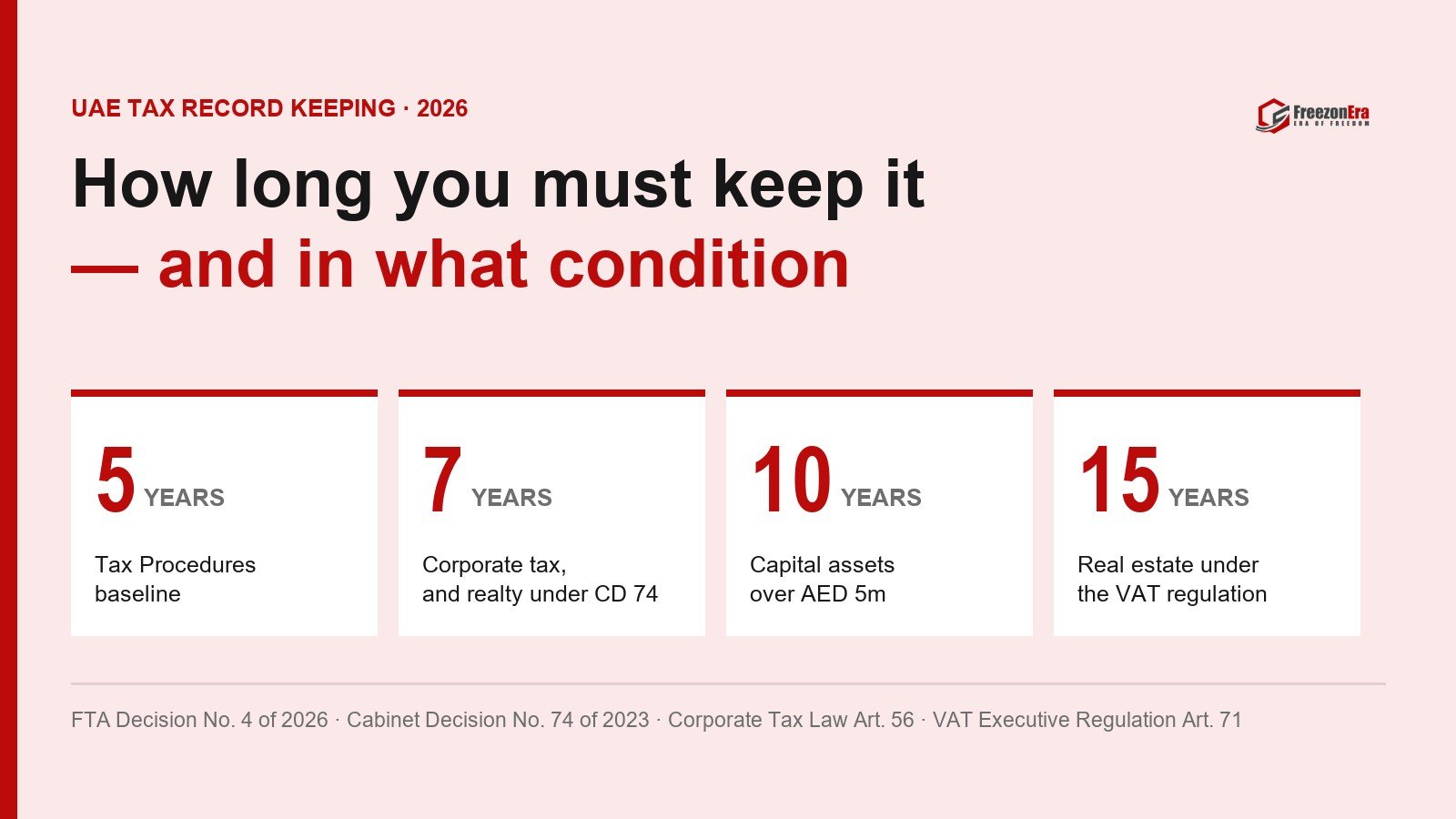
On 2 June 2026 the Federal Tax Authority issued FTA Decision No. 4 of 2026 on the rules and requirements for maintaining the information contained in accounting records and commercial books. The FTA publishes it as effective from 30 July 2026. Until then UAE law told you how long to keep a document and said almost nothing about what the copy had to look like. Decision No. 4 of 2026 closes that gap: it says a scan must carry every page in the original order, that partial scanning will not be accepted, that the file has to stay legible on a screen for the whole retention period, and that if your archive is encrypted you hand the Authority the keys.
This guide sets out the tax record keeping requirements UAE free zone companies actually face in 2026 — what counts as a record, the four different retention clocks and which one wins when two apply to the same document, the events that quietly extend every period, the new storage standard, the Arabic obligation, the Designated Zone evidence files that decide your VAT treatment, the penalties, and the e-invoicing deadlines that have already started to pass. It is general information rather than advice on your own position, and a registered tax agent should confirm how any of it lands on your facts.
The obligation starts in one sentence and the detail sits in the Executive Regulation
Article 4 of Federal Decree-Law No. 28 of 2022 on Tax Procedures is the parent rule and it is short. Any person conducting a business, or having an obligation under the tax law, shall keep accounting records and commercial books of that business and retain any tax related information as determined by the tax law, according to the controls specified in the Executive Regulation. Note who it binds. It is not limited to registered taxpayers. A person with an obligation under a tax law is caught, which is why a company that never registered can still be assessed for a records failure.
The controls live in Cabinet Decision No. 74 of 2023. Article 2 defines accounting records and commercial books as the records and books in relation to the business which evidence payments and receipts, purchases and sales, revenues and expenditures, including but not limited to:
- Balance sheet and profit and loss accounts.
- Records of wages and salaries.
- Records of fixed assets.
- Inventory records and statements, with quantities and values, at the end of any relevant tax period, and the stock-count records behind those statements.
Then a second limb: all documents supporting the entries, including correspondence, invoices, licences and contracts related to the business, and — the clause most finance teams miss — documents containing the details of any election, assessment, determination or calculation made in relation to the tax affairs of the business, including the basis or method used. The working paper is part of the record, not a draft you delete once the return is filed. The apportionment spreadsheet behind an input tax recovery, the memo explaining why a transaction was treated as qualifying income, the model behind a transfer pricing outcome: all of it is inside Article 2.
Article 2(2) adds a catch-all — the Authority may request any other information in order to verify, through a series of auditable documents, the person’s tax obligations, including their responsibility to register for tax. “Series of auditable documents” is the standard being applied. A number in a return that cannot be walked back to source is not a record, however well filed.
There are four retention clocks, not one
The most common error in UAE record keeping advice is to quote one number. There are four, and they run from different start points. Article 3(1) of Cabinet Decision No. 74 of 2023 sets the baseline, and it opens with a condition that does most of the work: records shall be retained “for the following periods, unless the Tax Law states otherwise“. Two tax laws do state otherwise, which is why the corporate tax and capital asset numbers are longer.
| Source | What it covers | Period | Clock starts |
|---|---|---|---|
| CD 74/2023, Art. 3(1)(a) | A Taxable Person, general baseline | 5 years | Following the tax period to which they relate |
| CD 74/2023, Art. 3(1)(b) | All persons other than Taxable Persons | 5 years | End of the calendar year the document was created |
| CD 74/2023, Art. 3(1)(c) | Real estate records | 7 years | End of the calendar year the document was created |
| Corporate Tax Law, Art. 56(1) | Records supporting a return, or that let taxable income be ascertained | 7 years | End of the tax period to which they relate |
| Corporate Tax Law, Art. 56(2) | Records letting an Exempt Person’s status be ascertained | 7 years | End of the tax period to which they relate |
| VAT Law, Art. 60(2) | Records related to Capital Assets | At least 10 years | Not specified in the article |
| VAT Executive Regulation, Art. 71(2) | Records related to real estate | 15 years | End of the tax period to which they relate |
Article 56 of Federal Decree-Law No. 47 of 2022 on corporate tax opens with “Notwithstanding the provisions of the Tax Procedures Law”, so the seven years is not an interpretation, it is an override written into the statute. It covers two categories: records that support the information provided in a tax return or any other document filed with the Authority, and records that enable taxable income to be readily ascertained. Article 56(2) applies the same seven years to an Exempt Person, for records that let the exemption itself be verified. An exempt free zone entity is not outside the regime — it is inside it with a different thing to prove.
The practical rule that follows: a single document can sit under two clocks at once, and the longer one governs the file. A lease invoice for warehouse space is a corporate tax record under Article 56 and a real estate record under the VAT Executive Regulation. Seven years does not discharge it. Fifteen does.
Real estate records: seven years in one instrument, fifteen in another
This is a genuine conflict on the face of the texts, and it is worth setting out properly because getting it wrong is a decade-scale mistake. Cabinet Decision No. 74 of 2023, Article 3(1)(c), says real estate records are kept for seven years from the end of the calendar year in which the document was created. Article 71(2) of the VAT Executive Regulation, Cabinet Decision No. 52 of 2017, says any records related to real estate must be held for fifteen years after the end of the tax period to which they relate. Different length, and a different start point as well.
The reconciliation is in the drafting of both. Article 3(1) of CD 74/2023 is expressly subject to the tax law stating otherwise. Article 71(1) of the VAT Executive Regulation says VAT records follow the Tax Procedures Law timeframes, but it says so “subject to Clause 2 of this Article” — and Clause 2 is the fifteen-year real estate rule. Each instrument steps aside for the other in the same place. Read together, fifteen years is the operative period for real estate records within the VAT regime, and seven is the residual position where the VAT regulation does not reach.
Neither text repeals the other, and we are not going to pretend the drafting is tidy. The safe operating rule is the one a tax auditor cannot argue with: keep anything touching real estate for fifteen years. Leases, sale and purchase agreements, construction and fit-out invoices, service charge statements, valuation reports, and the correspondence that explains them. If you want the shorter period on a specific file, that is a written position to get from your tax agent, not a default to assume.
The ten-year capital asset rule catches fit-outs that were never one purchase
Article 60(2) of the VAT Law requires a taxable person to keep the records related to Capital Assets for at least ten years. Article 57(1) of the VAT Executive Regulation defines a Capital Asset as a single item of business expenditure of AED 5,000,000 or more excluding tax, on which tax is payable, with an estimated useful life of at least ten years for a building or part of a building, or at least five years for anything else.
The trap is Article 57(3). Expenditure consisting of smaller sums which collectively amount to AED 5,000,000 or more is treated as a single item of expenditure where the sums are staged payments for the purchase of a building, the construction of a building, an extension, refurbishment, renewal or fitting out of a building, or the purchase, construction, assembly or installation of goods or immovable property supplied as separate components for assembly.
So a free zone company that fits out a warehouse across eighteen contractor invoices, none of them close to five million, has bought a Capital Asset if the total clears the threshold. Nothing in the accounting system flags it. The records — contracts, variations, payment certificates, the input tax working — carry a ten-year retention duty that nobody assigned. Where the works were done to a building you also cross into the real estate rule above, and the fifteen-year period is the one to operate.
Four events extend every period, and they are additive
Article 3(2) of Cabinet Decision No. 74 of 2023 says that in addition to the Article 3(1) periods, records shall be retained for further periods in four cases. The wording matters: these are not alternatives to the base period, they sit on top of it.
- A dispute with the Authority about the person’s tax obligations — an additional four years, or until the dispute is finally settled, whichever is later.
- An ongoing tax audit — an additional four years.
- Notice of an intended audit served before the base period expired — an additional four years.
- A voluntary disclosure filed in the fifth year from the end of the relevant tax period — an additional one year from the date of submission.
Article 3(3) adds a rule that catches people who thought they had walked away: a legal representative shall retain the books and records of the person they represent for one year from the date the legal representation expires.
These extensions are shaped around the Authority’s assessment window in Article 46 of the Tax Procedures Law, mirrored by Article 79 bis of the VAT Law. The Authority may not audit or assess after five years from the end of the relevant tax period, but if it notified you of audit procedures inside that window it gets four more years from the notification to finish, and where the matter relates to a fifth-year voluntary disclosure it gets one year from the submission date. No voluntary disclosure may be filed at all after five years, which is the real deadline on correcting an old return.
Two exceptions run much longer: fifteen years from the end of the tax period in the case of tax evasion, and fifteen years from the date registration should have happened where a person failed to register. Note the asymmetry honestly — no retention rule in Cabinet Decision No. 74 of 2023 requires fifteen years of general records, so in those two scenarios the Authority can lawfully examine a period for which you were never obliged to keep the file. Being unable to produce it is not a defence; it means the assessment gets made on the Authority’s view of the facts. That alone argues for keeping the core ledger past the minimum. Our free zone tax audit checklist covers what the Authority actually asks for when it arrives.
FTA Decision No. 4 of 2026 sets the standard the copy itself has to meet
Article 4 of Cabinet Decision No. 74 of 2023 always allowed two routes: retain the original supporting documents, or retain the information they contained as a photocopy or electronic copy — provided that copy is identical to the original, available throughout the Article 3 periods, reproducible as an easily readable copy within the period the Authority specifies, and stored so the Authority can verify your obligations. Article 4(2) then gave the Authority power to set rules for that second route, and to impose reasonable requirements ensuring the information stays available as if the originals had been kept.
Decision No. 4 of 2026 is that power being used. Article 2 states the three rules: records must be complete and identical to the original documents; they must be clear and easily legible; and access must be provided to the Authority on request, including access to the system in which the records are saved. Article 3 turns each into a testable requirement.
| Provision | What the text requires | What it means in an archive |
|---|---|---|
| Art. 3(1)(a) | The copy must be identical to the original and include all the pages in the same order | Annexes, schedules, signature pages and reverse sides are part of the document, not optional extras |
| Art. 3(1)(b) | Partial scanning of any part of the document shall not be accepted | A scanned first page with “full contract on file” is a failed record, not a partial one |
| Art. 3(2)(a) | Details must be clear and easily legible when displayed on a computer screen | Resolution is judged on screen, so thumbnail-grade phone photos of invoices do not qualify |
| Art. 3(2)(b) | Ink and paper must not fade during the record-keeping period; a non-coloured copy of a coloured document is allowed if the data stays legible | Thermal-paper receipts fade well inside five years — capture them electronically at the point of receipt |
| Art. 3(3)(a) | Where copies or the systems holding them are encrypted or password-protected, the person must provide the keys or passwords needed to give the Authority access | Someone must be able to produce credentials on demand, including for archives an ex-employee configured |
| Art. 3(3)(b) | Access to photocopies must be available, including the places where they are stored | Off-site or third-party physical storage must be reachable, not merely known about |
| Art. 4 | A third party may be engaged, but the person remains legally responsible for maintaining the records and ensuring their safety | Outsourcing the bookkeeping does not move the liability; assume you will be the one fined |
One drafting note, for accuracy. The FTA’s own publication of the decision carries an effective date of 30 July 2026, while Article 5 of the decision states that it comes into effect from the date of its publication in the Official Gazette. We have used the FTA’s stated date. If a specific compliance position turns on the exact commencement day, confirm it against the Gazette rather than on this article.
Nothing in Decision No. 4 of 2026 requires records to be stored inside the UAE. The controlling requirement is access, not location. A cloud archive hosted abroad is acceptable as long as the copies are complete and legible and the Authority can be given working access to the system on request — which is a contractual question to settle with the provider before an audit, not during one.
English is accepted, Arabic is the entitlement, and the gap costs AED 5,000
Article 5(1) of the Tax Procedures Law is unambiguous: every person shall submit the tax return and any data, information, records and documents related to tax in Arabic. Article 5(2) then softens it — the Authority may accept them in another language provided the person supplies an Arabic translated copy if the Authority asks. Article 5(3) puts the accuracy and the cost of that translation on the person submitting it, and entitles the Authority to rely on what it is given.
Article 5 of Cabinet Decision No. 74 of 2023 restates this from the Authority’s side: it may accept documents in English, and may at its discretion request translation into Arabic. Any translation must be approved in accordance with the law regulating translation in the State, and submitted within the period the Authority specifies.
The operational reading is that you may keep your books in English, but you are holding a contingent liability to produce certified Arabic on a deadline you do not set. For a free zone company with hundreds of contracts, the risk is not the translation itself — it is the turnaround. Failing to submit the data, records and documents in Arabic when requested is a stated violation carrying AED 5,000, in both penalty schedules.
In a Designated Zone the evidence file is the tax treatment
Free zone companies carry record duties a mainland company does not, and the sharpest of them is not really about record keeping at all: certain VAT outcomes are conditional on holding evidence. Article 51(5) of the VAT Executive Regulation says that where a supply of goods is made within a Designated Zone to a person to be consumed, the place of supply is inside the State — except in three cases. Two of them are evidence conditions:
- Goods delivered outside the State. The supplier must retain supporting commercial or official evidence proving the delivery, and customs evidence proving the goods were removed from the Designated Zone. Both, not either.
- Goods moved into the State. The supplier must retain official evidence establishing that VAT had been applied on that import.
Read as a compliance rule that looks like paperwork. Read as drafted, the consequence is different: without the evidence the exception does not apply, the place of supply is in the State, and the transaction is standard-rated. The file is not proof of the treatment; it is a condition of it. The same logic runs through customs duty refunds and guarantee releases, where the customs exit evidence is what unlocks the money.
Transfers between Designated Zones sit under Article 51(3): the movement is not subject to tax only if the goods are not released, used or altered in transit and the transfer follows the customs suspension rules under the GCC Common Customs Law, with Article 51(4) letting the Authority require a financial guarantee for the tax that may become due. The customs suspension paperwork is therefore part of your VAT record set — and it usually lives with a logistics provider rather than with finance.
Two further free zone specifics. Article 55(2) of the corporate tax law requires a taxable person whose related party and connected person transactions meet the conditions prescribed by the Minister to maintain both a master file and a local file; Article 55(3) and 55(4) give you thirty days from an Authority request to produce that documentation and any supporting information on the arm’s length nature of the transactions. Thirty days is a production deadline, not a preparation window — the transfer pricing files have to exist before the request arrives. And Ministerial Decision No. 84 of 2025 requires audited financial statements from a Qualifying Free Zone Person with no revenue threshold at all, alongside the AED 50,000,000 threshold that applies to other non-tax-group taxable persons, for tax periods starting on or after 1 January 2025. The audit file is itself a record you retain.
The same failure is a violation under two separate penalty decisions
Records penalties are not a single line item. Cabinet Decision No. 75 of 2023 governs corporate tax violations, and Cabinet Decision No. 40 of 2017 and its amendments governs tax procedures and VAT. The wording of the records violation is materially the same in each, and so are the amounts.
| Violation | CD 75 of 2023 (corporate tax) | CD 40 of 2017 and amendments (tax procedures and VAT) |
|---|---|---|
| Failure to keep the required records and other information specified in the Tax Procedures Law and the relevant tax law | AED 10,000 for each violation; AED 20,000 in each case of repeated violation within 24 months of the last violation | AED 10,000 for each violation; AED 20,000 in each case of repeated violation within 24 months of the last violation |
| Failure to submit the data, records and documents related to tax in Arabic when requested | AED 5,000 | AED 5,000 |
Two things follow. The penalty is expressed per violation, not per audit, and the repeat trigger is a rolling 24 months from the date of the last violation rather than a calendar reset. And because these are two separate instruments covering two separate tax regimes, one underlying archive failure that affects both a corporate tax position and a VAT position can be met under each schedule. Treat AED 10,000 as the floor for a single clean finding, not the ceiling.
E-invoicing changes what a record is, and the first deadline has already gone
Federal Decree-Law No. 17 of 2024 inserted Article 4 bis into the Tax Procedures Law, empowering the Minister to implement an Electronic Invoicing System and determine its effective dates and requirements, and providing that any person the Minister determines shall be subject to it. Ministerial Decision No. 244 of 2025, issued 17 September 2025, sets the timetable.
| Who | Appoint an Accredited Service Provider by | Implement the system by |
|---|---|---|
| Pilot Programme working group, by written agreement (Art. 3) | Not applicable | Programme commences 1 July 2026 |
| Voluntary adopters (Art. 4) | Not specified | Open from 1 July 2026 |
| Revenue of AED 50,000,000 or more (Art. 5(1)(a)) | 31 July 2026 — already passed | 1 January 2027 |
| Revenue below AED 50,000,000 (Art. 5(1)(b)) | 31 March 2027 | 1 July 2027 |
| Government entities (Art. 5(1)(c)) | 31 March 2027 | 1 October 2027 |
Revenue for this purpose is defined as gross income earned in the most recent accounting period per the financial statements, or other documentation acceptable to the Authority where statements are not available. Business-to-consumer transactions are outside the system under Article 5(2), and a person engaged exclusively in such transactions is not subject to it, until the Minister decides otherwise.
The date to look at first is 31 July 2026. It has passed. A free zone company with gross income of AED 50,000,000 or more in its last accounting period was required to have appointed an Accredited Service Provider by that date, and go-live is 1 January 2027. If that appointment has not happened, it is a live gap, not a future one.
For record keeping the shift is structural rather than procedural. Once invoices are issued through an accredited provider, the authoritative version of a core record is a structured file exchanged through a system you do not own — while the retention duty, the completeness standard in Decision No. 4 of 2026, and the obligation to give the Authority access all stay with you. Two questions belong in the provider contract before signature: how long the provider retains the data, and how you export a complete, legible, page-ordered copy into your own archive if the relationship ends.
A retention policy a free zone company can actually run
Most retention policies fail because they set one period and one folder. The legislation does not work that way, so the policy cannot either.
- Classify on the way in, not at year-end. Four buckets carry different clocks: general records at five to seven years, real estate at fifteen, capital assets at ten, and everything under an open audit or dispute at base plus four. A document filed into the wrong bucket is discovered years later, when it has already been deleted.
- Apply the longest applicable period to the whole file. A construction contract that is a corporate tax record, a real estate record and part of a capital asset is one physical file. Splitting it by legal basis is how pages go missing. Keep it for fifteen years.
- Capture at source, in full. Article 3(1)(b) of Decision No. 4 of 2026 rejects partial scans outright, so the scanning step has to include annexes, reverse sides and signature pages. Thermal receipts should be imaged on the day they arrive, because the ink will not survive the retention period.
- Keep a credentials register. Encrypted archives, password-protected drives and third-party portals all need a named owner and a retrievable key. Article 3(3) requires you to hand these over on request, and an archive nobody can open is functionally a lost record.
- Flag cumulative spend against AED 5,000,000. Staged payments on a building or a fit-out aggregate under Article 57(3) of the VAT Executive Regulation. Run the check per project, not per invoice.
- Hold the Designated Zone evidence with the transaction. Commercial or official proof of delivery, customs exit evidence, import VAT evidence and customs suspension paperwork are conditions of the VAT treatment. If they sit only with your freight forwarder, they are not in your file.
- Line up a licensed translator before you need one. The Arabic obligation lands with a deadline set by the Authority. Knowing who can certify a translation, and how fast, is the whole control.
- Write down the freeze rule. The moment an audit notice, a dispute or a fifth-year voluntary disclosure appears, deletion stops on everything in scope and the clock extends. That has to be a documented trigger, not a memory.
None of this is expensive. It is mostly a matter of deciding the classification once and enforcing it at capture. The cost appears only when a document is asked for and cannot be produced — and by then the retention period is not the thing being tested.
Getting the structure right comes before any of this becomes routine. Explore UAE free zone options and how they change what you have to file, prove and keep.
Frequently Asked Questions
How long do I need to keep tax records in the UAE?
There is no single answer, which is why the question causes so much trouble. The baseline in Article 3(1) of Cabinet Decision No. 74 of 2023 is five years for a taxable person, running from the tax period the records relate to. Corporate tax records are seven years under Article 56 of the corporate tax law, which expressly overrides the Tax Procedures Law. Records related to capital assets are at least ten years under Article 60(2) of the VAT Law, and records related to real estate are fifteen years under Article 71(2) of the VAT Executive Regulation.
Where two periods apply to the same document, operate the longer one. And remember the extensions in Article 3(2): a dispute, an ongoing audit, a notified audit or a fifth-year voluntary disclosure each add further time on top of the base period.
Which wins for a property file, the seven-year rule or the fifteen-year rule?
Fifteen years is the safe operating position. Cabinet Decision No. 74 of 2023 sets seven years for real estate records but opens Article 3(1) with “unless the Tax Law states otherwise”. The VAT Executive Regulation is a tax law instrument and its Article 71(2) sets fifteen years, carved out of the general cross-reference in Article 71(1).
Both provisions are live and neither repeals the other, so this is a reading rather than a settled rule. The asymmetry of risk makes the choice easy: keeping a lease for fifteen years costs storage, while destroying it at seven costs an unsupported position on a transaction the Authority can still examine.
Can a UAE free zone company keep its tax records on a cloud server outside the UAE?
Nothing in FTA Decision No. 4 of 2026 or Cabinet Decision No. 74 of 2023 requires the storage location to be in the UAE. What the law requires is that the records are complete, identical to the originals, legible, and accessible to the Authority on request — including access to the system in which they are saved, and the encryption keys or passwords protecting it.
So an overseas cloud archive is acceptable in principle, but the contract with the provider matters. You need the ability to grant access, to export a complete page-ordered copy, and to keep both for the full retention period rather than for the life of the subscription.
Do I still need the paper originals, or are scans enough?
Scans are enough, on conditions. Article 4(1) of Cabinet Decision No. 74 of 2023 offers two routes: retain the original supporting documents, or retain the information they contained in photocopy or electronic form, provided an easily readable copy can be reproduced within the period the Authority specifies and the storage lets the Authority verify your obligations.
FTA Decision No. 4 of 2026 then sets the quality bar for that second route. The copy must include every page in the original order, partial scanning is explicitly not accepted, and the result must be clear and easily legible on a computer screen. A scanning process that captures the front page of a contract and skips the schedules does not meet it.
Can I keep my accounting records in English?
Yes. Article 5 of Cabinet Decision No. 74 of 2023 lets the Authority accept records in English, and in practice free zone companies keep their books in English routinely. The obligation you retain is contingent: Article 5(1) of the Tax Procedures Law requires submission in Arabic, and the Authority may request an Arabic translation at its discretion.
That translation must be approved in accordance with the law regulating translation in the State, submitted within the period the Authority specifies, and paid for by you. Failing to produce it when requested is a AED 5,000 violation under both penalty schedules.
My accountant holds all my records. Am I still liable if they lose them?
Yes. Article 4 of FTA Decision No. 4 of 2026 permits a person to engage a third party to maintain records and books, but states that the person remains legally responsible for maintaining them and ensuring their safety. The obligation does not transfer with the files.
Practically, that argues for two things: a written commitment from the provider on retention period, access and export, and your own independent copy of the core ledger and the supporting documents behind any material position. If the relationship ends badly, the penalty exposure under Cabinet Decision No. 75 of 2023 and Cabinet Decision No. 40 of 2017 is yours.
What should I do if records are lost in a system migration?
Deal with it as a live compliance issue rather than an IT incident. Establish exactly which tax periods and which record classes are affected, because the answer determines whether you are inside a five, seven, ten or fifteen year window, and whether any Article 3(2) extension is running.
Then recover what is recoverable from counterparties — suppliers and customers hold their own copies of the same invoices, banks hold statements, free zone authorities hold licence and lease documentation, and customs systems hold declaration data. Where a gap cannot be closed, take a registered tax agent’s view on whether a voluntary disclosure is appropriate before an audit notice arrives, remembering that Article 46(5) of the Tax Procedures Law bars any voluntary disclosure more than five years after the end of the relevant tax period.