

The most affordable license for a company setup in uae might actually become your most expensive mistake by the end of 2026. While a low entry price is tempting, choosing a jurisdiction without considering the 9% corporate tax laws introduced in June 2023 or upcoming regulatory shifts can lead to costly restructuring. It’s a common frustration for entrepreneurs; you want to launch quickly, but the fear of hidden costs and the complexities of the UAE’s 50+ free zones creates a sense of paralysis. You aren’t alone in feeling overwhelmed by jurisdictional choices that impact your long-term scalability and operational freedom.
We’re here to provide the clarity and compliance you need to move forward with confidence. This guide simplifies the complex process by providing a direct, side-by-side comparison of mainland, free zone, and offshore structures. You’ll gain a clear decision-making framework to ensure your business remains tax-efficient as we approach the 2026 fiscal updates. We’ve mapped out a structured roadmap to help you navigate corporate bank account requirements and build a future-driven foundation for your business success.
Key Takeaways
- Master the strategic differences between Mainland, Free Zone, and Offshore jurisdictions to determine the optimal structure for your local or international trade goals.
- Navigate the updated regulatory landscape with clarity, debunking ownership myths and preparing for the critical requirements of corporate bank account opening.
- Follow a structured, five-step roadmap designed to simplify every stage of company setup in uae, from initial application to securing your trade license.
- Discover how to transition from administrative setup to market dominance by integrating a digital presence and SEO into your long-term growth strategy.
- Gain expert insights into leveraging government portals and professional consultancy to ensure your business remains compliant and future-ready in 2026.
Understanding the UAE Business Ecosystem in 2026
The United Arab Emirates functions as a global Sophisticated Navigator for international trade, providing a bridge between disparate markets. By 2026, the UAE Business Ecosystem has fully transitioned into a knowledge-based economy. Data from the Ministry of Economy shows that non-oil sectors contributed over 73% to the national GDP as of 2023, a trend that has only accelerated. For entrepreneurs, company setup in uae now means entering a highly regulated, digitally integrated environment that prioritizes transparency and long-term stability.
This year marks a period of maturity for the nation’s fiscal policy. The corporate tax regime, established by Federal Decree-Law No. 47 of 2022, is now a standard part of the operational landscape. Businesses have moved past the initial implementation phase into a cycle of established compliance. Additionally, the seamless integration of the Golden Visa program with commercial licensing means that company setup in uae is no longer just a business decision; it’s a comprehensive residency strategy for global talent.
Why Choose the UAE for Your Global Hub?
The UAE’s strategic location remains its most formidable asset. It serves as the primary gateway to the MEASA (Middle East, Africa, and South Asia) region, offering access to billions of consumers within an eight-hour flight. Government services are now digital-first, utilizing blockchain and AI to reduce administrative friction. This efficiency is paired with a competitive tax structure. While a 9% corporate tax applies to taxable income exceeding AED 375,000, the UAE remains one of the most tax-efficient jurisdictions globally for SMEs and startups. The system is designed to reward growth while maintaining international standards of financial oversight.
The 2026 Regulatory Landscape
The regulatory environment has undergone significant liberalization since the 2021 amendments to the Commercial Companies Law. These updates allow for 100% foreign ownership of mainland companies across more than 1,000 industrial and commercial activities, removing the previous requirement for a local Emirati shareholder. The Ministry of Economy has streamlined these processes through unified digital platforms, significantly cutting the time required for license issuance.
Current trends show a massive influx of capital into ‘Future Economy’ sectors. Smart manufacturing and renewable energy tech are seeing the highest growth rates. The government’s focus on Operation 300bn has turned the UAE into a laboratory for advanced industrial technology. To ensure your business aligns with these latest compliance standards and hits the ground running, you can reach out to our expert consultants
Mainland vs. Free Zone vs. Offshore: The Strategic Comparison
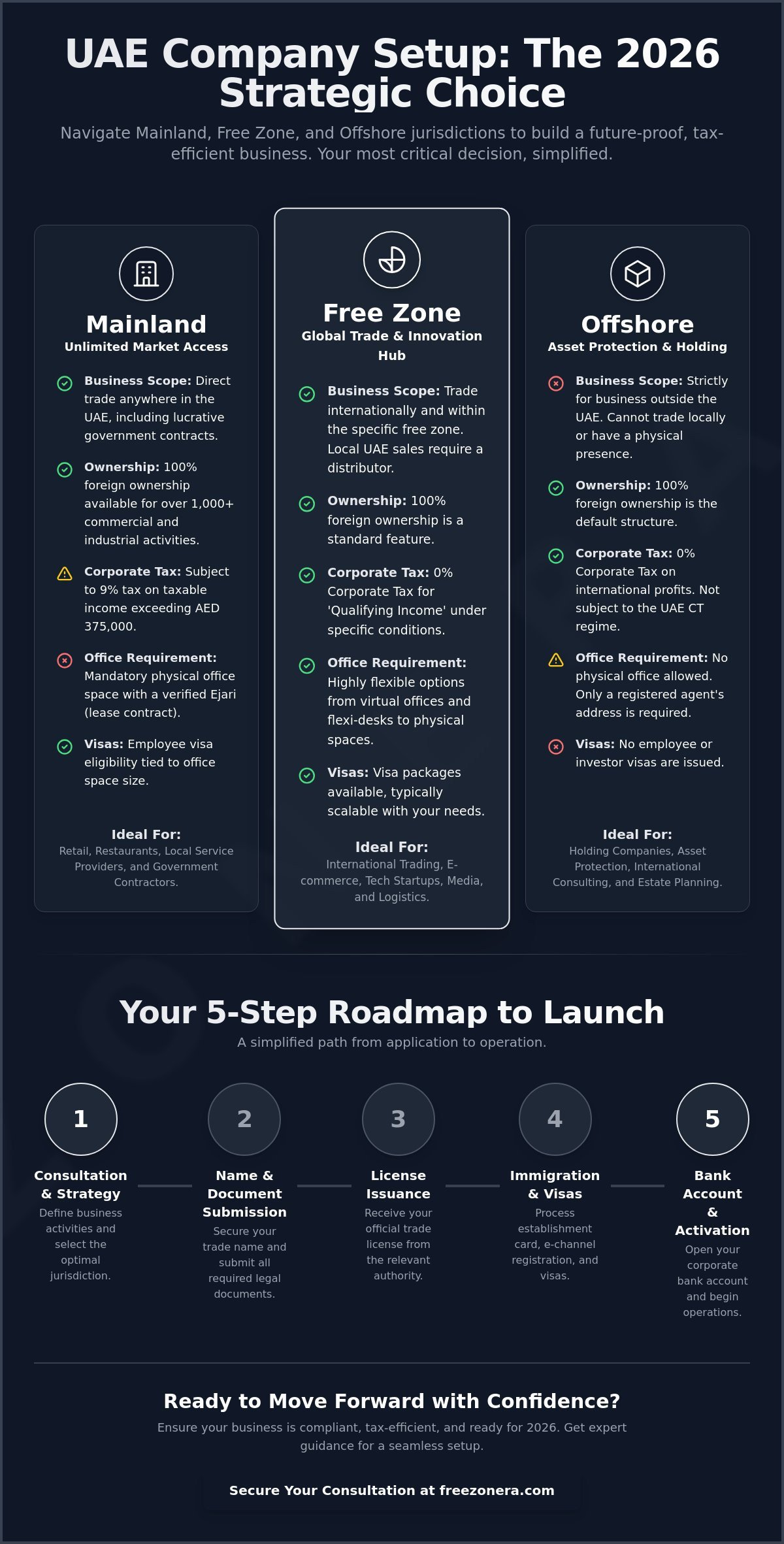
Selecting the right jurisdiction for your company setup in uae requires aligning your license with specific operational goals. Entrepreneurs must evaluate whether their revenue stems from local UAE consumers or international trade. This choice dictates your administrative burden, tax obligations, and long-term scalability. A structured approach ensures you don’t overpay for infrastructure you don’t need.
Mainland UAE: Unlimited Local Market Access
A mainland license issued by the Department of Economy and Tourism (DET) provides the highest level of flexibility. Since the June 2021 amendment to the Commercial Companies Law, foreign investors can maintain 100% ownership in over 1,000 commercial and industrial activities. This jurisdiction removes geographic restrictions, allowing you to trade anywhere in the UAE and bid for lucrative government contracts. You’ll need a physical office space with a verified Ejari (lease contract), which serves as a foundation for corporate bank account approvals and employee visa quotas.
Free Zones: The Entrepreneur’s Favorite
Free zones are the backbone of the UAE’s innovation ecosystem. Hubs like RAKEZ in Ras Al Khaimah, Dubai South, and Sharjah Publishing City (SPC) offer specialized environments with 100% import and export tax exemptions. These jurisdictions simplify customs procedures, making them ideal for logistics and trading firms. Industry-specific clusters, such as Dubai Internet City or Healthcare City, provide immediate proximity to relevant partners and talent. For a detailed roadmap on selecting the right hub, review our UAE Company Setup 2026 Strategy.
Offshore Entities: International Asset Protection
This UAE Company Formation Guide highlights that offshore entities are primarily designed for asset protection and international tax optimization. Jurisdictions like RAK International Corporate Centre (RAKICC) and JAFZA offshore allow for global trade without a physical UAE presence. They’re excellent for holding companies, managing international intellectual property, or owning real estate. While cost-effective, offshore companies don’t grant residency visas or the right to trade within the UAE market. You can explore these structures further in our RAK Offshore Strategic Guide.
Setup speed and administrative requirements vary significantly between these three paths. Mainland setups typically take 3 to 7 working days, while certain free zone licenses can be issued in as little as 24 hours. Offshore formations are often the fastest but involve rigorous KYC (Know Your Customer) checks due to their international nature. For global entrepreneurs planning worldwide formations in Dubai, understanding these structural differences is essential to building a tax-efficient and compliant international business. If you’re unsure which path fits your 2026 growth plan, you can reach out to our consultants for a tailored feasibility study.
- Mainland: Best for local retail, construction, and government contracting.
- Free Zone: Best for startups, e-commerce, and professional services.
- Offshore: Best for holding assets, inheritance planning, and global trade.
Addressing Common Misconceptions and Compliance Hurdles
Many entrepreneurs still believe they need a local 51% partner for mainland operations. This is no longer the case. Since June 2021, the UAE government has allowed 100% foreign ownership for over 1,000 commercial and industrial activities. This shift transformed the landscape for company setup in uae, removing a major barrier to entry. While ownership is simpler, compliance has become more sophisticated. You must accurately select your ‘Activity Code’ from the Department of Economy and Tourism (DET) list. An incorrect code can cause licensing delays of three weeks or more. Additionally, all businesses must adhere to Ultimate Beneficial Owner (UBO) reporting under Cabinet Decision No. 58 of 2020 to maintain transparency and avoid heavy fines.
The Banking Barrier: Why Compliance is King
Opening a corporate bank account is often the most time-consuming phase of company setup in uae. Central Bank regulations require rigorous Know Your Customer (KYC) and Anti-Money Laundering (AML) checks. Banks often reject applications linked to virtual offices because they lack a “physical substance” footprint. To secure approval, you need a verifiable business address and clear financial projections. FreezonEra simplifies this process by aligning your documentation with specific bank appetites. We ensure your application meets every compliance benchmark from the first submission, reducing the risk of a 90-day rejection cooling-off period.
Corporate Tax & VAT: What You Need to Know
The UAE’s fiscal environment changed on June 1, 2023, with the introduction of a 9% corporate tax on taxable profits exceeding AED 375,000. Small businesses earning below this threshold remain at a 0% rate, but they must still register with the Federal Tax Authority (FTA). VAT registration is mandatory once your taxable turnover reaches AED 375,000 within a 12-month period. You can choose to register voluntarily at the AED 187,500 mark. Keeping your books in order isn’t just good practice; maintaining accurate financial records for at least five years is now a non-negotiable legal requirement. If you need clarity on your specific tax obligations or Economic Substance Regulations (ESR) under Cabinet Resolution No. 57 of 2020, you can reach us for a professional consultation. Our team provides the structured guidance needed to turn these compliance hurdles into a competitive advantage.
The 5-Step Roadmap to UAE Company Formation
The speed of your company setup in uae depends heavily on your chosen jurisdiction and business activity. Digital integration through platforms like Invest in Dubai allows for instant licensing in as little as 15 minutes for standard mainland activities. However, complex industrial setups or those requiring physical office inspections typically follow a 10-day trajectory. While government portals offer a DIY route, a consultant provides the regulatory foresight needed to avoid costly application rejections or incorrect activity mapping.
Step 1: Activity Selection and Legal Structure
Mapping your business model to the official UAE activity list is the first critical hurdle. There are over 2,000 permitted activities across various departments. You’ll need to decide between a Free Zone Establishment (FZE) for a single shareholder or a Free Zone Company (FZCO) if you have multiple partners. Certain sectors require a green light from third-party regulators. For example, educational ventures need KHDA approval; medical clinics must secure clearance from the Dubai Health Authority (DHA) before the trade license is granted. Choosing the wrong activity can lead to banking complications later, so precision at this stage is vital.
Step 2: Trade Name Reservation and Initial Approval
Compliance begins with your company name. UAE naming conventions prohibit religious references, political affiliations, or names of existing prominent organizations. Once the Department of Economy and Tourism (DET) or the relevant Free Zone authority approves the name, you’ll receive an Initial Approval. This document is the signal to start drafting your legal framework. You’ll prepare the Memorandum of Association (MOA) or, for certain mainland professional licenses, a Local Service Agent (LSA) agreement. These documents define the ownership percentages and management powers within the entity.
Step 3: Visa Processing and Office Space
Residency and physical presence are the final pieces of the puzzle. Most jurisdictions now use the E-channel system, an online portal that accelerates entry permit issuance. You’ll need to select a workspace that aligns with your license type and budget. Options range from cost-effective flexi-desks in co-working hubs to private physical offices, which usually require a minimum of 200 square feet for mainland entities. The journey concludes with your medical fitness test and Emirates ID biometrics. If you’re planning for a long-term future, explore the Dubai Golden Visa Roadmap to see if your company setup in uae qualifies you for extended 10-year residency.
Ready to secure your trade license without the administrative burden? Consult with FreezonEra today for a tailored setup strategy that ensures total compliance from day one.
Scaling Your Brand: Why Your License is Just the Beginning
Securing a trade license is a significant milestone, but it’s only the foundation of your journey. Most entrepreneurs treat the issuance of legal documents as the finish line. In reality, this marks the start of “Phase 2.” A successful company setup in uae provides the legal right to operate, yet it doesn’t guarantee market share or customer trust. To move from administrative setup to true market penetration, you must shift your focus toward visibility and brand authority.
The UAE market is exceptionally competitive. As of early 2024, Dubai alone recorded over 670,000 active business licenses. Standing out in this environment requires a transition from bureaucratic compliance to active commercial engagement. You aren’t just competing with local startups; you’re competing with global entities that view the Emirates as a primary hub. Your roadmap must include a strategy for digital dominance and operational sustainability.
Digital Marketing for New UAE Companies
Building a digital presence is the most effective way to establish trust with a diverse consumer base. In a country with an internet penetration rate of over 99%, your website serves as your primary storefront. It’s vital to build a localized platform that offers content in both English and Arabic. This dual-language approach respects local culture and expands your reach across the entire GCC region.
- SEO Strategy: New entities must leverage SEO to compete with established players. Ranking for localized keywords ensures you’re visible when potential clients search for specific services within your jurisdiction.
- Social Media Management: The UAE is a multicultural environment. Your social media presence must be nuanced and platform-specific. LinkedIn is essential for B2B entities, while Instagram and TikTok dominate the B2C sector.
- Brand Authority: High-quality, informative content positions your brand as an expert. This reduces the friction of entering a new market where your brand name isn’t yet recognized.
Future-Proofing Your Business with Freezonera
Growth is only possible when your operational foundation remains secure. Freezonera acts as your strategic partner long after the initial company setup in uae is complete. We provide structured guidance to ensure you remain compliant with evolving regulations, such as Corporate Tax requirements and Ultimate Beneficial Owner (UBO) filings. Our team manages the complexities of license renewals, audits, and visa maintenance so you can focus on scaling your operations.
We offer customized growth strategies designed for the specific needs of startups and SMEs. Whether you’re expanding from a free zone to a mainland branch or diversifying your license activities, we provide the clarity and precision needed for a smooth transition. Our approach is future-driven, helping you navigate the financial and legal landscapes of the Emirates with total confidence. Simplify your UAE business setup with Freezonera today and transform your legal entity into a thriving market leader.
Launch Your 2026 Growth Strategy Today
Success in the 2026 business landscape requires more than just a trade license. It demands a precise choice between mainland and free zone jurisdictions to ensure your operations align with the UAE’s evolving regulatory framework. By following a structured 5-step roadmap, you can transform company setup in uae from a bureaucratic hurdle into a competitive advantage. Navigating these legal requirements early prevents costly delays and sets a foundation for sustainable scaling.
Freezonera acts as your sophisticated navigator in this complex environment. We specialize in Simplifying UAE Business Setup for Entrepreneurs through a Fixed-Fee Business Setup model that eliminates financial surprises. Our team offers Expert Compliance Guidance to meet 2026 standards and Comprehensive Digital Marketing Support to build your brand’s presence immediately. Don’t let administrative complexity stall your vision. We focus on clarity and compliance so you can build a future-driven enterprise in the world’s most dynamic economy.
Start Your UAE Business Journey with Freezonera
The Emirates offer a world of opportunity. Your global success story begins with the right partner by your side.
Frequently Asked Questions
Can I own 100% of my company in the UAE mainland?
You can own 100% of your mainland business following the 2021 update to the UAE Commercial Companies Law. This landmark regulation removed the requirement for a local Emirati partner to hold 51% of shares for over 1,000 commercial and industrial activities. It’s a strategic shift that simplifies the path for international entrepreneurs seeking full operational control within the local market.
What is the cheapest free zone for a startup in 2026?
Sharjah Research Technology and Innovation Park (SRTIP) and the International Free Zone Authority (IFZA) remain the most competitive options for budget-conscious founders. In 2024, entry-level packages for these jurisdictions started at approximately AED 12,900 for a zero-visa setup. These zones offer scalable solutions that allow you to start small and add residency visas as your business grows.
How long does it take to get a business license in Dubai?
You can secure a mainland license in just 15 minutes through the “Invest in Dubai” digital platform for standard commercial activities. Free zone setups typically take between 3 and 7 working days depending on the specific jurisdiction’s internal approval speed. Once your license is issued, the subsequent residency visa and Emirates ID process usually requires an additional 10 to 14 days to complete.
Do I need a physical office to get a UAE trade license?
You don’t need a traditional brick-and-mortar office to launch your venture, as most free zones offer “flexi-desk” or “virtual office” arrangements. These setups provide a legal business address and satisfy regulatory requirements at a fraction of the cost of a private suite. However, mainland companies are generally required by the Department of Economy and Tourism to lease a physical space of at least 200 square feet.
What are the requirements for a UAE Investor Visa?
To qualify for a standard 2-year Investor Visa, you must hold an ownership stake in a UAE company with a minimum value of AED 72,000. If you’re seeking the 10-year Golden Visa, the investment threshold increases to AED 2,000,000 in business capital or property. You’ll need to submit your trade license, a memorandum of association, and pass a mandatory medical fitness test at a government center.
Is it mandatory to register for VAT immediately after company setup?
VAT registration is only mandatory if your company’s taxable supplies and imports exceed the threshold of AED 375,000 over a 12-month period. You can choose to register voluntarily if your turnover exceeds AED 187,500. Most founders initiating a company setup in uae monitor their monthly revenue closely to ensure they comply with Federal Tax Authority regulations the moment they hit these legal limits.
Can a free zone company do business on the UAE mainland?
A free zone entity cannot trade physical goods directly with the mainland market without appointing a local distributor or commercial agent. You can provide professional services to mainland clients, but goods moving from a free zone into the local market are subject to a 5% customs duty. Some jurisdictions offer a “Dual License” option, which permits you to operate in both areas under a single corporate structure.
How much does it cost to set up a company in the UAE?
The total investment for a company setup in uae starts at roughly AED 12,500 for a basic free zone license without residency visas. If you require a mainland license with a physical office and multiple employee visas, costs typically rise above AED 35,000. You must also account for the 9% corporate tax on annual profits exceeding AED 375,000, which became effective for fiscal years starting on or after June 1, 2023. For a comprehensive breakdown of cost benchmarks and structure options tailored to international investors, explore our guide on worldwide formations in Dubai for global entrepreneurs in 2026.
For professionals setting up as consultants or service providers, our UAE professional license requirements guide explains exactly what each free zone demands. If Ras Al Khaimah is on your list, the RAKEZ 2026 guide gives you the honest breakdown most consultants omit.