

By 2026, the UAE’s 9% corporate tax regime will have fundamentally redefined the financial structures of more than 300,000 active commercial entities. You’re likely feeling the weight of these upcoming changes while trying to filter through the noise of 40+ different free zones. It’s natural to feel overwhelmed by the technicalities of company formation in dubai, especially when the fear of hidden compliance costs or banking delays stalls your progress. You need a partner who values precision over jargon.
This guide serves as your sophisticated navigator, simplifying complex legal landscapes into a clear, structured roadmap. We’ll show you exactly how to choose between mainland and free zone jurisdictions using industry-specific examples that reflect the 2026 reality. You’ll gain the clarity needed to secure your banking and visas with confidence. Let’s move past the administrative hurdles to build a business that is truly driven by the future.
Key Takeaways
- Leverage the D33 Economic Agenda to transform your business into a high-growth gateway for the broader MEASA region.
- Identify the ideal jurisdiction for your specific goals by comparing the unrestricted market access of the Mainland against specialized Free Zone advantages.
- Master the essential 5-step roadmap for company formation in dubai to ensure a compliant and efficient launch in the 2026 landscape.
- Gain practical clarity through industry-specific case studies that demonstrate successful setups for global consultancies and e-commerce hubs.
- Build a future-driven foundation by integrating mandatory corporate tax compliance and digital scaling strategies into your post-formation plan.
The Evolution of Company Formation in Dubai for 2026
Dubai has transformed from a regional trade hub into the primary gateway for the MEASA (Middle East, Africa, and South Asia) region, an area comprising over 1.7 billion people. The D33 Economic Agenda, launched in January 2023, set a target to double the city’s economy by 2033 with a 32 trillion AED impact. As we move into 2026, company formation in dubai has become the strategic choice for businesses focusing on high-growth sectors like fintech, green energy, and AI-driven logistics. This year marks a pivot point where the city’s infrastructure fully aligns with global sustainability goals and digital-first mandates.
The legal landscape offers a sophisticated dual-system that caters to diverse operational needs. Entrepreneurs must choose between Mainland and Free Zone jurisdictions, each governed by specific UAE corporate and business structures. While Free Zones offer specialized ecosystems for niche industries, Mainland setups provide the freedom to trade directly within the local market and bid for lucrative government contracts. FreezonEra acts as a sophisticated navigator in this space, providing the clarity and compliance required to make an informed decision.
Why Dubai Remains the Global Entrepreneurial Hub
Dubai’s geographic advantage is unmatched. It sits within an eight-hour flight of two-thirds of the world’s population. Beyond location, the pro-business tax environment is a major draw. Since the 2021 amendments to the Commercial Companies Law, 100% foreign ownership is now the standard for more than 1,000 commercial and industrial activities. This change removed the historical requirement for a local service agent in most sectors, significantly simplifying the path for international investors.
- Digital Ecosystem: 5G penetration reached 99% in 2024, supporting a “future-driven” environment for remote and tech-heavy operations.
- Trade Compliance: The city maintains world-class customs infrastructure, ensuring that international trade remains efficient and transparent.
- Infrastructure: Massive investments in smart manufacturing and logistics hubs provide a ready-made foundation for scaling startups.
New Regulatory Standards to Know in 2026
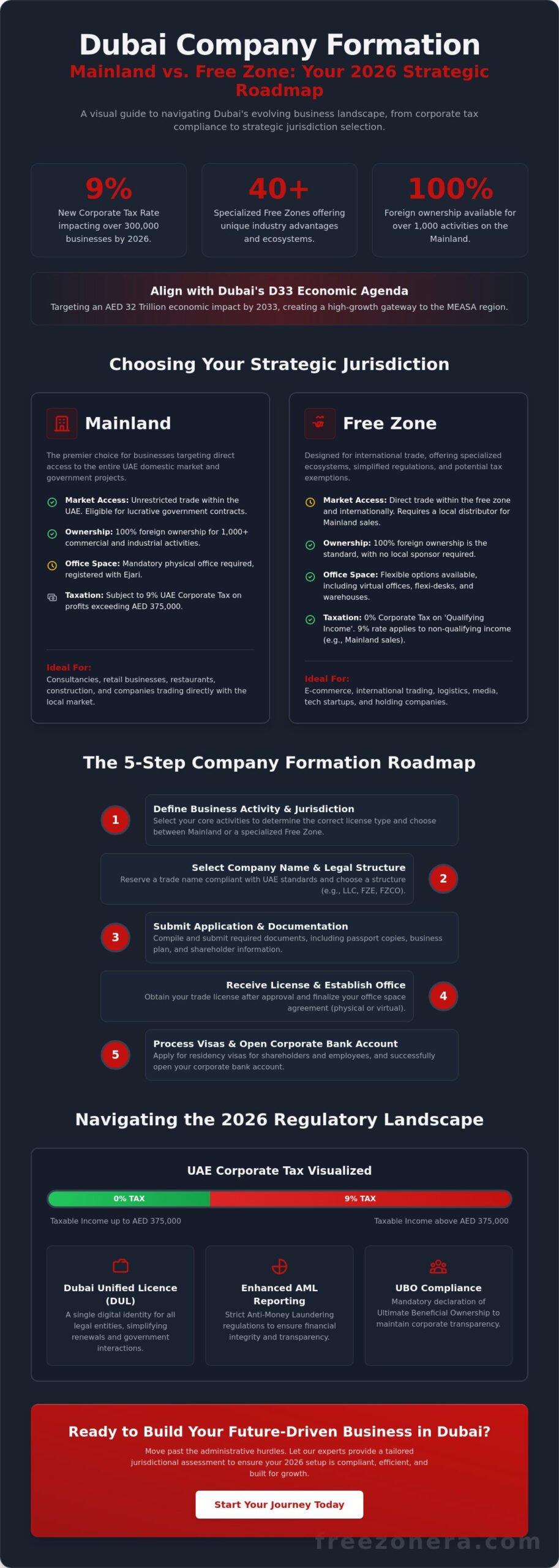
Success in the UAE market requires a deep understanding of evolving regulations. The Corporate Tax regime, which became effective in June 2023, remains a central focus for 2026. Businesses benefit from a 0% tax rate on taxable income up to 375,000 AED, while a competitive 9% rate applies to profits exceeding that threshold. This structure ensures that small businesses and startups can grow without heavy immediate tax burdens.
Identity and administration have also seen massive simplification through the Dubai Unified Licence (DUL). This initiative provides a single digital identity for all legal entities, streamlining renewals and government interactions. However, compliance standards have tightened. Enhanced Anti-Money Laundering (AML) and Ultimate Beneficial Ownership (UBO) reporting are now strictly enforced to maintain the UAE’s reputation for financial integrity. If you’re ready to begin, you can reach us to ensure your company formation in dubai meets every modern regulatory standard. We specialize in simplifying UAE business setup for entrepreneurs, allowing you to focus on your core strategy while we handle the administrative complexities.
Mainland vs. Free Zone: Selecting Your Strategic Jurisdiction
Choosing between a Mainland and Free Zone setup is the most consequential decision you’ll make during company formation in dubai. This choice dictates your tax obligations, your ability to trade locally, and your physical office requirements. Since the landmark 2021 amendment to the UAE Commercial Companies Law, 100% foreign ownership is now available for over 1,000 commercial and industrial activities on the Mainland. This shift has narrowed the gap between jurisdictions, yet the strategic intent of your business remains the deciding factor.
Ownership structures vary based on your choice. On the Mainland, the Limited Liability Company (LLC) is the standard vehicle for commercial ventures. In Free Zones, you’ll choose between a Free Zone Establishment (FZE) for a single shareholder or a Free Zone Company (FZCO) for multiple partners. Each structure offers distinct governance frameworks tailored to different scales of operation. If you’re unsure which path fits your five-year plan, you can connect with our consultants for a tailored jurisdictional assessment.
When to Choose a Dubai Mainland Setup
Mainland registration is the gold standard for businesses targeting the local UAE market. It’s the only option for retail brands, construction firms, and healthcare providers that require a physical presence in residential or commercial districts like Downtown Dubai or Jumeirah. Unlike Free Zones, Mainland entities can bid directly for lucrative government contracts, such as those issued by the Dubai Road and Transport Authority (RTA) or the Dubai Municipality.
- Physical Flexibility: You can lease office or warehouse space anywhere in the city without geographic restrictions.
- Scalable Workforce: Visa quotas are generally tied to the size of your office space, allowing for massive team expansions as you grow.
- Direct Trade: You can sell goods and services directly to consumers across all seven emirates without a local distributor.
The Strategic Advantage of Dubai Free Zones
Free Zones are designed as industry-specific ecosystems. They offer streamlined customs procedures and 100% import and export tax exemptions, making them ideal for international trade and digital services. For instance, the Dubai Multi Commodities Centre (DMCC) is the global hub for gold and diamond trading, while the Dubai International Financial Centre (DIFC) operates under its own independent, English-language common law judiciary.
These zones provide a plug-and-play environment for entrepreneurs. You’ll find pre-built warehouses, “flexi-desk” options for startups, and simplified licensing processes that can often be completed remotely. For a broader look at how these zones fit into the national economic landscape, explore our guide on UAE Company Setup 2026. This jurisdiction remains the preferred choice for 70% of tech startups and consulting firms due to the ease of repatriating 100% of capital and profits. Successful company formation in dubai often starts by identifying which of the 40+ Free Zones aligns with your specific industry niche.
Industry-Specific Examples: Formation Scenarios in Action
Successful company formation in dubai requires a strategy tailored to your specific sector. By 2026, the Dubai Economic Agenda (D33) aims to double the size of the economy, creating distinct advantages for different business models. We see this play out in four primary scenarios.
- Cross-Border E-commerce: A European retailer uses Dubai CommerCity as a regional hub. They benefit from automated customs clearance and proximity to DXB airport, reaching 2 billion consumers within a four-hour flight.
- Global Management Consultancy: A boutique firm establishes a presence in the Dubai International Financial Centre (DIFC). This allows them to operate under a common-law framework while advising clients across the GCC.
- FinTech Innovation: A startup joins the VARA (Virtual Assets Regulatory Authority) sandbox. They test blockchain-based payment solutions in a controlled environment before scaling to a full commercial license.
- International Holding Company: An investor sets up a Jebel Ali Free Zone (JAFZA) holding structure. This entity centralizes global assets, providing a robust layer of legal protection and simplifying succession planning.
E-commerce and Digital Trade Examples
Choosing the right jurisdiction is the first hurdle for digital retailers. Dubai CommerCity offers specialized infrastructure for e-commerce, but a mainland license is often better for companies prioritizing last-mile delivery within the UAE. Media companies, content studios and digital agencies often choose Dubai Internet City (DIC) for its established media cluster and competitive licence costs. For example, an online grocery store like Shift 2 Fresh depends on this structure to efficiently distribute fresh fruits and vegetables from the Philippines across the Emirates. If you hold physical inventory, your license must reflect warehousing activities. Dropshipping models require a different service-based activity code. Most entrepreneurs find that integrating payment gateways like Stripe or Checkout.com is seamless once the trade license and corporate bank account are active. We focus on simplifying these technical steps so you can focus on your storefront.
Professional Services and Remote Work Models
The transition from a solo entrepreneur to a corporate entity is a common path in Dubai’s 2026 landscape. Many start with a freelance permit to test the market. As revenue grows, they transition into a full corporate setup to hire staff and bid for larger government contracts. Virtual office solutions remain a cost-effective entry point, though co-working spaces in hubs like DMCC provide better networking opportunities for growing teams. For those seeking long-term stability, we often link corporate setup with the Dubai Golden Visa. This 10-year residency ensures that your personal and professional future remains secure regardless of your employment status. This structured approach to company formation in dubai turns a complex administrative task into a strategic growth milestone.
The 5-Step Roadmap to Forming Your Dubai Company
Establishing a business in the UAE is a logical progression for growth-oriented brands. The process of company formation in dubai involves five distinct stages designed to ensure regulatory compliance and operational readiness. In 2024, the Dubai Department of Economy and Tourism (DET) reported a 25% increase in new business licenses, proving that precision in the initial stages is vital for a smooth launch.
- Select your activity and structure: You must choose from over 2,000 permitted business activities. This choice dictates whether you require a Limited Liability Company (LLC) or a professional sole proprietorship.
- Reserve your trade name: Submit three name options to the authorities. Once approved, you’ll receive an initial approval certificate, which signifies the UAE government has no objection to your business starting.
- Finalize legal documentation: Draft your Memorandum of Association (MOA). At this stage, you also need to secure a physical office space or a virtual desk, depending on your jurisdiction’s requirements.
- Submit final documentation: Present your signed MOA, lease agreement, and passport copies to the DED or your chosen Free Zone Authority.
- Collect your license: After paying the registration fees, you’ll receive your trade license. This document is the foundation for your banking and visa applications.
When planning your company formation in dubai, precision is your greatest asset. Small errors in activity selection can lead to restricted operations or unexpected tax obligations under the UAE Corporate Tax Law effective since June 2023.
The Critical Path to Corporate Banking
Opening a corporate account is often the most rigorous hurdle in the setup journey. UAE banks have intensified their compliance checks to meet international anti-money laundering standards. You’ll need to provide a comprehensive business plan, six months of personal bank statements, and clear proof of your source of wealth. Freezonera provides dedicated corporate bank account opening support to help you navigate these KYC (Know Your Customer) requirements. We ensure your documentation meets the specific criteria of Tier 1 banks, reducing the risk of application rejection.
Visa Processing for Owners and Employees
Your trade license allows you to apply for residency visas for yourself, your partners, and your staff. This process includes a mandatory medical fitness test and biometrics for your Emirates ID. Once your residency is stamped, you can sponsor family members or domestic employees. To keep these visas active, you must enter the UAE at least once every 180 days. For those seeking long-term stability, certain sectors now qualify for the 10-year Golden Visa, which removes the need for frequent re-entry.
Ready to begin your journey? Consult with our formation experts today to secure your Dubai trade license and start your expansion.
Scaling Post-Formation: Compliance and Growth in 2026
Securing your trade license is just the beginning of your journey. In 2026, the landscape for company formation in dubai requires a proactive stance on fiscal responsibility and operational transparency. With the UAE Corporate Tax now fully integrated into the business ecosystem, firms must maintain a 9% tax rate on taxable income exceeding AED 375,000. This shift demands a robust internal framework to ensure every transaction aligns with Federal Tax Authority (FTA) guidelines from day one.
Maintaining Regulatory Compliance
Compliance isn’t a one-time event; it’s a continuous operational requirement. Economic Substance Regulations (ESR) remain a critical pillar for firms engaged in “Relevant Activities” such as banking, insurance, or lease-finance. Since the 2019 implementation, the FTA has intensified its audit frequency. Larger firms now find it essential to appoint a dedicated compliance officer to manage these filings. This role prevents common pitfalls, such as failing to submit the ESR Notification or Report, which can trigger penalties ranging from AED 10,000 to AED 400,000. Failure to provide accurate information can even lead to license suspension.
Annual license renewals are equally vital for long-term stability. Operating with an expired license for even 24 hours can lead to bank account freezes and visa cancellations. You’ll need to submit audited financial statements for most mainland entities and specific free zones to ensure your 2026 renewal proceeds without friction. Staying ahead of these deadlines protects your legal standing and your reputation with local partners. It’s about maintaining clarity and compliance in a fast-moving market.
Building Your Brand in the UAE Market
Once the legal foundation is solid, your focus must shift to market penetration. The UAE’s digital economy is projected to reach $140 billion by 2031. To capture this growth, you need a synergy between your business setup and high-impact digital marketing. Localized SEO and targeted social media campaigns aren’t optional; they’re the engines of 2026 revenue. Capturing local demand requires a strategy that understands the cultural nuances of the GCC while maintaining global standards.
Many successful entrepreneurs combine their initial company formation in dubai with long-term marketing retainers. This approach ensures your brand’s digital footprint grows at the same pace as your physical operations. Freezonera acts as your Sophisticated Navigator throughout this journey. We don’t just hand over a folder of documents and disappear. We provide the structured guidance needed to manage audits, renewals, and strategic expansion. Success in the Emirates belongs to those who prioritize precision. Simplify your UAE journey with Freezonera and build a legacy that lasts well beyond the setup phase.
Launch Your Strategic Vision in the 2026 Dubai Market
The landscape for company formation in dubai is shifting toward a highly regulated, digitally-driven economy as we approach 2026. Successfully navigating the 5-step roadmap requires more than just submitting paperwork. It demands a deep understanding of the 40+ Free Zones available and the specific compliance mandates of the UAE Mainland. Choosing the right jurisdiction today ensures your business remains scalable and compliant as the market matures and new economic policies take effect.
FreezonEra acts as your sophisticated navigator in this evolving environment. We specialize in simplifying complex legal processes through a future-driven strategic consultancy model. Our team provides fixed-fee transparency and expert guidance across 40+ specialized jurisdictions to eliminate administrative friction. You don’t have to manage the complexities of 2026 regulations alone. We provide the clarity and compliance you need to focus entirely on your commercial growth and long-term asset management.
Start your Dubai success story with Freezonera today
Your entrepreneurial journey deserves a steady hand and a clear path toward a profitable future in the Middle East’s premier business hub.
Frequently Asked Questions
How much does company formation in Dubai cost in 2026?
Company formation in Dubai starts at approximately AED 12,500 for basic free zone packages in 2026. This entry-level price typically covers the registration and license but doesn’t include visa costs or office rentals. For mainland setups, you should expect to pay upwards of AED 25,000 depending on your specific business activity. We simplify this process by providing a transparent breakdown of all government and administrative fees from the start.
Can I own 100% of my company in Dubai as a foreigner?
You can own 100% of your company in Dubai across all free zones and most mainland sectors. The 2021 amendment to the Commercial Companies Law removed the requirement for a local Emirati shareholder for over 1,000 commercial and industrial activities. This change allows international investors to maintain full control of their operations and profits. It’s a strategic move that has boosted foreign direct investment across the UAE.
What is the fastest way to get a business license in Dubai?
Applying for an Instant License through the Department of Economy and Tourism (DET) is the fastest method available. This digital process issues a license in under 5 minutes for specific activities that don’t require external approvals. Free zones like IFZA or Meydan also offer 24 hour turnarounds for standard applications. Our structured guidance ensures your documentation is ready to meet these rapid timelines without any administrative delays.
Do I need a local partner to start a business in Dubai mainland?
You don’t need a local partner for the majority of business activities on the Dubai mainland today. Since June 2021, the UAE government allows 100% foreign ownership for most commercial licenses. Certain strategic sectors like oil, gas, and utilities still require local participation or specific government approvals. We help you identify if your industry falls under these restricted categories to ensure your setup remains in full compliance.
What are the main differences between FZE and FZCO?
The primary difference lies in the number of shareholders permitted within the corporate structure. A Free Zone Establishment (FZE) is limited to a single shareholder, which can be either an individual or a corporate entity. A Free Zone Company (FZCO) functions like a limited liability company and requires two or more shareholders. Both structures offer the same benefits regarding tax exemptions and the full repatriation of capital and profits.
Is a physical office mandatory for company formation in Dubai?
A physical office isn’t mandatory if you choose a flexi-desk or virtual office solution provided by many free zones. These arrangements provide a legal address and basic facilities to satisfy licensing requirements without the high cost of a traditional lease. However, if you plan to hire more than three employees, the Ministry of Human Resources and Emiratisation often requires a physical lease based on specific square footage requirements.
How does the UAE corporate tax affect new startups in 2026?
New startups benefit from a 0% tax rate on taxable income up to AED 375,000. For profits exceeding this threshold, a standard 9% corporate tax rate applies as established by the Federal Decree-Law No. 47 of 2022. Small Business Relief is also available for entities with revenue below AED 3 million until the end of December 2026. We provide the clarity you need to navigate these fiscal responsibilities while maximizing your financial efficiency.
Can I apply for a Golden Visa through my new Dubai company?
You can qualify for a 10-year Golden Visa by establishing a company with a minimum capital of AED 2 million. Another route involves getting your startup idea approved by a government-accredited incubator or having a previous project sold for at least AED 7 million. This residency program offers long-term stability for entrepreneurs and their families. It’s an excellent way to secure your future while driving growth through your company formation in Dubai.
If you are evaluating specific free zones, our DMCC costs and setup guide is the most thorough resource available with real 2026 AED figures. For banking after incorporation, the Dubai corporate bank account requirements checklist covers what most agents leave out of their proposals.
Related: Formation cost guide