

What if the legal hurdles you currently view as obstacles are actually the secret to unlocking your company’s next round of international funding? In 2026, a robust regulatory framework is your most valuable asset, yet industry data suggests that over 40% of startups face significant delays because they underestimate the complexity of local regulations. You’ve likely felt the stress of navigating bureaucratic terminology or the anxiety that a hidden legal trap might result in a rejected bank account. It’s exhausting to feel like your vision is held hostage by a lack of clarity regarding what is compliance in business in a foreign jurisdiction.
We understand that you want to focus on innovation rather than administrative red tape. This guide promises to simplify these complex processes, helping you protect your assets and ensure your legal standing for the long term. You’ll gain a clear checklist of requirements and a streamlined path to UAE market entry. By the end of this article, you’ll have the structured guidance needed to build a scalable foundation for global growth and future-driven success.
Key Takeaways
- Understand what is compliance in business by shifting from basic regulatory adherence to an integrity-based governance model that secures your long-term success.
- Identify the essential pillars of financial transparency and operational integrity required to build a scalable foundation for global growth.
- Learn how to proactively mitigate compliance risks to protect your brand reputation and avoid costly legal hurdles.
- Follow a structured roadmap to conduct regulatory gap analyses and implement a future-driven compliance framework for your organization.
- Master the specific 2026 requirements for UAE jurisdictions, simplifying the complexities of both Free Zone and Mainland business operations.
Defining Business Compliance in the 2026 Economy
Understanding what is compliance in business starts with a fundamental shift in perspective. It’s no longer just a bureaucratic hurdle or a list of rules to follow. In the 2026 economy, compliance represents the process of ensuring a company strictly adheres to local laws, international regulations, and high ethical standards. This transition moves away from “check-the-box” mentalities toward integrity-based governance. Modern firms prioritize transparency and ethical conduct as core assets because these values dictate long-term viability and market reputation.
For those looking at UAE company setup 2026, compliance is the essential first step. You can’t build a sustainable brand on a shaky legal foundation. Establishing clarity and compliance from day one allows entrepreneurs to focus on growth while we handle the complexities of the regulatory environment. This proactive approach builds trust with investors, banks, and customers, transforming a legal requirement into a competitive advantage.
Internal vs. External Compliance
Success requires balancing two distinct layers of oversight. External compliance involves Regulatory Compliance, which includes adhering to government laws, tax codes, and industry-specific mandates. In jurisdictions like the UAE, this means following Federal Tax Authority guidelines and free zone regulations. Internal compliance focuses on company-wide policies, ethical codes, and operational protocols. Strong internal controls are vital; they act as a shield to prevent external regulatory breaches before they occur. When employees follow internal standards, the risk of a legal violation drops significantly, creating a culture of accountability.
The Evolution of Regulatory Expectations
The 2026 landscape places a heavy emphasis on ESG (Environmental, Social, and Governance) standards. It’s not enough to be profitable; you must be responsible. We define Dynamic Compliance as the ability to adapt to rapid legislative shifts. This agility is non-negotiable as global markets become more interconnected. Why wait for a fine to change your ways? A proactive stance ensures your business remains resilient against sudden policy updates. FreezonEra focuses on simplifying UAE business setup for entrepreneurs by providing a structured guidance system that anticipates these changes, ensuring your future-driven results aren’t derailed by shifting laws. This foresight is why what is compliance in business has evolved into a strategic asset rather than a cost center.
The Core Pillars of a Compliant Business Structure
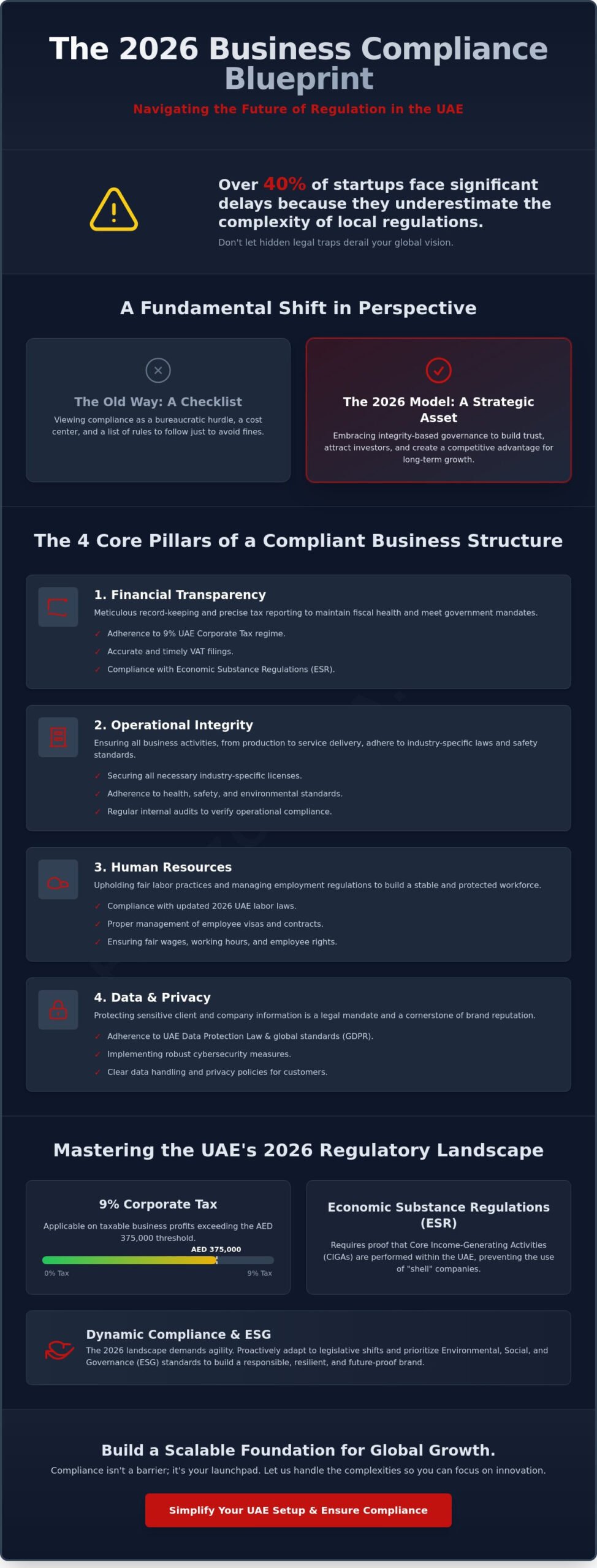
Understanding what is compliance in business requires looking at it as a multi-dimensional foundation rather than a single checklist. For entrepreneurs in 2026, compliance serves as the structural integrity of the enterprise. It protects the company from legal friction and builds immediate trust with international partners. A robust framework rests on four essential pillars that ensure every department operates within the boundaries of the law.
- Financial Transparency: This involves meticulous record-keeping and precise tax reporting. In jurisdictions like the UAE, this means staying current with VAT filings and the established 9% Corporate Tax regime.
- Operational Integrity: Businesses must secure industry-specific licenses and adhere to occupational health and safety standards. To stay legally compliant, owners should conduct regular internal audits to verify that physical and digital operations meet local regulatory requirements.
- Human Resources: This pillar covers fair labor practices, employee rights, and the management of visa regulations. Following the 2026 updates to labor laws ensures a stable, protected workforce.
- Data and Privacy: Adherence to global standards like GDPR and local frameworks, such as the UAE Data Protection Law, is mandatory. Protecting client data is a legal requirement and a core component of brand reputation.
Financial and Tax Compliance
The 2026 corporate landscape demands a sophisticated approach to fiscal responsibility. Economic Substance Regulations (ESR) remain a critical focus for international entities. These rules require companies to prove they perform core income-generating activities within the jurisdiction where they’re registered. Since the UAE implemented the 9% Corporate Tax on business profits exceeding AED 375,000, accurate tax accounting has become a daily operational necessity. Audited financial statements have emerged as the “gold standard” for compliance. They provide the verified clarity that banks and investors demand before committing to a partnership. If you find these fiscal requirements daunting, you can reach out to our consultants for structured guidance on tax registration.
AML and KYC: The Gatekeepers of Banking
Anti-Money Laundering (AML) and Know Your Customer (KYC) protocols are the primary gatekeepers of the modern financial system. These processes aren’t just bureaucratic hurdles; they’re essential defenses against financial crime. In 2026, banks require exhaustive documentation to verify the identity of stakeholders and the legitimacy of funds. A central part of this is the Ultimate Beneficial Owner (UBO) declaration. Regulators now demand total transparency regarding who truly owns and controls a company. Maintaining an updated UBO register is a mandatory requirement for all mainland and free zone entities. When these documents are organized and transparent, the often-complex process of opening a corporate bank account becomes significantly faster and more predictable.
Why Compliance is the Foundation of Global Expansion
Scaling a business across borders requires more than just a viable product. It demands a deep understanding of what is compliance in business and how it functions as the structural integrity of your expansion strategy. Without a robust framework, the foundation of a global enterprise can crumble under the weight of regulatory scrutiny. Compliance isn’t a bureaucratic hurdle; it’s a strategic asset that ensures longevity.
Mitigating compliance risk is the first step toward sustainable growth. This involves avoiding the heavy fines, legal battles, and license revocations that often derail ambitious startups. In 2023, global financial institutions faced over $6.6 billion in penalties for failures in anti-money laundering (AML) and “know your customer” (KYC) protocols. Beyond the immediate financial impact, a single regulatory breach can destroy years of brand equity. Trust is hard to build but incredibly easy to lose when a company fails to meet its legal obligations.
Investing in a structured framework provides a distinct competitive advantage. It allows your business to:
- Win high-value government tenders that require strict adherence to international standards.
- Attract Tier-1 partners who prioritize supply chain transparency and ethical governance.
- Reduce long-term operational costs by avoiding the “emergency” spending associated with fixing compliance failures.
The cost of non-compliance is almost always higher than the investment in a proactive system. Leaders who prioritize these standards find that they can move faster because they aren’t constantly looking over their shoulders for potential legal threats.
Navigating Cross-Border Regulatory Hurdles
Operating in multiple jurisdictions simultaneously introduces a complex web of tax, labor, and reporting laws. For instance, RAK offshore company formation requires specific international compliance standards, particularly regarding Economic Substance Regulations (ESR). Localized expertise is essential when entering foreign markets to ensure that your business model aligns with local statutes without compromising your global strategy. Simplifying these complex processes is what allows entrepreneurs to focus on innovation rather than paperwork. Global entrepreneurs pursuing worldwide formations in Dubai must also account for the UAE’s evolving regulatory landscape, including mandatory e-invoicing requirements and FTA-certified software standards taking effect in 2026.
Compliance and Investor Readiness
Venture capital and private equity firms perform deep-dive due diligence before committing funds. They look for a “clean” history that proves the business is built on stable ground. This SBA guide to legal compliance provides a baseline for the internal requirements that investors expect to see. A rigorous governance structure directly increases company valuation. When you can demonstrate that your operations are fully aligned with what is compliance in business, you present a lower risk profile, making your company a much more attractive target for acquisition or an IPO exit.
Building a Compliance Framework: A Practical Roadmap
Understanding what is compliance in business requires more than just reading a manual; it demands a functional architecture. For entrepreneurs in the UAE, this framework ensures that mainland or free zone operations remain uninterrupted by legal hurdles. Follow this five-step roadmap to build a resilient system.
- Step 1: Conduct a regulatory gap analysis. Compare your current internal policies against the latest UAE federal laws, such as the 2023 updates to Anti-Money Laundering (AML) regulations. This identifies where your ship leaks before a regulator finds the hole.
- Step 2: Appoint a compliance officer. You need a dedicated expert or a specialized consultancy to own this process. They act as the primary point of contact for regulators and internal teams.
- Step 3: Implement RegTech. Deploy automated monitoring tools for real-time oversight. By 2026, the global RegTech market is projected to exceed $28 billion, reflecting its necessity in modern risk management.
- Step 4: Establish continuous training. Compliance isn’t a one-time seminar. Set up monthly micro-learning modules for all staff to ensure they understand evolving KYC (Know Your Customer) and data protection protocols.
- Step 5: Schedule regular audits. Perform internal reviews quarterly and engage external auditors annually. These checkups verify adherence and prove “due diligence” if a legal inquiry ever arises.
The Role of the Compliance Department
In 2026, the compliance department isn’t just a “no” machine. It functions as a strategic bridge between legal requirements and daily operations. The Compliance Officer monitors legislative shifts in jurisdictions like the Dubai International Financial Centre (DIFC) and translates them into actionable business steps. They ensure the company doesn’t just follow the law but stays ahead of it. Compliance culture is a top-down leadership priority where ethical integrity is woven into every operational decision rather than treated as a separate administrative task.
Leveraging Technology for Compliance
Digital transformation is now inseparable from staying legal. 65% of high-growth startups now use AI for fraud detection and document verification, slashing manual processing times by nearly 40%. Blockchain technology provides an immutable record-keeping system, creating audit trails that are impossible to tamper with. This tech-first approach clarifies what is compliance in business for the modern era. It moves the burden from human memory to secure, automated systems that scale with your growth.
Building a secure future starts with a solid foundation. Connect with our expert consultants today to simplify your compliance roadmap and protect your UAE investment.
Navigating Business Compliance in the UAE
Understanding what is compliance in business requires a specialized lens when operating in the United Arab Emirates. The UAE utilizes a dual-jurisdiction system: Mainland and Free Zones. Mainland companies must adhere to the Federal Decree-Law No. 32 of 2021, which governs commercial companies. In contrast, Free Zones like RAKEZ or the Dubai Multi Commodities Centre (DMCC) operate under their own independent regulatory authorities. By 2026, these jurisdictions have transitioned to 100% digital compliance platforms, making real-time reporting and electronic documentation mandatory for all license holders.
Staying compliant isn’t just about filing paperwork; it’s about securing your right to operate and reside in the country. Maintaining your Dubai Golden Visa status depends on continuous adherence to the specific investment or professional criteria set by the Federal Authority for Identity, Citizenship, Customs and Port Security (ICP). If an entrepreneur fails to maintain an active trade license or violates the terms of their specific business activity, they risk losing this 10-year residency status. Precision in administrative renewals is non-negotiable for long-term stability.
Essential UAE Regulatory Filings
Compliance in the UAE involves several recurring obligations that require strict attention to deadlines. Failure to meet these can result in fines ranging from AED 5,000 to over AED 50,000 depending on the severity of the oversight.
- VAT Registration and Filing: Businesses with taxable supplies and imports exceeding AED 375,000 must register with the Federal Tax Authority (FTA). Quarterly filings are the standard, requiring accurate record-keeping of all invoices.
- Economic Substance Regulation (ESR): Companies performing “Relevant Activities,” such as banking, insurance, or shipping, must submit annual notifications. This ensures the UAE stays aligned with OECD global tax standards.
- Trade License Maintenance: Your license is the foundation of your legal presence. Annual renewals are mandatory and often require updated lease agreements and, in some jurisdictions, audited financial statements. Entrepreneurs evaluating their options can benefit from a detailed company setup in UAE strategic comparison to choose the jurisdiction that best aligns with their compliance obligations and long-term growth plans.
How Freezonera Ensures Your Success
We act as your “Sophisticated Navigator” in this complex regulatory environment. Our team provides a structured guidance system that replaces ambiguity with 100% clarity. We manage the heavy lifting of authority coordination, ensuring your setup follows a fixed-fee model without hidden administrative surprises. We don’t just process applications; we build future-driven foundations for your growth.
Success in the UAE relies on a deep understanding of what is compliance in business across different Emirates and jurisdictions. We bridge the gap between your entrepreneurial vision and the technical requirements of the UAE government. Simplify your UAE business compliance with Freezonera today and focus on scaling your enterprise while we handle the legal precision.
Secure Your Future with a Proactive Compliance Framework
Understanding what is compliance in business determines whether your venture thrives or stalls in the 2026 economy. It’s no longer just about following rules; it’s about building a resilient foundation for global expansion and operational integrity. You’ve seen how structural pillars and a clear roadmap protect your assets from shifting regulatory tides. A well-executed framework creates the clarity you need to lead with confidence in an increasingly complex world.
Navigating the UAE legal landscape requires a partner who values precision and expert guidance. Freezonera offers over 5 years of UAE market entry expertise to help you master these complexities. We provide specialized support for RAKEZ, SPC, and Dubai Free Zones with a commitment to fixed-fee transparency. This ensures you won’t encounter hidden costs or administrative surprises as you scale your operations. We’re here to simplify complex processes and turn your administrative burden into a strategic advantage. Let’s build a future-driven business that stands the test of time.
Start Your Compliant UAE Business Journey with Freezonera
Your vision deserves a secure and compliant start.
Frequently Asked Questions
What is the primary goal of compliance in business?
The primary goal is to ensure an organization adheres to all external laws and internal regulations to mitigate legal and financial risks. It protects a company’s reputation and ensures ethical operations across all departments. In 2026, understanding what is compliance in business means focusing on data privacy and ESG standards. Effective programs prevent 90% of avoidable legal disputes by establishing clear operational boundaries from day one.
What happens if a business fails to comply with regulations?
Failure leads to severe financial penalties, license revocation, and criminal charges against directors. According to the 2023 Global Compliance Report, non-compliance costs companies 2.71 times more than the cost of maintaining a robust program. Beyond fines, businesses face a 30% drop in brand value when regulatory breaches become public. These consequences often lead to permanent closure for startups lacking a capital reserve.
Is business compliance the same as corporate governance?
Business compliance is the act of following established rules, while corporate governance is the strategic framework that sets those rules. Governance defines the “why” and “how” of leadership; compliance ensures the “what” meets legal standards. Think of governance as the architect’s blueprint and compliance as the building inspector’s checklist. Both must function together to ensure long-term stability in any competitive jurisdiction.
Who is responsible for compliance within a company?
The Board of Directors holds ultimate accountability, but the Chief Compliance Officer (CCO) manages daily operations. In smaller firms, the CEO or a dedicated legal partner often takes this role. Every employee shares responsibility for following internal policies to avoid breaches. Clear reporting lines ensure that 100% of staff understand their specific regulatory obligations within the corporate structure.
How much does it cost to implement a compliance program?
Implementation costs vary significantly based on industry complexity and company size. A 2021 study by the Ponemon Institute found that the average cost of compliance for multinational organizations was $5.47 million. For smaller entities, costs focus on software licenses and professional consultancy fees. Investing in these systems early prevents the much higher 2026 average cost of non-compliance, which reached $14.82 million globally.
Can a small business or startup ignore compliance?
Small businesses cannot ignore these regulations because they’re subject to the same legal frameworks as larger corporations. Ignoring what is compliance in business often results in immediate operational bans or frozen bank accounts. Regulatory bodies like the UAE Ministry of Economy require 100% adherence to Anti-Money Laundering (AML) laws regardless of company size. Early adoption builds investor confidence and streamlines future scaling efforts.
What is a compliance audit and how often should it happen?
A compliance audit is a comprehensive review of a company’s adherence to regulatory guidelines and internal policies. These audits should happen at least once every 12 months to ensure continued alignment with changing laws. High-risk sectors, such as fintech or healthcare, often perform quarterly reviews. This systematic approach identifies 95% of potential vulnerabilities before they escalate into legal violations or financial losses.
Does compliance change when doing business in the UAE?
Compliance changes significantly in the UAE due to the dual system of Mainland and Free Zone jurisdictions. Businesses must navigate specific Economic Substance Regulations (ESR) and Ultimate Beneficial Owner (UBO) filings introduced in 2019 and 2020. Each Free Zone, like the DMCC or ADGM, has its own unique regulatory body. Success requires precise adherence to these local mandates to maintain a valid trade license and banking access. Understanding the structural differences between these options is essential, and a thorough company setup in UAE comparison for mainland, free zone, and offshore structures can help entrepreneurs make the most tax-efficient and compliant choice for their specific business model.