

What Does Compliance Mean for Business Owners?
Business compliance means following all laws, regulations, and internal policies that apply to your operations — including tax filings, AML/KYC checks, employment law, data protection, and sector-specific licencing. Non-compliance costs 2.7× more than compliance investment on average. For UAE businesses in 2026, AML, ESR, UBO registration, and corporate tax obligations are the highest-priority compliance requirements.
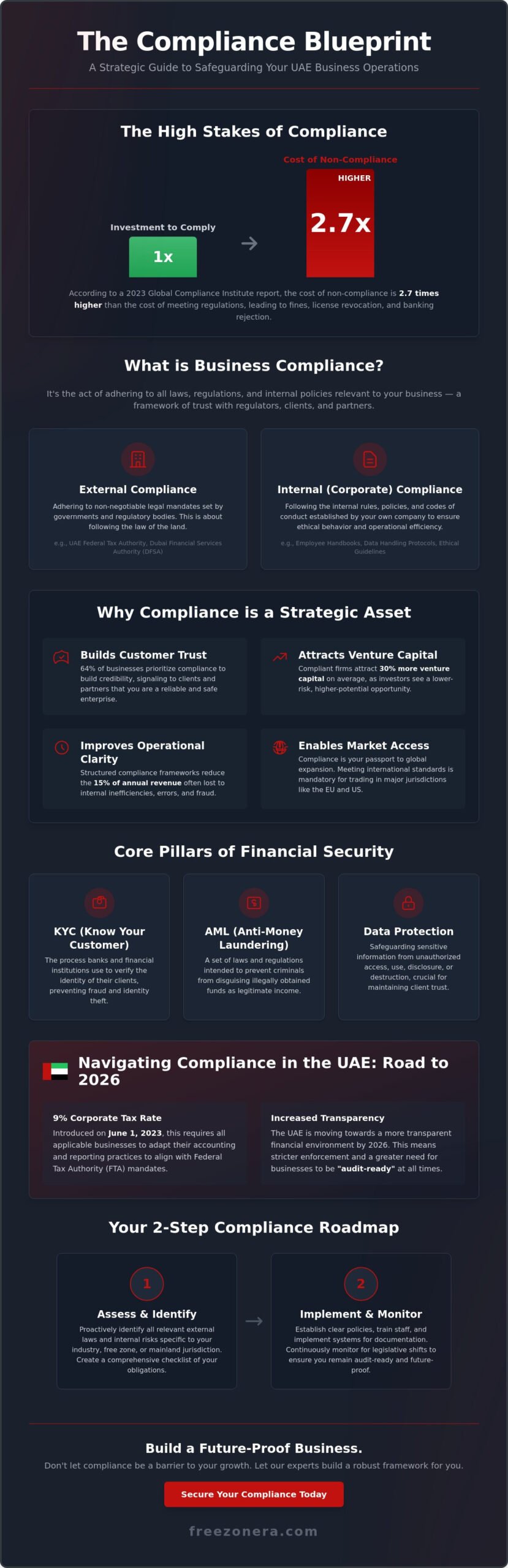
A single administrative oversight can halt a multi-million dollar expansion before it even begins. According to a 2023 report by the Global Compliance Institute, the cost of non-compliance is 2.7 times higher than the investment required to meet regulations. You might feel that “compliance” is just a buzzword designed to complicate your life, but understanding what does compliance mean is actually the most effective way to protect your assets. It’s the difference between a thriving enterprise and a business that faces sudden license revocation or banking rejection.
We understand that legal terminology often feels like a barrier to your growth. You’ve likely felt the anxiety of wondering if a hidden filing will trigger a fine or if your bank account will be closed without warning. This guide removes that uncertainty. We’ll provide a clear, expert-led definition of compliance and explain its direct impact on your business setup in the UAE. You’ll gain a structured three-step plan to stay compliant and ensure your future-driven goals remain on track.
Key Takeaways
- Learn what does compliance mean for your business and why distinguishing between internal policies and external legal mandates is vital for long-term stability.
- Explore how prioritizing regulatory adherence builds a “Trust Factor” with partners while mitigating the risks of legal penalties and reputational harm.
- Identify the essential pillars of financial security, such as KYC and AML, and understand their role in protecting your company’s integrity.
- Stay ahead of the curve by understanding the UAE’s 2026 requirements, including the transition to a more transparent Corporate Tax environment.
- Gain a clear, two-step roadmap for building a professional compliance framework tailored to your specific industry and jurisdiction.
What Does Compliance Mean in a Business Context?
Compliance is the structural backbone of a successful enterprise. At its core, it’s the act of adhering to laws, regulations, guidelines, and specifications relevant to your business operations. For entrepreneurs entering new jurisdictions, understanding What Does Compliance Mean? is essential for long-term stability. It isn’t just about following rules; it’s about building a framework of trust with regulators, clients, and partners.
Business compliance functions through two primary channels: external and internal. External compliance involves meeting the legal mandates of the state, such as the UAE’s Federal Tax Authority requirements. Internal compliance refers to the policies your own company establishes to ensure ethical behavior and operational efficiency. Regulatory bodies, like the Dubai Financial Services Authority (DFSA), enforce industry-specific standards to maintain market integrity. These organizations have the power to issue fines or revoke licenses if standards aren’t met.
Regulatory Compliance vs. Corporate Compliance
Regulatory compliance is non-negotiable. It involves following external laws set by national or international bodies. If you operate in a free zone or the mainland, you must follow the specific regulations of that jurisdiction. Corporate compliance focuses on the internal rules and codes of conduct established by your board. These rules protect the business entity by ensuring every employee acts in the company’s best interest. When these two layers intersect, they create a robust shield against both legal penalties and internal fraud.
Common Compliance Terminology for Beginners
- Statutory: These are legal requirements specifically enacted by a legislative body that your business must follow by law.
- Governance: The structured system of rules, practices, and processes used to direct and control a company.
- Risk Management: The proactive process of identifying, assessing, and mitigating potential threats to your firm’s capital and earnings.
There’s a critical difference between being compliant and being audit-ready. You’re compliant if you’re following the rules today. You’re audit-ready if your records are so well-organized that an external inspector could verify your compliance for the past five years without delay. Compliance is the alignment of business operations with legal mandates.
Why Business Compliance is Critical for Modern Entrepreneurs
Compliance isn’t just a legal obligation; it’s a strategic asset. When entrepreneurs ask, “what does compliance mean” for their daily operations, they’re really asking how to protect their future. A 2023 survey by Global Risk Management showed that 64% of businesses prioritize compliance to build customer trust. When you adhere to regulatory standards, you’re signaling to investors and partners that your company is a safe bet. It establishes a foundation of reliability that’s essential for long-term growth.
Beyond credibility, compliance acts as a framework for operational efficiency. It forces a structure that prevents internal fraud and reduces human error. This systematic approach ensures that every transaction is documented and every employee follows a set protocol. For those scaling into international markets, meeting these standards is mandatory. You can’t trade in jurisdictions like the EU or the US without meeting strict requirements. Key benefits include:
- Market Access: Compliance is the passport to global expansion.
- Operational Clarity: Clear rules reduce the 15% of annual revenue often lost to internal inefficiencies.
- Strategic Advantage: Compliant firms attract 30% more venture capital on average.
Understanding “what does compliance mean” in a practical sense helps you view these regulations as a shield rather than a hurdle. It’s about building a business that can withstand external audits and internal shifts without losing momentum.
The Relationship Between Compliance and Banking
Banks are currently the most aggressive enforcers of global compliance. They operate under “Know Your Customer” (KYC) and Anti-Money Laundering (AML) laws that leave no room for ambiguity. If your records are incomplete or your source of funds is unclear, your application will likely be rejected. Securing corporate bank account opening support is often the only way to navigate these hurdles. A clean compliance profile is your most valuable currency when dealing with financial institutions. Without it, your business lacks the oxygen of liquidity.
Avoiding the High Cost of Non-Compliance
The price of cutting corners is steep. In the UAE, administrative fines for late AML registrations can reach 1,000,000 AED. Beyond the money, the risk of “blacklisting” can end a founder’s career. Understanding Business Compliance helps you realize that proactive measures are always cheaper than reactive legal battles. For instance, a 2022 report found that the cost of compliance is roughly 2.7 times lower than the cost of non-compliance. Proactive firms avoid license suspensions and the reputational damage that takes years to repair.
Stay ahead of the curve by simplifying your administrative setup today to ensure your business remains future-proof and fully protected.
The Core Pillars: KYC, AML, and Data Protection
To understand what does compliance mean in a practical sense, you must look at the regulatory framework that governs business identity and financial integrity. These pillars aren’t just bureaucratic hurdles. They’re essential safeguards that protect the global financial system and your specific jurisdiction. Transparency starts with Ultimate Beneficial Ownership (UBO). Since 2020, UAE Cabinet Resolution No. 58 requires businesses to maintain a register of the real individuals who own or control at least 25% of the company. This ensures that the people behind every license are identifiable and accountable.
Understanding the KYC Process
KYC, or Know Your Customer, involves verifying the identity and integrity of every client you engage with. Banks and authorities require passport copies and proof of address to ensure that the people behind a business are who they claim to be. This due diligence extends beyond basic ID checks. It involves screening partners against global sanctions lists to mitigate risk. KYC is the first line of defense against financial fraud. It ensures that your business doesn’t inadvertently facilitate criminal activity while operating in a competitive free zone or mainland environment.
AML and CFT: Preventing Financial Crimes
Anti-Money Laundering (AML) and Counter-Terrorism Financing (CFT) focus on monitoring transactions to stop illegal funds from entering the economy. The Financial Action Task Force (FATF) sets the global standards that the UAE and other major hubs follow. Suspicious activity in business banking often includes sudden large cash deposits or high-volume transfers to high-risk jurisdictions without clear commercial logic. Businesses in specific sectors must report any unusual transaction exceeding 55,000 AED to the Financial Intelligence Unit. Keeping meticulous records isn’t optional; it’s a legal necessity for your long-term success.
Safeguarding sensitive information is the final pillar. Whether it’s the European GDPR or the UAE Federal Decree-Law No. 45 of 2021, data protection laws demand that you handle personal data with extreme care. When entrepreneurs ask what does compliance mean for their daily operations, it often translates to how they store and process client information. Businesses must implement technical and organizational measures to prevent data breaches. Failure to comply can lead to significant administrative fines. We simplify these complex requirements so you can focus on building your enterprise with confidence and clarity.
- KYC: Verifying identities to prevent fraud.
- AML: Monitoring cash flows to stop illegal activity.
- Data Protection: Securing personal information under local and international laws.
- UBO: Identifying the actual owners of a corporate entity.
By mastering these pillars, you position your startup as a reliable player in the international market. This structured guidance helps you avoid the pitfalls of modern regulation while fostering a culture of professional excellence.
Navigating Compliance in the UAE: 2026 Requirements
The UAE regulatory landscape changed forever on June 1, 2023, with the introduction of Federal Corporate Tax. By 2026, these regulations aren’t just new expectations; they’re the standard operating procedure for every entrepreneur in the region. Understanding what does compliance mean in this context requires looking beyond simple license renewals. It involves maintaining a transparent financial trail that satisfies both the Federal Tax Authority (FTA) and international standards.
The transition from a tax-free environment to a regulated, transparent hub means that “Mainland” and “Free Zone” entities face distinct obligations. While Mainland businesses operate under federal laws and Department of Economy and Tourism (DET) oversight, Free Zone companies must navigate specific jurisdictional rules alongside federal mandates. Ignoring these nuances can lead to operational blocks or significant financial penalties.
UAE Corporate Tax and ESR Compliance
Economic Substance Regulations (ESR) add another layer of complexity. If your business performs “Relevant Activities” like distribution, shipping, or service center operations, you must file an annual ESR notification. This proves your business has a real physical presence and isn’t just a shell. Failing to submit this can result in fines starting at AED 20,000 and may lead to the suspension of your trade license.
AML Compliance for UAE Businesses
The UAE’s removal from the FATF “Grey List” in February 2024 solidified its status as a secure, globally recognized financial center. To maintain this “White List” standing, authorities have intensified monitoring through the GoAML portal. This system is a mandatory reporting tool for Designated Non-Financial Businesses and Professions (DNFBPs).
- Real Estate Agents: You’re required to report suspicious transactions or high-value cash deals immediately.
- Precious Metal Dealers: You must verify the source of funds for all significant transactions.
- Auditors and Lawyers: Strict “Know Your Customer” (KYC) protocols are now a legal necessity, not a choice.
Authorities monitor these sectors closely to prevent money laundering. If you’re a business owner, you must appoint a dedicated Compliance Officer and register on the GoAML portal. When asking what does compliance mean for a DNFBP, it means zero tolerance for missing documentation. Administrative fines for non-compliance in this area can reach AED 1,000,000, making precision your most valuable asset.
How to Build a Compliance Framework for Your Business
Understanding what does compliance mean in a theoretical sense is only the beginning. For a business to thrive in the UAE, you must translate these definitions into a functional, living framework. This structure acts as your organization’s internal compass, ensuring every transaction and hire aligns with the law. Building this from scratch requires a methodical approach that prioritizes precision over speed.
The Role of Technology in Compliance
Modern businesses can’t rely on manual spreadsheets alone. Using software for automated Know Your Customer (KYC) checks and transaction monitoring reduces human error significantly. Digital record-keeping ensures that your documents are organized and accessible within seconds during an audit. Freezonera simplifies these complex processes for new founders, integrating technological efficiency with expert oversight to ensure your records are always “audit-ready.”
Partnering with Experts for Peace of Mind
Future-Proof Your UAE Business Strategy
Navigating the Emirates’ regulatory environment requires more than just awareness. It demands a proactive approach to the upcoming 2026 requirements. By prioritizing KYC and data protection pillars today, you safeguard your venture against shifting legal standards. Truly grasping what does compliance mean for your specific jurisdiction is the difference between a stalled startup and a thriving enterprise. It’s about turning administrative obligations into a competitive advantage that builds lasting trust with global partners.
Since 2020, FreezonEra has acted as a sophisticated navigator for entrepreneurs seeking clarity. We specialize in fixed-fee business setup and licensing within RAKEZ, SPC, and various Dubai Free Zones. Our experts remove the stress of navigating foreign legal landscapes by delivering precise, future-driven results. You don’t have to manage these complexities alone. Simplify your UAE business compliance with Freezonera and ensure your company remains on the right side of every regulation. Your journey toward a successful, fully compliant future starts with the right partner by your side.
Frequently Asked Questions
Is compliance the same as legal advice?
What happens if my business is found to be non-compliant?
Non-compliance leads to severe financial and operational penalties. The UAE Ministry of Economy can impose fines ranging from AED 50,000 to AED 5 million for violations of Anti-Money Laundering laws. Beyond financial loss, authorities may suspend your trade license or blacklist your company. These actions effectively halt your ability to operate within the jurisdiction and damage your professional reputation.
Do small startups need a dedicated compliance officer?
Most startups don’t require a full-time, dedicated officer immediately, but they must appoint a person responsible for the role. Cabinet Decision No. 10 of 2019 requires Designated Non-Financial Businesses and Professions to have a named compliance officer. For smaller entities, this responsibility is often outsourced to a professional consultancy. This approach ensures precision without the overhead of a full-time salary.
How often should a company review its compliance policies?
You should review your compliance policies at least once every 12 months. This annual schedule ensures your business adapts to the 30 plus regulatory updates the UAE often implements yearly. If a significant change occurs in your business structure or a new federal law is passed, you must conduct an immediate interim review. Staying updated prevents administrative bottlenecks during license renewals.
What is the difference between KYC and AML?
KYC is a specific component of the broader AML framework. AML refers to the entire set of laws and procedures designed to prevent the generation of income through illegal actions. KYC is the 3-step verification process used to confirm the identity and risk profile of your clients before you engage in business. One is the strategy, while the other is the tactical verification tool.
Is compliance mandatory for UAE Free Zone companies?
Compliance is mandatory for all companies operating within the 40 plus UAE free zones. Each jurisdiction has its own specific regulatory body that enforces federal and local rules. Understanding what does compliance mean in your specific free zone is vital. Failure to submit annual audits or maintain updated registers can result in immediate fines or license cancellation.
How does compliance affect my corporate bank account opening?
Compliance is the primary factor that determines whether a bank approves your corporate account application. UAE banks follow strict Central Bank regulations that require extensive documentation regarding your source of funds and business activities. If your compliance documentation is incomplete, you’ll likely face rejection. Banks prioritize risk mitigation to protect their own regulatory standing, making your transparency essential for success.
Can compliance software replace human oversight?
Software can’t replace human oversight. While automated tools efficiently flag 100 percent of high-risk transactions, they often produce false positives that require expert analysis. You need a human professional to interpret the data and make strategic decisions. We use technology to simplify the process, but the final accountability and judgment rest with your appointed officers.