

Did you know that your professional expertise can now translate into 100% business ownership in the heart of Dubai without a local partner taking a single share of your equity? While the opportunity’s never been greater, understanding the specific requirements for a professional license in UAE has become more complex following the 9% corporate tax on income over AED 375,000. It’s natural to feel overwhelmed by the distinction between a Local Service Agent and a Local Sponsor or the volume of paperwork required. You’re likely looking for a way to build a future-driven business without getting caught in a bureaucratic maze.
We understand that you need clarity and compliance to move forward with confidence. This guide simplifies the path to setup, ensuring your corporate structure’s both legally sound and strategically optimized for 2026. We’ll break down the essential documentation needed for 100% foreign ownership, clarify the latest regulatory updates, and provide a clear roadmap to securing your residency visa. By the end of this article, you’ll have the structured guidance needed to launch your venture with absolute precision.
Key Takeaways
- Identify the critical distinctions between professional and commercial licenses to secure 100% foreign ownership of your service-based venture.
- Master the specific requirements for a professional license in UAE, from selecting unified activities to appointing a Local Service Agent for mainland jurisdictions.
- Determine the optimal jurisdiction for your business by weighing the local market access of the Mainland against the international benefits of specialized Free Zones.
- Ensure full 2026 compliance by understanding the 9% corporate tax threshold and the mandatory GoAML registration requirements for professional sectors.
- Learn how to streamline your formation process and avoid hidden costs using a structured, fixed-fee approach to business setup.
What is a Professional License in the UAE?
A professional license in the UAE is specifically designed for individuals or corporate entities whose business activities rely on intellectual, artistic, or specialized skills. Unlike other permits, this license focuses entirely on the “work” performed by a person rather than the “trade” of physical goods. In the context of the 2026 regulatory environment, the UAE government has broadened these categories significantly. You’ll now find specialized licenses for AI development, remote-first strategic consulting, and digital transformation experts. This evolution reflects the nation’s commitment to becoming a global hub for knowledge-based industries.
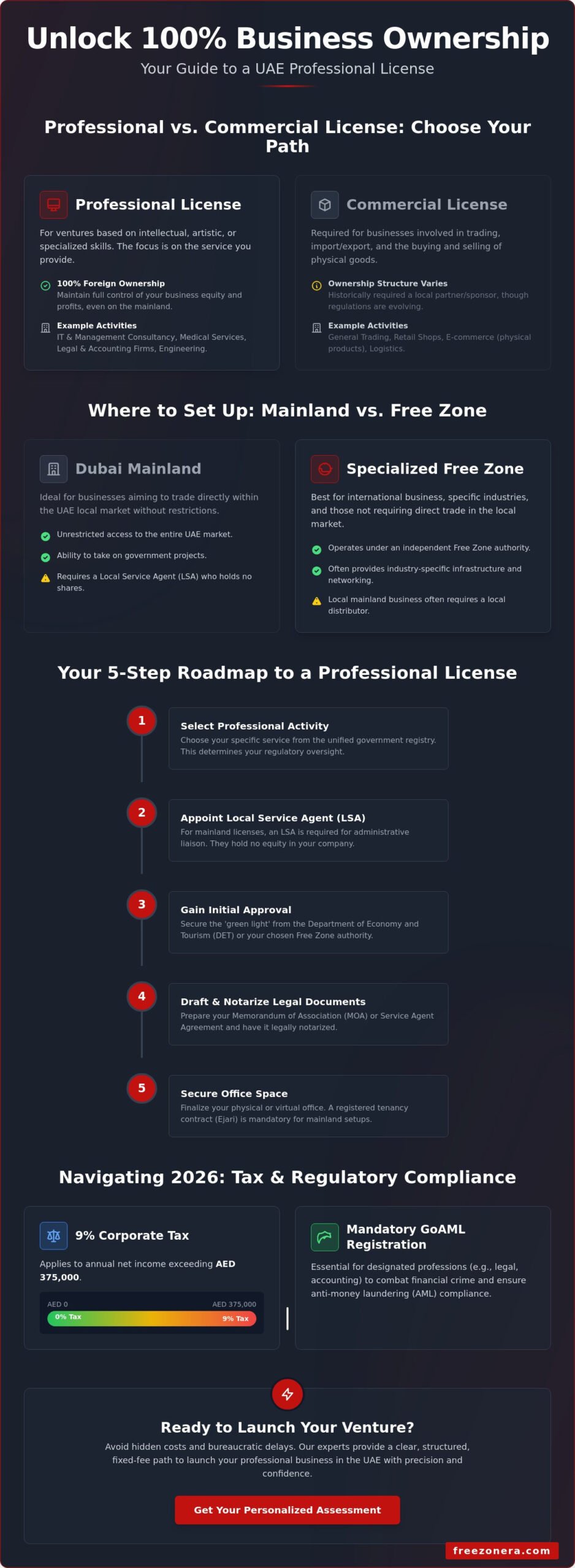
Securing a professional license allows expatriates to enjoy the privilege of 100% ownership of their business entity, even when operating on the mainland. While business licenses globally vary in scope, the UAE’s professional structure is unique because it prioritizes the individual’s expertise as the core asset. Understanding the specific requirements for a professional license in UAE is the first step toward establishing a compliant and future-proof presence in this market.
Professional vs. Commercial Licenses
Choosing between a professional and commercial license is a critical decision that dictates your operational freedom. A commercial license is for trading, where you buy and sell products. If you provide a service but mistakenly apply for a commercial license, you risk heavy fines or total operational suspension during government audits. Choosing the right category is essential when reviewing the requirements for a professional license in UAE.
Common professional activities include:
- Management and IT Consultancy: Strategic advice and technology implementation.
- Medical and Healthcare: Specialized clinics and wellness services.
- Legal and Accounting: Professional firms offering audit or advisory services.
- Architectural and Engineering: Design and technical consultancy for the construction sector.
In a mainland professional setup, you typically appoint a Local Service Agent (LSA). This individual or entity doesn’t own shares in your company; they act as a liaison with government departments to facilitate administrative tasks. This ensures you maintain full control over your business operations and profits while staying compliant with local regulations.
Benefits of the Professional Structure in 2026
The 2026 landscape offers unprecedented advantages for specialists. You retain 100% of your capital and can repatriate all profits without restriction. This structure also serves as a direct pathway to long-term residency. Highly skilled professionals often qualify for the 10-year Golden Visa, providing long-term stability for your family and team. Additionally, professional setups generally require lower initial capital investment than industrial or large-scale commercial operations. This makes it an ideal choice for consultants and boutique firms looking to scale efficiently. If you’re ready to explore these benefits, you can reach out to our consultants for a personalized assessment of your specific business needs.
Core Requirements for a Professional License in UAE
The process begins with selecting your professional activity from the unified registry. This choice is pivotal because it dictates which regulatory body will oversee your operations. For those establishing a presence on the mainland, appointing a Local Service Agent (LSA) is a fundamental step. While the LSA assists with administrative tasks like visa processing, they have no ownership stake. This structure is a cornerstone of the requirements for a professional license in UAE, allowing you to retain full control over your earnings and business direction. You’ll then need to secure Initial Approval from the Department of Economy and Tourism (DET) or the relevant Free Zone authority. This serves as the government’s “green light” for your venture.
Documentation is the next hurdle. You must draft and notarize a Service Agent Agreement or a Memorandum of Association (MOA) depending on your legal structure. Simultaneously, you’ll need to secure a physical or virtual office space. For mainland licenses, an Ejari (tenancy contract) is mandatory. These Licensing Requirements for Professional Services ensure that your business has a verifiable footprint in the country. If you’re unsure which jurisdiction suits your specific activity, you can contact our team for a tailored activity mapping session.
Educational Qualifications and Attestation
Certain professional activities require specific academic credentials. If you’re setting up a medical clinic, engineering firm, or accounting practice, you must provide a degree relevant to that field. In 2026, the Ministry of Foreign Affairs (MoFA) has streamlined this through a digital attestation process. Your documents must first be verified in your home country and then digitally stamped by MoFA in the UAE. Occasionally, the Ministry of Education may require an equivalency certificate to confirm your degree meets local standards. This step is a vital part of the requirements for a professional license in UAE for highly regulated sectors.
Trade Name Reservation Rules
Choosing a trade name involves more than just branding; it requires strict adherence to DED guidelines. You should avoid prohibited words, religious references, or names of existing global brands. In 2026, the fee structure for trade name reservation is centralized, and you can check availability across all emirates via a unified registry. Once reserved, the name is valid for six months, giving you ample time to complete the remaining licensing steps. Getting this right early prevents costly re-filing fees and ensures your brand aligns with local cultural sensitivities.
Choosing Your Jurisdiction: Mainland vs. Free Zone
Deciding where to anchor your professional practice is a strategic move that dictates your client reach and long-term scalability. The requirements for a professional license in UAE differ based on whether you choose the mainland or a free zone. Each jurisdiction offers distinct advantages tailored to specific business models. Mainland licenses, issued by the Department of Economy and Tourism (DET), provide the highest level of flexibility for those targeting the local market. Conversely, free zones offer a streamlined, digital-first experience ideal for specialists serving international clients.
A cost-benefit analysis reveals that while free zones often have lower initial entry costs, mainland setups offer superior operational freedom. In 2026, total mainland setup costs, including office space and visas, typically start at AED 25,000. Free zones might offer packages below this, but they often restrict your ability to work directly with government entities or local mainland clients. Understanding the nuances of UAE professional licensing requirements is essential to avoid choosing a structure that limits your growth. For many, the “Dual License” has become a preferred solution, allowing a free zone entity to operate on the mainland without the need for a separate physical office.
The Mainland Professional Advantage
Operating on the mainland removes the invisible borders that can restrict your business. You can provide services anywhere in the UAE without geographic limitations. This is particularly beneficial for consultants or medical professionals who need to visit clients at their premises. Mainland firms also gain direct access to lucrative government tenders and contracts, which are often restricted to DET-licensed companies. Additionally, mainland structures often simplify the visa process for larger teams, as the visa quota is generally tied to the square footage of your office space rather than fixed zone limits.
Why Professionals Choose Free Zones in 2026
Free zones remain the primary choice for digital nomads and international consultants due to their rapid setup times. In 2026, many zones offer 24-hour license issuance through fully integrated digital portals. You can join specialized hubs like Dubai Media City for creative services or technology-focused parks for AI and fintech, placing you in an ecosystem of like-minded experts. These jurisdictions also offer modern coworking spaces that satisfy the physical office requirement, keeping overhead low for startups. If you’re looking for a jurisdiction that matches your specific niche, you can reach out to our consultants to find the perfect fit for your 2026 goals.
Navigating 2026 Regulatory and Tax Compliance
Compliance in the UAE has evolved from a one-time setup checklist into a dynamic operational requirement. As of 2026, the federal corporate tax regime is fully active, impacting every service provider. Understanding the fiscal requirements for a professional license in UAE is no longer optional; it’s a core pillar of your business strategy. You’ll need to navigate a tiered tax system while maintaining strict records for anti-money laundering (AML) and ultimate beneficial ownership (UBO) filings to avoid substantial penalties.
Professional firms must register on the GoAML portal if they fall under the category of Designated Non-Financial Businesses and Professions (DNFBPs). This includes accountants, auditors, and legal consultants. Additionally, the UBO declaration is a mandatory filing that identifies the individuals who actually own or control the company. Failure to update this registry can lead to license suspension. Economic Substance Regulations (ESR) also apply if your activity involves “Relevant Activities” like headquarter services or intellectual property. Meeting these reporting requirements for a professional license in UAE ensures your business stays in good standing with the Ministry of Finance. Maintaining the role of a compliance department in UAE companies is the most effective way to manage these recurring obligations without disrupting your daily operations.
Corporate Tax for Service Providers
The UAE implements a 9% corporate tax on taxable income exceeding AED 375,000. However, many professional startups can benefit from Small Business Relief. This relief applies to resident taxable persons with gross revenue below AED 3 million in the relevant and previous tax periods, effective for periods ending on or before December 31, 2026. To claim these benefits and ensure long-term stability, your firm must maintain audited financial statements. These documents prove your eligibility for the 0% bracket and are often required for tax residency certificates if you operate internationally.
Digital Compliance and Data Protection
Modern consultancies and fintech firms must also align with the UAE Data Privacy Law. This regulation sets strict standards for how you collect, process, and store client data. If your professional activity involves sensitive information, you’ll need to implement robust cybersecurity protocols to meet government standards. This digital hygiene is as critical as your financial reporting in the current regulatory landscape. To ensure your firm meets every 2026 standard, you can book a compliance audit with our expert team today to secure your operational future.
Simplifying Your Setup with Freezonera
Establishing a business in a foreign jurisdiction shouldn’t be a source of stress. Freezonera acts as your Sophisticated Navigator through the intricate UAE bureaucracy. We focus on simplifying the complex requirements for a professional license in UAE so you can concentrate on your craft. Our commitment to clarity means we provide a fixed-fee business setup. You won’t face hidden costs or surprise administrative charges during the formation process. We provide a steady hand, ensuring your corporate structure is both compliant and commercially viable from day one. Our team bridges the gap between traditional administrative setup and modern business strategy to deliver results driven by the future.
Our 4-Step Professional Setup Process
We follow a methodical rhythm to get your business operational without the typical delays. First, we conduct a consultation and activity mapping session. This ensures your license matches your specific 2026 goals and qualifies for the most beneficial tax treatments. Second, we handle document preparation and attestation support. We manage the Ministry of Foreign Affairs (MoFA) legwork, so you don’t have to navigate those queues yourself. Third, we manage the submission and approval phase. We coordinate directly with the Department of Economy and Tourism (DET) or Free Zone authorities to secure your initial and final approvals. Finally, we provide post-license support. This includes everything from banking to long-term asset management. You can learn more about our holistic approach in our guide on UAE Company Setup 2026: The Comprehensive Strategy for Entrepreneurs.
Our partnership extends far beyond the issuance of a permit. We provide comprehensive support for corporate bank account opening, navigating the heightened compliance standards of 2026. We also manage UAE Residency Visa services for you and your team, ensuring a clear path to long-term residency. To help your business thrive, we offer future-driven strategies that integrate SEO and digital marketing with your new license. This ensures you’re not just legally registered, but also visible to your target audience in a competitive market.
Ready to Launch Your Professional Career in the UAE?
2026 is the ideal year to establish your professional presence in Dubai. The regulatory landscape has stabilized, and the digital infrastructure for service providers is world-class. You’ve seen the requirements for a professional license in UAE; now it’s time to act. We offer more than just services; we offer a structured guidance system designed for your success. Don’t let documentation requirements hold you back from a 100% foreign-owned future. Contact us today for a structured guidance session to begin your journey. Simplify your UAE professional license today with Freezonera.
Securing Your Professional Future in the UAE
Launching a service-based business in the UAE is a strategic investment in your unique expertise. You’ve now explored the critical 2026 tax thresholds and the strategic choice between mainland flexibility and free zone efficiency. Mastering the requirements for a professional license in UAE is the final barrier between your vision and a fully operational, compliant entity. Success in this market requires more than just a permit; it demands a corporate structure built for long-term growth.
At Freezonera, we specialize in removing every administrative hurdle. With expertise across 40+ UAE Free Zones and a commitment to fixed-fee transparency, we ensure your setup is precise and predictable. Our team doesn’t just stop at licensing. We provide dedicated support for corporate bank account opening and residency visas to complete your business ecosystem. Don’t let administrative complexity slow your momentum in one of the world’s most dynamic economies. Start your UAE professional journey with Freezonera and build a legacy driven by the future. Your professional success is within reach, and we’re ready to guide you every step of the way.
Frequently Asked Questions
Can I get a professional license in UAE without a local partner?
Yes, you can maintain 100% ownership of your professional practice. Following Federal Decree-Law No. 26 of 2020, expatriates are permitted full ownership of mainland professional companies. You’ll only need to appoint a Local Service Agent (LSA) to assist with administrative government liaison, but they hold no equity or management rights in your firm.
What is the total cost of a professional license in Dubai for 2026?
The estimated cost for the license itself in Dubai for 2026 ranges from AED 10,000 to AED 20,000. When you factor in the total setup, including residency visas and office space requirements, the initial investment typically starts at AED 25,000. These costs can fluctuate based on your specific professional activity and the chosen jurisdiction.
Is a physical office mandatory for a professional license?
A physical office is mandatory for mainland licenses, as you must provide a registered Ejari to complete the setup. However, many free zones offer virtual office or “flexi-desk” solutions that satisfy the legal requirements for a professional license in UAE. These options allow you to maintain a professional address while keeping your overhead costs low.
How long does it take to issue a professional license in the UAE?
Digital transformation has significantly reduced processing times across the emirates. Most free zone licenses are issued within 24 to 48 hours once all documents are submitted. Mainland licenses typically take between 3 to 7 working days, though this can extend if your specific activity requires external approvals from authorities like the Dubai Health Authority.
Can I sponsor my family on a professional license?
Yes, holding a professional license entitles you to an investor or partner visa, which grants you the right to sponsor your dependents. You’ll need to provide attested marriage and birth certificates along with proof of adequate housing. Our residency visa services ensure this process is handled with precision to keep your family’s transition seamless.
Do I need a degree for every professional license activity?
Educational requirements depend entirely on the nature of your service. Regulated professions like engineering, medicine, and accounting strictly require a relevant degree attested by the Ministry of Foreign Affairs. For many creative or management consultancy roles, the requirements for a professional license in UAE may not include formal educational attestation, focusing instead on professional experience.
What is the role of a Local Service Agent (LSA)?
An LSA acts as your administrative representative before government bodies. They manage tasks like labor permit applications and residency renewals on your behalf. It’s important to remember that the LSA has no financial interest in your business and doesn’t participate in your company’s operations, profits, or decision-making processes.
Can a professional license be converted to a commercial one later?
Direct conversion isn’t usually possible because professional and commercial licenses represent different legal frameworks. If you decide to move from providing services to trading goods, you’ll likely need to apply for a new commercial license. This shift often requires a change in your corporate structure and may involve different shareholding requirements depending on the activity.