

By 2026, the cost of a regulatory oversight in the UAE will far outweigh the initial savings of a bargain-bin license. You’ve likely realized that the landscape for those looking to setup a company in dubai has shifted toward a more mature, tax-compliant framework. It’s natural to feel a sense of hesitation when weighing the merits of a Mainland presence against 40 plus distinct Free Zones, especially with the 9% corporate tax now a permanent fixture of your balance sheet. You want to avoid the common pitfalls of hidden administrative fees or the lengthy delays that often plague new corporate bank account applications.
We’re here to provide the structured guidance you need to move forward with confidence. This complete roadmap eliminates the guesswork by offering a transparent look at the 2026 licensing requirements and compliance standards. You’ll gain access to a clear 5-step roadmap that simplifies complex legal hurdles and secures your path to a future-driven business. We’ll walk you through jurisdictional selection, tax registration, and the specific documentation required to ensure your operations are both legal and strategically positioned for growth in the coming year.
Key Takeaways
- Gain a strategic understanding of the D33 Agenda and how Dubai’s 2026 economic landscape empowers foreign investors in the tech and finance sectors.
- Master the essential steps to setup a company in dubai, ensuring you select the optimal business activity and legal structure for your specific industry.
- Evaluate the critical trade-offs between Mainland and Free Zone jurisdictions to maximize your tax benefits and access to government contracts.
- Streamline your post-incorporation journey by mastering the 2026 requirements for residency visas and high-level corporate banking compliance.
- Discover how a structured guidance system can simplify complex administrative regulations, turning your vision into a future-driven business reality.
Why Setup a Company in Dubai? The 2026 Economic Landscape
Dubai has solidified its position as the primary global nexus for trade, finance, and technology. By 2026, the city’s infrastructure and legal frameworks have evolved to support a digital-first economy. Entrepreneurs who choose to setup a company in dubai benefit from a stable environment that bridges Eastern and Western markets. The Economy of the United Arab Emirates remains resilient, driven by aggressive diversification away from oil and toward a knowledge-based future. This stability provides a calm, steady hand for investors navigating a volatile global market.
The strategic advantages extend beyond location. Investors now enjoy 100% foreign ownership in most sectors across both mainland and free zone jurisdictions. World-class logistics, powered by the Jebel Ali Port and Al Maktoum International Airport, ensure that supply chains remain uninterrupted. FreezonEra focuses on simplifying complex processes to help you leverage these assets quickly and with full compliance.
The D33 Agenda: Doubling Dubai’s Economy
The Dubai Economic Agenda (D33), launched in early 2023, is the primary catalyst for growth in 2026. For new SMEs and startups, this initiative translates into enhanced support systems and access to 100 transformative projects. The focus has shifted toward high-growth sectors including green tech, AI-driven services, and advanced manufacturing. The D33 Agenda is a strategic blueprint designed to double Dubai’s GDP and position the city among the top three global economic hubs by 2033. This long-term vision ensures that your investment is backed by government-led momentum and structured guidance.
Taxation and Incentives in 2026
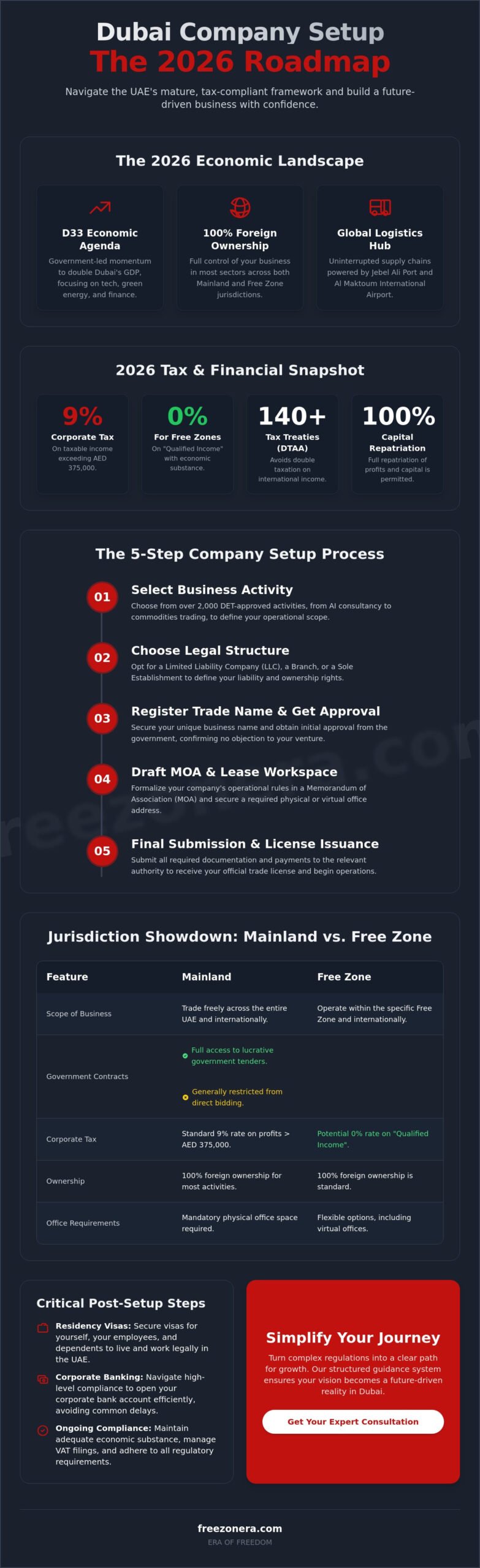
The UAE tax environment is professional and transparent. A standard Corporate Tax rate of 9% applies to taxable income exceeding AED 375,000. However, Free Zone entities can often maintain a 0% tax rate on “Qualified Income,” provided they maintain adequate economic substance and comply with all regulatory filings. It’s essential to understand these distinctions early in your journey to ensure clarity and compliance.
- VAT Requirements: Businesses must register for VAT if their taxable supplies and imports exceed the mandatory threshold of AED 375,000.
- DTAA Benefits: The UAE has established over 140 Double Taxation Avoidance Agreements, protecting international firms from being taxed on the same income in two different countries.
- Capital Repatriation: Dubai allows for the full repatriation of profits and capital, providing a secure exit or reinvestment strategy for global founders.
Navigating these fiscal requirements doesn’t have to be overwhelming. If you’re ready to explore how these regulations apply to your specific business model, you can reach out to our expert team for a detailed consultation. We specialize in future-driven results that align your corporate structure with the latest UAE laws.
Step-by-Step Guide: How to Setup a Company in Dubai
The 2026 regulatory framework in Dubai focuses on speed and digital integration. The World Bank’s Doing Business report has long recognized the UAE for its efficiency in starting a business, and current initiatives have only improved these metrics. To setup a company in dubai today, you must follow a structured five-step sequence designed to ensure full compliance with local laws.
- Step 1: Select your business activity. You must choose your specific operations from the official Department of Economy and Tourism (DET) list or your chosen Free Zone’s directory. There are over 2,000 activities available, ranging from commodities trading to specialized AI consultancy.
- Step 2: Choose your legal structure. Most entrepreneurs opt for a Limited Liability Company (LLC), but you can also establish a Branch of a foreign company or a Sole Establishment. Your choice dictates your liability and ownership rights.
- Step 3: Register your trade name and obtain initial approval. This step confirms that the Dubai government has no objection to you starting a business and that your chosen name is available.
- Step 4: Draft the Memorandum of Association (MOA) and lease a workspace. The MOA outlines the operational rules of your firm. Simultaneously, you must secure a physical address, as a tenancy contract is mandatory for mainland licenses.
- Step 5: Submit final documents and receive your trade license. Once the authorities verify your lease and MOA, you pay the final fees to receive your license.
Selecting Business Activities and Trade Names
Precision is vital when selecting your activities. If your license doesn’t accurately reflect your daily operations, you risk fines during future audits. By 2026, the ‘Invest in Dubai’ platform has become the primary tool for digital-first registration, often reducing the approval time for mainland companies to less than 15 minutes. When choosing a trade name, avoid restricted terms related to global brands, religious references, or political affiliations. It’s also mandatory that the name doesn’t already exist in the DET registry.
Legal Documentation and Workspace Requirements
The Memorandum of Association (MOA) remains the legal backbone of your entity. In 2026, these documents are typically processed via digital notarization, removing the need for physical presence in many cases. Your choice of workspace depends on your scale. Startups often utilize Flexi-desk options in Free Zones to keep overheads low, while mainland companies usually require a dedicated physical office of at least 200 square feet. For a deeper analysis of these choices, see our strategy on UAE Company Setup 2026.
Success in this market requires a steady hand and local expertise to avoid administrative delays. If you’re ready to begin your journey, you can reach out for expert guidance to ensure your application is perfect from day one.
Choosing Your Jurisdiction: Mainland vs. Free Zone in 2026
Deciding where to anchor your business defines your operational reach and tax obligations. In 2026, the distinction between jurisdictions remains the most critical decision for entrepreneurs who want to setup a company in dubai. Your choice dictates whether you can trade directly with the local market or if you are restricted to international and zone-to-zone commerce. Each path offers distinct advantages tailored to specific business models.
- Mainland (Onshore): Offers unlimited trade within the UAE and the ability to bid for lucrative government contracts. There are no geographic restrictions on where you can open offices or retail outlets.
- Free Zones: Provide 100% tax holidays on qualifying income and simplified customs procedures within specialized hubs. These are ideal for startups and tech firms focused on regional or global exports.
- Offshore: Designed for asset protection and international trade focus. These entities cannot trade within the UAE or occupy physical office space, serving primarily as holding structures.
Mainland entities typically have flexible visa quotas based on office size, whereas free zones offer pre-determined visa packages that are often more cost-effective for smaller teams. If you need a detailed cost comparison for your specific industry, you can reach us to speak with a consultant who can map out your requirements.
When to Choose Dubai Mainland
Mainland setups are the primary choice for retail, construction, and professional services that require a physical presence across the city. The Dubai Unified Licence (DUL) has transformed the landscape by providing a single digital identity for all onshore businesses. This streamlines compliance and speeds up interactions with government departments. Under the 2021 ownership reforms, entrepreneurs enjoy 100% foreign ownership for over 1,000 commercial and industrial activities. You’ll keep full control without the need for a local sponsor in most sectors. This jurisdiction is essential if your business model involves selling directly to UAE consumers or participating in large-scale infrastructure projects.
Top Dubai Free Zones for 2026
Choosing the right free zone depends on your industry and logistics needs. DMCC is the world’s leading hub for commodities and tech startups, offering a sophisticated digital infrastructure. DIFC remains the premier jurisdiction for financial services and fintech ventures, operating under its own independent, English-language common law judiciary. Proximity matters. If your business relies on heavy sea freight, JAFZA is the logical choice due to its integration with Jebel Ali Port. For air-cargo-dependent models, DAFZ provides direct access to Dubai International Airport. Many founders use their business setup as a pathway to residency. You can find detailed eligibility criteria in our Dubai Golden Visa Guide to see how your 2026 setup a company in dubai strategy fits into long-term immigration plans.
Critical Post-Setup: Visas, Banking, and Compliance
Obtaining your trade license is only the first milestone in your journey. To successfully setup a company in dubai, you must navigate the operational requirements of residency and financial infrastructure. These steps ensure your business remains compliant with federal laws while providing the stability needed for long-term growth. Moving from a legal entity to an active operation requires a structured approach to administrative integration.
Securing Your UAE Residency
The 2026 residency framework offers various paths for entrepreneurs. While the standard two-year Investor Visa remains a reliable entry point, the 10-year Golden Visa has become the primary goal for many. This long-term residency is available to those who meet specific criteria, such as a property investment of at least AED 2 million or recognition as an exceptional talent in technology or science. The process begins with an entry permit, followed by a medical fitness test and biometric enrollment for your Emirates ID. This card serves as your primary identification for all government and private transactions. Once your residency is active, you can sponsor dependents and domestic staff through the General Directorate of Residency and Foreigners Affairs (GDRFA), provided you meet the minimum salary thresholds.
Banking and Financial Compliance
Opening a corporate bank account remains a significant hurdle for new firms. In 2026, UAE banks apply strict Know Your Customer (KYC) protocols to comply with global Anti-Money Laundering (AML) standards. It’s essential to prepare comprehensive documentation, including three to six months of personal bank statements, proof of residency, and a clear business plan. Digital-first banks have transformed the landscape for SMEs, offering faster onboarding and intuitive interfaces for daily transactions. For international trade firms, Economic Substance Regulations (ESR) serve as a mandatory framework to ensure that profits are generated through actual local activity rather than purely for tax optimization. Maintaining clarity and compliance in these areas prevents future legal friction and protects your corporate assets.
Building Your Local Presence
Your administrative setup concludes with visibility. Establishing a digital footprint is essential to compete in the Dubai market. This involves securing a .ae domain and implementing a localized SEO strategy to capture high-intent leads. Building a local presence ensures your brand resonates with the diverse demographic of the UAE. When you setup a company in dubai, your digital strategy should be as robust as your legal foundation to ensure immediate market penetration.
If you need expert assistance with these complex post-setup requirements, you can connect with our consultants to streamline your transition into the Dubai market.
Simplifying Your Journey with Freezonera
Navigating the 2026 regulatory environment in the UAE requires more than just filling out forms. With the full implementation of the 9% corporate tax regime and stricter Economic Substance Regulations (ESR), the margin for error has disappeared. Freezonera acts as your Sophisticated Navigator, transforming a complex bureaucratic hurdle into a streamlined strategic launch. We provide fixed-fee business setup and licensing services, ensuring you never face hidden costs or unexpected delays during the process.
Choosing to setup a company in dubai is a significant milestone. However, the administrative landscape involves multiple layers of government coordination. Our role is to provide clarity and compliance, acting as the steady hand that guides you through every legal requirement. We handle the technicalities so you can focus on building your brand.
The Freezonera Advantage
Our approach to UAE bureaucracy is methodical and precise. We manage all government coordination and legal documentation across various jurisdictions, including mainland and specialized free zones. Our team has successfully helped more than 550 entrepreneurs scale within competitive markets by providing structured guidance on corporate structures. We don’t just submit applications; we build foundations driven by future growth.
- Government Liaison: Direct coordination with the Department of Economy and Tourism (DET) and specific Free Zone authorities.
- Document Accuracy: Precision in drafting Articles of Association and legal translations to meet 2026 standards.
- Fixed-Fee Transparency: Clear, upfront pricing with no hidden administrative charges or surprise consultancy fees.
Beyond the administrative setup, we recognize that true market entry requires digital visibility. Freezonera integrates SEO and digital marketing strategies into our consultancy model. This ensures that your business doesn’t just exist on paper but thrives in the digital marketplace from the moment you receive your license. This holistic approach bridges the gap between traditional setup and modern business strategy.
Ready to Start Your Dubai Success Story?
The roadmap to success in 2026 moves from a strategic idea to a fully operational license. This journey includes selecting the correct business activity, choosing a jurisdiction, and securing your residency visas. Freezonera simplifies this entire lifecycle, providing a future-driven strategy that anticipates market shifts. We’ve streamlined the process so that most licenses are issued within a matter of days once the documentation is verified.
Every business is unique. We recommend getting a personalized quote for your specific activity to ensure your setup a company in dubai is cost-effective and compliant. Taking the first step today positions you ahead of the competition in one of the world’s most dynamic economies. Our experts are ready to turn your vision into a compliant, operational reality.
Launch Your Future-Driven Enterprise in 2026
The roadmap to 2026 demonstrates that Dubai remains a premier global hub for innovation. As the D33 Economic Agenda works to double the emirate’s economy by 2033, the opportunity for growth is significant. Success depends on selecting the right jurisdiction. Whether it’s the industrial power of RAKEZ, the trade focus of DMCC, or the flexibility of SPC, you need a strategy that aligns with your specific goals. Navigating these legal frameworks requires precision to ensure full compliance and seamless banking integration from day one.
FreezonEra acts as your sophisticated navigator, simplifying every complex administrative hurdle. We provide fixed-fee licensing services and expert guidance that removes the stress from the registration process. Beyond the initial paperwork, we offer comprehensive digital marketing support to help your brand scale immediately after you setup a company in dubai. It’s time to move from planning to execution with a partner that values clarity and long-term success. Your vision deserves a foundation built on expertise and forward-thinking strategy.
Book Your Free Dubai Business Setup Consultation
We’re excited to help you turn your entrepreneurial dreams into a thriving reality in the heart of the UAE.
Frequently Asked Questions
Can a foreigner own 100% of a company in Dubai in 2026?
Yes, you can own 100% of your business in Dubai. Following the 2021 update to the UAE Commercial Companies Law, the requirement for a local Emirati partner holding 51% of shares was removed for over 1,000 commercial and industrial activities. Whether you choose a Free Zone or Mainland jurisdiction, you maintain full control of your enterprise. This legal framework remains a cornerstone of the 2026 business environment.
How much does it cost to setup a company in a Dubai Free Zone?
Total costs depend on your chosen jurisdiction and visa requirements. For instance, a basic license in the Meydan Free Zone often starts around AED 12,500, while other zones might charge up to AED 50,000 for complex setups. You’ll need to budget for license fees, registration, and mandatory insurance. We focus on simplifying the process by identifying the most cost-effective zone for your specific industry goals.
What is the minimum capital requirement for a Dubai company?
Most Dubai Mainland LLCs don’t require a specific minimum share capital paid upfront. The law simply states capital must be sufficient for the company’s purpose. However, certain Free Zones, such as the Dubai Multi Commodities Centre (DMCC), typically require a minimum share capital of AED 50,000 per company. Always verify the specific requirements of your chosen jurisdiction before you begin the process to setup a company in dubai.
How long does the business setup process take in Dubai?
You can obtain a digital trade license in as little as 24 to 48 hours through “Instant License” portals. However, the complete lifecycle, including visa processing and corporate bank account opening, usually takes 3 to 5 weeks. We manage these timelines with precision to ensure your operations begin without unnecessary delays. This structured approach helps you transition from an applicant to an active business owner quickly.
Is a physical office mandatory for a Dubai trade license?
No, a traditional physical office isn’t always mandatory for every license type. Many Free Zones offer “flexi-desk” or “smart office” solutions that satisfy the legal requirement for a registered address. For Mainland companies, the Dubai Department of Economy and Tourism (DET) often requires a minimum of 200 square feet of office space. However, newer initiatives allow for virtual leases under specific conditions to lower initial overhead.
Do I need a local partner to start a business in Dubai Mainland?
You don’t need a local partner for most commercial or industrial activities in 2026. While professional licenses used to require a Local Service Agent (LSA), regulatory shifts since June 2021 have simplified this for entrepreneurs. Even when an LSA is involved for administrative liaison, they don’t hold equity in your company. This ensures you retain 100% of the profits and full decision-making authority over your business strategy.
What are the corporate tax implications for new Dubai companies in 2026?
Dubai companies are subject to a 9% federal corporate tax on taxable profits exceeding AED 375,000. This law, effective since June 1, 2023, includes specific exemptions for Free Zone entities that earn “Qualifying Income” from transactions with parties outside the UAE. Navigating these tax layers requires clarity and compliance to ensure you leverage available incentives. We help you understand how these fiscal policies impact your long-term financial planning.
Can I open a corporate bank account remotely for my Dubai company?
Most traditional UAE banks require at least one physical meeting with the business owner to complete “Know Your Customer” (KYC) protocols. While you can start the application process and submit documents online, a face-to-face verification is standard for final approval. Digital banking platforms like Wio or Mashreq NeoBiz offer more streamlined, tech-driven onboarding. This is a critical step when you setup a company in dubai to ensure smooth capital flow.