

You don’t need a local partner to secure 100% ownership of your business vision in the UAE. While the 2023 introduction of a 9% corporate tax changed the financial landscape, the solo entrepreneur’s path to success remains clear through the right legal structure. You likely feel the weight of choosing between a mainland entity and a free zone, fearing that a single mistake in your fze application could lead to hidden compliance costs or administrative delays. It’s a common concern for the thousands of professionals looking to enter the market this year.
This guide provides the structured guidance you need to master the Free Zone Establishment framework. We’ll simplify the complex transition into the 2026 regulatory environment, ensuring your venture is built on a foundation of clarity and compliance. You’ll gain a transparent look at the specific setup steps, current jurisdictional requirements, and the strategic advantages of maintaining total individual control. From initial registration to long-term asset management, we’re outlining the roadmap for your future-driven success in the Emirates.
What Is an FZE in the UAE and How Does It Work?
An FZE (Free Zone Establishment) is a UAE free zone company structure for a single shareholder. It provides 100% foreign ownership, zero personal income tax, and limited liability protection. Most UAE free zones issue FZE licences within 2–4 weeks; setup costs typically range from AED 8,000 to AED 30,000.
Key Takeaways
- Learn how the single-shareholder structure provides total ownership while isolating your personal assets from business risks.
- Gain clarity on the 2026 legal framework to ensure your fze remains fully compliant with updated UAE Corporate Tax regulations.
- Identify the strategic advantages of zero personal income tax and the infrastructure benefits of prime jurisdictions like Ras Al Khaimah.
- Master the 5-step roadmap to launch your entity, from selecting a trade name to securing final authority approval.
- Discover how to simplify your setup journey using a fixed-fee model and professional guidance for a seamless market entry.
Understanding the FZE: Definition and Core Purpose
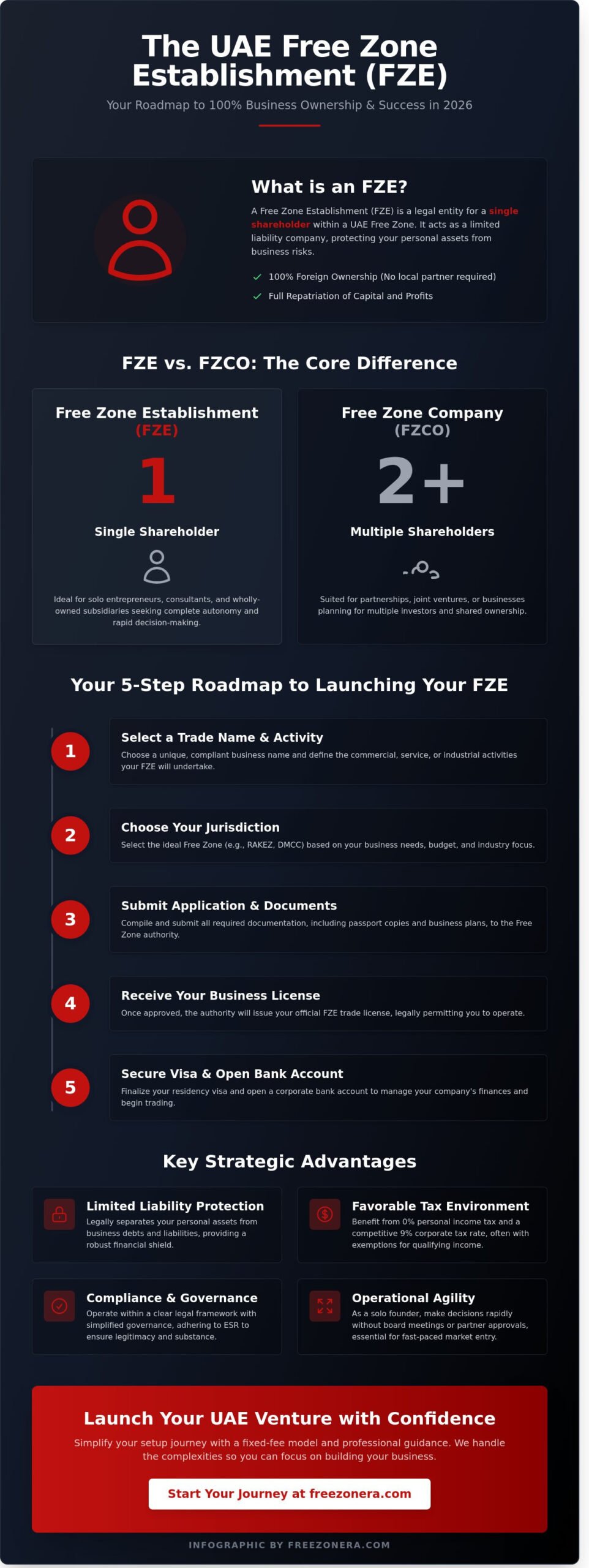
An fze, or Free Zone Establishment, is a specialized legal entity designed for single-shareholder operations within the UAE Free Trade Zones. It functions as a limited liability company, meaning the owner’s personal assets remain protected from business liabilities. This structure serves as a robust foundation for international trade and services, offering a secure and transparent environment for global investors looking to tap into the Middle Eastern market.
The distinction between an “Establishment” and a “Company” is a fundamental aspect of UAE corporate law that every founder must grasp. An Establishment indicates a single owner, whereas a Company suggests multiple partners. For entrepreneurs, the primary appeal of an fze is the absolute autonomy it provides. Owners enjoy 100% foreign ownership and 100% repatriation of capital and profits, removing the historical requirement for a local Emirati sponsor. This entity type is highly versatile. It can be registered by an individual professional or a corporate entity looking to create a wholly-owned subsidiary to expand its global footprint.
FZE vs. FZCO: The Shareholder Difference
The difference between these two structures is purely numerical but carries significant legal weight. An FZE requires exactly one shareholder. A Free Zone Company (FZCO) requires a minimum of two. This simplicity reflects in the Memorandum of Association (MOA). Since there’s only one stakeholder, the governance rules are straightforward and focus primarily on the powers of the appointed manager. If the business grows and requires external investment, the entity can transition to an FZCO. This process involves amending constitutional documents and updating the license with the specific free zone authority to reflect the new shareholding structure.
Why Solo Entrepreneurs Choose FZE in 2026
In 2026, agility is the most valuable asset for any startup founder. Solo entrepreneurs favor the FZE model because it grants full management control without the bureaucracy of mandatory board meetings or complex shareholder resolutions. Decision-making is rapid, which is essential for successful market entry in fast-paced sectors. It’s the ideal vehicle for consultants, digital nomads, and tech founders who prioritize clarity and compliance while maintaining a lean operational footprint. By simplifying the setup process, founders can focus on scaling their future-driven ideas rather than managing administrative friction. This structure allows for a professional presence in a prestigious jurisdiction with minimal overhead.
Legal Framework and Compliance for FZEs in 2026
Operating an fze in the UAE provides a robust legal shield for entrepreneurs. This structure ensures limited liability protection, which legally separates your personal assets from the company’s liabilities. If the business encounters financial distress or legal disputes, your private wealth remains protected. This security is a primary reason why international investors choose this model for market entry. It creates a clear boundary between the individual and the enterprise, allowing for calculated risk-taking in a stable environment.
Compliance in 2026 requires strict adherence to Economic Substance Regulations (ESR). To meet these standards, your entity must demonstrate genuine economic activity within the UAE. This includes maintaining a physical or virtual office address registered within the specific free zone’s boundaries. Understanding the Benefits of setting up in an FTZ helps clarify how these regulations actually support the legitimacy of your global operations. Every establishment must fulfill these core requirements to maintain its license:
- A valid lease agreement for a physical office or a flexi-desk within the zone.
- Annual ESR notifications and substance reports if conducting “Relevant Activities” like banking or shipping.
- Appointment of a qualified manager or director to oversee local operations.
Capital Requirements and Share Structure
Minimum share capital requirements depend on your chosen jurisdiction. For instance, RAKEZ offers flexible options with low entry barriers, while DMCC typically requires a higher committed capital, often starting around AED 50,000. In many zones, you don’t need to pay up this capital upfront during the initial registration phase. Your Share Certificate serves as the official legal document that defines your 100% ownership stake in the fze. It’s the primary proof of your investment and defines your rights within the corporate structure.
Corporate Tax and VAT Registration
The UAE tax environment has evolved. As of 2026, all establishments must register for Corporate Tax. A 9% rate applies to taxable income exceeding AED 375,000. Even if your profit falls below this threshold, you must file annual returns and maintain audited financial statements. This transparency builds trust with local banks and international partners. Regarding VAT, registration becomes mandatory once your taxable supplies and imports exceed AED 375,000 within a 12-month period. Voluntary registration is available at AED 187,500. If you’re unsure how these rules apply to your specific trade, simplifying complex processes with professional guidance ensures you remain fully compliant from day one.
Strategic Benefits of an FZE Structure
Choosing an fze structure provides a robust foundation for fiscal efficiency and operational growth. The UAE remains one of the world’s most attractive tax environments. You’ll benefit from 0% personal income tax, allowing for maximum capital retention. While a 9% corporate tax applies to certain activities, it only impacts taxable profits exceeding 375,000 AED. This threshold ensures that small to medium-sized establishments remain highly competitive. We focus on simplifying UAE Business Setup for Entrepreneurs by aligning these tax advantages with your specific commercial goals.
Reliable banking is the lifeblood of any business. Establishing an fze offers a distinct advantage over offshore entities in this regard. Financial institutions prioritize corporate substance, which this structure provides through physical office requirements and local licensing. This transparency leads to faster KYC approvals and smoother international fund transfers. It’s a strategic move that builds long-term institutional trust and ensures your capital remains accessible.
Global Trade and Logistics Advantages
Free zone entities are strategically positioned to leverage the UAE’s position as a global logistics nexus. One of the most tangible benefits is the exemption from customs duties on imports and exports. This 0% duty rate applies to goods brought into the zone for processing or re-export, which is vital for maintaining healthy margins. It’s an ideal setup for international e-commerce and dropshipping businesses that require agile, cost-effective supply chains. By utilizing world-class hubs in Ras Al Khaimah, you gain direct access to sophisticated port infrastructure. For a deeper look at the current landscape, consult our guide on Business Setup UAE 2026.
Residency and Talent Acquisition
The establishment structure is a direct path to securing your future in the UAE. As the sole owner, you’re eligible for a UAE Investor Visa, which is typically renewable every two or three years. This residency status allows you to sponsor your spouse, children, and domestic staff, providing stability for your family. Jurisdictions like RAKEZ and SPC provide flexible visa quotas, often allowing solo establishments to secure multiple employee visas without requiring massive physical footprints. This flexibility makes it easier to recruit specialized global talent and scale your operations according to market demand.
The 5-Step Roadmap to Launching Your FZE
Establishing an fze in the United Arab Emirates follows a structured path designed for efficiency. By 2026, the digital transformation of most free zone authorities has reduced bureaucratic friction, allowing entrepreneurs to move from concept to operation in record time. This roadmap ensures your setup remains compliant while securing your commercial interests.
- Select your business activity: Your chosen activity dictates your license type and compatible jurisdictions. Ensure your activity aligns with the specific regulations of your target zone.
- Register your trade name: Submit three name options for approval. The authority checks these against existing registers to ensure uniqueness and compliance with UAE naming conventions.
- Prepare legal documents: Draft the Memorandum of Association (MOA) and complete the official application forms. These documents define the internal governance of your entity.
- Finalise your lease agreement: Secure a physical address. Whether you choose a cost-effective flexi-desk or a dedicated executive office, a valid lease is mandatory for license issuance.
- Receive your license: Once the authority approves your submission, you’ll receive your trade license. This document allows you to initiate residency visa applications and corporate banking.
Choosing the Right Jurisdiction
Location is a strategic financial decision. Jurisdictions in the Northern Emirates, such as Ras Al Khaimah (RAK) or Sharjah, often provide setup costs that are 20% to 30% lower than Dubai counterparts. However, Dubai zones like DIFC or DTEC offer unparalleled access to global venture capital and tech ecosystems. Your choice should reflect your industry needs; manufacturing firms often prefer the logistical hubs of Khalifa Economic Zones Abu Dhabi (KEZAD) or Hamriyah Free Zone. Before committing to a jurisdiction, reviewing a detailed breakdown of the UAE free zone company setup cost across different zones will ensure your budget accounts for every mandatory fee. For a deeper look at location strategy, review our UAE Company Setup 2026 guide.
Document Preparation and Submission
Precision during the documentation phase prevents costly delays. You’ll need a clear checklist to stay organized. Most authorities require:
- Clear passport copies of the shareholder and appointed manager.
- A comprehensive business plan outlining three-year financial projections.
- A professional CV detailing the shareholder’s industry experience.
A registered agent plays a vital role by simplifying the submission process and acting as a liaison with government bodies. In 2026, the typical timeline for fze license issuance has stabilized at 3 to 7 working days, provided all digital uploads meet compliance standards. This speed allows you to transition quickly into the operational phase. To ensure every document is in order before you begin, our ultimate checklist to set up a company in UAE provides a step-by-step readiness guide aligned with the latest 2026 compliance standards.
Ready to start your journey? Contact FreezonEra for expert guidance on your company formation.
Maximising Your FZE Success with Freezonera
Establishing an fze in 2026 requires more than just administrative filing; it demands a strategic roadmap. Freezonera acts as your Sophisticated Navigator, providing the clarity needed to traverse the UAE’s evolving regulatory environment. We’ve simplified the setup process into a structured guidance system that prioritizes your time and resources. Our team manages the technical hurdles so you can focus on your core business objectives.
Compliance is a non-negotiable pillar of our service. With the UAE’s 2026 regulatory framework focusing heavily on Economic Substance Regulations (ESR) and Anti-Money Laundering (AML) standards, maintaining your license requires constant vigilance. Our experts provide ongoing support to protect your reputation and ensure your fze remains in good standing with all government authorities. We manage the renewals, filings, and regulatory updates that keep your operations seamless.
Structured Guidance for Solo Founders
Success for a solo entrepreneur starts with selecting the right jurisdiction. We provide personalized consulting to match your specific business activity with one of the 40+ specialized free zones in the UAE. We manage the complex processes of government coordination, handling all documentation and approvals. This meticulous approach ensures your business is built on a compliant, scalable foundation. We don’t just set up businesses; we build ideas driven by the future.
Ready to Start Your Journey?
The FZE remains the most efficient solo business structure in 2026, offering 100% ownership and full capital repatriation. If you’re ready to secure your place in the UAE’s vibrant economy, the time to act is now. Our team is prepared to transform your vision into a legal reality with precision and speed. Take the first step toward your global ambitions by Simplifying UAE Business Setup for Entrepreneurs with a partner you can trust.
Future-Proof Your Business Vision in the UAE
Navigating the 2026 regulatory landscape requires more than just an idea; it demands a structured approach to compliance and growth. Establishing an fze offers you 100% foreign ownership and a tax-efficient framework within the UAE’s evolving legal system. By following our 5-step roadmap, you transition from a concept to a fully operational entity with total legal clarity. We’ve seen the UAE’s business environment transform, and staying ahead of new corporate tax regulations is now vital for long-term success.
Freezonera provides the expert compliance guidance you need to simplify these complex processes. Based in Ras Al Khaimah with a reach that spans global markets, our team delivers a fixed-fee business setup that eliminates financial surprises. To plan your Year 1 and Year 2 expenses with confidence, our comprehensive guide on UAE free zone company setup cost for 2026 gives you a transparent breakdown of every fee across jurisdictions. We focus on building ideas driven by the future, ensuring your company isn’t just launched but positioned for sustainable scaling. Don’t let administrative hurdles slow your momentum in one of the world’s most dynamic jurisdictions.
Take the first step toward your professional goals with a partner that values precision and transparency. Start your FZE journey with Freezonera today. Your success in the Emirates starts with the right foundation.
Frequently Asked Questions
What is the main difference between FZE and FZCO?
The primary difference lies in the number of shareholders allowed under the license. A Free Zone Establishment is a single-shareholder entity, while a Free Zone Company requires two or more shareholders. Both offer 100% foreign ownership and similar tax benefits under the 2026 regulations. Your choice depends entirely on whether you’re launching solo or with partners. This distinction is vital for your long-term corporate governance strategy.
Can an FZE be owned by a company instead of an individual?
Yes, an FZE can be owned by either a natural person or a corporate entity. This flexibility allows international parent companies to establish a 100% owned subsidiary in the UAE. You’ll need to provide attested board resolutions and incorporation documents from the parent company during the setup process. It’s a strategic way for global brands to enter the Middle East market while maintaining total control over their operations.
How many visas can I get with an FZE license?
Your visa allocation depends primarily on the physical size of your office space. Typically, you receive one visa for every 9 square meters of leased space. If you opt for a “Flexi-desk” package, you’re usually limited to 1 to 3 visas depending on the specific jurisdiction’s 2026 regulations. Always verify the specific quota with your chosen authority before signing the lease to ensure it meets your hiring needs.
Is an FZE allowed to trade within the UAE mainland?
No, an FZE isn’t permitted to trade directly with the UAE mainland without a local distributor or agent. To sell goods outside the free zone, you must engage a UAE clearing agent or establish a mainland branch. However, you can provide services to mainland companies if the work is performed within the free zone boundaries. Understanding these jurisdictional limits ensures your business remains in full legal compliance throughout its lifecycle.
What is the minimum capital required for an FZE in 2026?
The minimum capital required depends entirely on your chosen jurisdiction, with some zones requiring 0 AED in 2026. For instance, some zones like IFZA or Meydan Free Zone often require no minimum paid-up capital for an fze setup. In contrast, JAFZA has historically set higher thresholds, sometimes reaching 1,000,000 AED for specific activities. You should check the specific 2026 decree for your chosen zone to confirm the exact figure.
Can I convert my FZE into an FZCO later if I find a partner?
You can convert your FZE into an FZCO if you decide to take on additional partners later. This process involves amending the Memorandum of Association and updating the share register with the free zone authority. It’s a standard procedure that allows your corporate structure to evolve as your business grows. Most authorities require a formal board resolution and an application fee to process this structural change within 15 working days.
Does an FZE need to appoint an auditor?
Yes, most UAE free zones require you to appoint a UAE-registered auditor to submit annual financial statements. Authorities like DMCC and JAFZA mandate this for license renewal to ensure financial transparency and compliance. While some smaller zones might waive this for micro-entities, keeping audited records is a best practice for corporate governance. It also simplifies the process if you apply for corporate bank accounts or seek external investment.
Is a physical office mandatory for an FZE?
Yes, a physical office or registered address is mandatory for every fze, though flexible options are available. You can choose “Flexi-desks” or “Smart Offices” which provide a registered address and shared facilities. These options satisfy the legal requirement for a physical presence while keeping overhead costs low. Over 70% of new startups in UAE free zones utilize these flexible workspace solutions to maintain compliance.