
A freelance visa is not a single product; it’s a two-stage legal architecture consisting of a work permit and a residency status. You likely feel the weight of navigating complex jargon or the fear of selecting a jurisdiction that doesn’t fit your long-term goals. With the UAE economy projected to grow by 5% in 2026, the opportunity for independent professionals is massive, but the path to compliance must be precise. It’s common to feel uncertain about the 2026 income requirements or which free zone offers the most secure foundation for your business.
This guide provides the expert clarity you need on how to get a freelance visa in Dubai, ensuring you meet every requirement from the Ministry of Human Resources and Emiratisation. We’ll master the complete journey together, from securing your initial permit to finalizing your residency stamping and Emirates ID. We’ll examine the specific 2026 income requirements for the 5-year Green Visa, including the AED 360,000 threshold, and break down the total costs that typically range between AED 7,500 and AED 26,000. By the end, you’ll have a clear roadmap to legal residency and the power to sponsor your family with confidence.
Key Takeaways
- Differentiate between the mandatory freelance permit and the residency visa to build a secure legal foundation for your career.
- Identify the specific 2026 eligibility markers, including the AED 360,000 income requirement and degree verification for long-term Green Visas.
- Navigate the selection process of how to get a freelance visa in Dubai by comparing the cost-efficiency of RAKEZ against specialized hubs like TECOM.
- Gain a structured roadmap for the entire application cycle, from the initial permit filing to the final medical tests and Emirates ID issuance.
- Learn how to streamline your setup by leveraging professional support for complex tasks like Establishment Card registration and MOHRE compliance.
Understanding the Dubai Freelance Visa vs. Freelance Permit
To succeed as an independent professional in the Emirates, you must first grasp the distinction between your work authorization and your residency status. Many entrepreneurs conflate these terms, yet they serve entirely different legal functions. The Freelance Permit is your trade license. It’s a document issued by a licensing authority, such as a free zone or the Ministry of Human Resources and Emiratisation (MOHRE), that grants you the legal right to provide services and invoice clients. Without this permit, you cannot legally operate as a business entity in the UAE.
The Freelance Visa is your residency permit. This is the sticker in your passport or the digital record that allows you to live in the country, rent an apartment, and open a personal bank account. Understanding how to get a freelance visa in Dubai starts with recognizing that you are building a two-part legal foundation. You cannot apply for a residency visa without first holding a valid permit. This structure ensures that every resident has a legitimate economic reason for staying in the country, tied directly to their professional activity.
A common misconception is that a freelance visa functions like a traditional work permit from an employer. It doesn’t. In a traditional setup, the company is your sponsor and holds the liability. As a freelancer, you often operate under a “Sole Professional” status. This means you are the business. You don’t have a Limited Liability structure to shield you in the same way a corporate entity might, but you gain 100% ownership and full control over your operations. This distinction is vital for compliance and long-term financial planning. If you’re unsure which path fits your specific professional activity, you can reach out to our consultants for a personalized assessment.
The Two-Stage Legal Framework
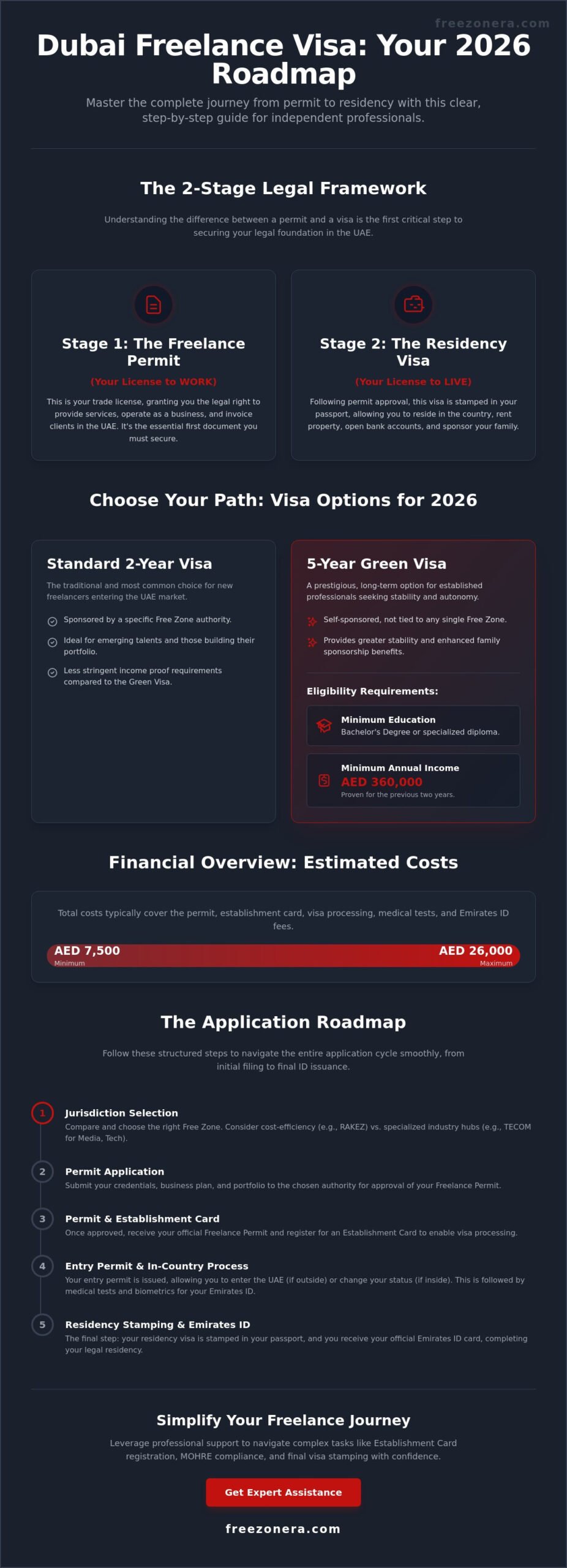
The process follows a methodical, two-stage sequence. Stage 1 is the acquisition of the Permit. You submit your portfolio, credentials, and business plan to the chosen jurisdiction for approval. Once the permit is issued, you move to Stage 2: Processing the entry permit and residency stamping. In 2026, regulations require tighter alignment between these stages. Authorities now conduct more frequent audits to ensure that the activity listed on your permit matches the services you actually provide to UAE clients. This alignment is a core component of the broader UAE Visa Policy, which aims to attract high-quality talent while maintaining strict regulatory standards.
Standard 2-Year Visa vs. 5-Year Green Visa
Choosing between the standard 2-year residency and the 5-year Green Visa depends on your financial trajectory. The standard 2-year visa is the traditional choice for those entering the market. It’s often sponsored by a specific free zone. The 5-year Green Visa, however, offers self-sponsorship, meaning you aren’t tied to a specific zone’s administrative umbrella. To qualify for the Green Visa in 2026, you must demonstrate a bachelor’s degree and a minimum annual income of AED 360,000 for the previous two years. This longer tenure provides greater stability and enhanced benefits for family sponsorship, making it the preferred choice for established consultants with a proven track record of success.
Eligibility and Requirements for Freelancers in 2026
The UAE has refined its entry criteria to attract high-value talent, making it essential to understand the specific benchmarks for 2026. While the doors are open to global professionals, the path you take depends heavily on your academic background and financial track record. If you’re researching how to get a freelance visa in Dubai, you’ll find that the 5-year Green Visa is the most prestigious option, but it comes with strict prerequisites. Specifically, you must hold a minimum of a Bachelor’s degree or a specialized diploma. This educational foundation is non-negotiable for the self-sponsored Green Visa category.
Financial transparency is equally critical. For the Green Visa, you must provide documented proof of an annual income from self-employment for the previous two years amounting to no less than AED 360,000 (approximately $98,000). If you’re a newcomer who hasn’t reached this threshold yet, alternative pathways exist. Many free zones offer 2-year residency packages that don’t require the same high-income proof, though they still require a valid freelance permit. These options are ideal for emerging talents in approved categories such as Media, Technology, Design, Education, and Consultancy. You can consult with our experts to determine which category best aligns with your portfolio.
MOHRE Classification and Skill Levels
The Ministry of Human Resources and Emiratisation (MOHRE) categorizes freelancers into specific skill levels. Skill Level 1 typically applies to managers and professionals with degrees, while Skill Level 2 covers technicians and specialized creative roles. Your classification isn’t just a label; it directly impacts your banking options. UAE banks often view Skill Level 1 applicants as lower-risk, which can simplify the process of opening a business or personal account. Ensuring your job title on the permit accurately reflects your expertise is a vital step in simplifying your business setup journey.
Document Checklist for 2026
Preparation is the key to a seamless application. For 2026, the document requirements have become more digitized but also more rigorous regarding verification. You’ll need:
- Attested Degree: Your certificate must be verified by the issuing country’s authorities and the UAE Ministry of Foreign Affairs (MOFA).
- Bank Statements: Authorities strictly require the last six months of personal or business bank history to verify your financial solvency.
- Professional Portfolio: Creative professionals in Media or Design must provide a curated portfolio or links to verified work to justify their permit request.
Once your documents are in order, you can track your application status via the official UAE government portal. This transparency ensures you stay informed during the transition from permit approval to residency stamping.
Step-by-Step: How to Get a Freelance Visa in Dubai
Securing your residency in the UAE requires a methodical approach that aligns your professional permit with immigration protocols. The process isn’t a single application but a sequence of approvals. Understanding how to get a freelance visa in Dubai starts with selecting your jurisdiction. You must choose between Dubai Mainland or one of the specialized free zones. While Mainland allows you to work directly with government entities, free zones often provide a more streamlined path for individual entrepreneurs. This flexibility is a major reason why many professionals are joining what Forbes on the freelance revolution in Dubai describes as a rapidly growing ecosystem.
Once you’ve selected your jurisdiction, you’ll apply for your Freelance Permit. This is your professional license. After this is issued, you’ll receive your Establishment Card and Entry Permit. If you’re already inside the UAE on a different visa, you’ll undergo a “Status Change” to move onto your new freelance residency without leaving the country. The final stage involves a medical fitness test and biometrics for your Emirates ID. If you need assistance navigating these technical filings, you can connect with our team for structured guidance.
Applying for the Establishment Card
The Establishment Card is the essential link between your business license and the immigration department. It’s a document that registers you as a licensed entity capable of sponsoring a residency visa. In 2026, processing times for this card typically range from two to four business days. The cost for an Establishment Card is approximately AED 2,000, though this can vary slightly depending on the specific free zone authority. You cannot proceed to the entry permit stage without this active registration.
Medical, Biometrics, and Stamping
The final physical steps are the medical test and biometrics. You’ll visit a government-approved health center for a blood test and chest X-ray. For those on a tight schedule, VIP processing centers can return results in as little as four hours, whereas standard processing takes approximately 24 to 48 hours. Following the medical, you’ll visit a Federal Authority for Identity and Citizenship (ICP) center for fingerprinting. In 2026, your residency is largely managed through the UAE Pass app. This digital identity platform allows you to access your digital residency and Emirates ID before the physical card arrives. If a medical test is flagged for health protocols, authorities may require a follow-up screening, so it’s vital to ensure you’re in good health before starting the application.
Comparing Jurisdictions: Dubai Free Zones vs. RAKEZ
Choosing the right jurisdiction is the most critical financial decision you’ll make when researching how to get a freelance visa in Dubai. For those in media, design, or education, the GoFreelance initiative by TECOM Group remains the gold standard. It provides access to high-profile communities like Dubai Media City and Dubai Knowledge Park, fostering a niche-specific environment. However, if your focus is on technical consultancy or general services, Dubai South offers a strategic location near Expo City and major logistics hubs. For those who need to work directly with government entities on the mainland, the Dubai Department of Economy and Tourism (DET) offers a “Sole Professional” license, though this often requires more administrative oversight.
While Dubai hubs offer prestige, many entrepreneurs overlook the northern emirates. Ras Al Khaimah Economic Zone (RAKEZ) has emerged as a powerhouse for cost-conscious freelancers. It’s not just about the initial setup; it’s about the long-term operational costs. Understanding these nuances is a key part of building a UAE Company Setup 2026 strategy that prioritizes profit over unnecessary overhead.
Cost Comparison and Hidden Fees
Total setup costs typically range from AED 7,500 to AED 26,000, depending on the emirate and visa duration. RAKEZ is often 30% to 40% cheaper for initial entry because its permit and establishment card fees are significantly lower than those in central Dubai. You must also account for the 5% VAT if your annual earnings exceed the mandatory registration threshold of AED 375,000. It’s vital to look beyond the base license price. A “cheap” permit can become expensive once you add mandatory health insurance, which starts around AED 1,100, and the required security deposits for your residency visa. We recommend calculating the “all-in” cost before committing to a specific zone.
Operational Flexibility
A common concern is whether a RAKEZ visa limits your ability to work for Dubai-based clients. It doesn’t. You can legally invoice any company in the UAE regardless of where your visa was issued. The primary difference lies in the physical infrastructure requirements. Most free zones offer “Flexi-desk” or virtual office arrangements that satisfy the legal requirement for a business address without the cost of a full office lease. This setup provides the professional appearance of a physical headquarters while maintaining the flexibility of a remote worker. If you’re struggling to decide which jurisdiction balances cost and credibility for your specific niche, contact our consultants for a detailed cost-benefit analysis.
Simplifying Your Freelance Journey with Freezonera
Establishing yourself as an independent professional in the UAE requires more than just following a checklist. It demands a strategic partner who understands the nuances of local regulations. At Freezonera, we adopt the role of a Sophisticated Navigator, guiding you through the intricate legal and financial landscapes of the Emirates. We don’t just provide a service; we offer a structured guidance system designed to alleviate the stress of administrative hurdles. If you’re looking for the most efficient path on how to get a freelance visa in Dubai, our expertise ensures that your application is both compliant and future-proof.
The administrative burden of securing an Establishment Card or navigating the Ministry of Human Resources and Emiratisation (MOHRE) requirements can be overwhelming for individual entrepreneurs. We manage these complexities on your behalf, ensuring that your professional permit and residency status are perfectly aligned. Beyond the initial setup, we provide essential support for opening corporate bank accounts, a step that many freelancers find challenging due to strict compliance checks. Our goal is to provide a complete ecosystem where your business can thrive from day one.
Expert Guidance on Compliance
One of the most common reasons for visa rejection is a mismatch between the applicant’s professional title and their actual business activities. In 2026, authorities are more vigilant than ever about activity-specific compliance. We help you select the precise job title that reflects your expertise while satisfying the requirements of your chosen jurisdiction. Avoiding these “DIY” mistakes is essential for a seamless transition to your new life in Dubai. To ensure your application is handled with precision, you can Reach Us for a Consultation and speak with an expert today.
Post-Visa Support
Our commitment to your success doesn’t end when your residency is stamped. We provide ongoing support for annual license renewals and visa maintenance, ensuring you never fall out of compliance with UAE laws. As your business grows, we help you evaluate long-term options, such as transitioning your freelance status into a Dubai Golden Visa strategy. This 10-year residency option is becoming increasingly accessible for high-earning professionals who have established a significant economic presence in the region.
The 2026 landscape for freelancers in Dubai is filled with opportunity for those who approach it with clarity and professional support. By choosing a partner that values precision and future-driven results, you’re not just getting a visa; you’re building a foundation for long-term success. Secure your future in Dubai today by letting us simplify the complexities of your business setup.
Building Your Independent Career in the UAE
Navigating the path to residency in the Emirates requires a precise alignment of your professional goals with the latest regulatory frameworks. You’ve learned that the journey involves a distinct two-stage architecture: securing a freelance permit and then processing your residency visa. Whether you choose the cost-efficiency of RAKEZ or the prestige of DMCC, your success depends on meeting the 2026 standards, such as the AED 360,000 income threshold for the 5-year Green Visa. Mastering the details of how to get a freelance visa in Dubai is simpler when you have a structured guidance system in place.
Freezonera provides deep expertise across mainland and free zone jurisdictions, ensuring your professional title matches your actual business activity. We offer comprehensive support for corporate bank account opening and operate as a fixed-fee consultancy to eliminate hidden administrative surprises. Simplify your Dubai Freelance Visa application with Freezonera and take the first step toward a future-driven career today. The 5% economic growth projected for 2026 makes this the ideal moment to establish your presence. We’re here to ensure your transition is seamless and legally secure.
Also see: Freelancers looking for a Fujairah-based licence should also consider Fujairah Creative City (FCC) — a digital-first free zone with freelance permits from AED 10,000/year and no employer NOC required.
Frequently Asked Questions
Can I sponsor my family on a Dubai freelance visa in 2026?
Yes, you can sponsor your spouse and children. Under 2026 regulations, Green Visa holders can sponsor sons up to 25 years old and unmarried daughters of any age. You’ll need to provide legalized marriage and birth certificates along with proof of adequate housing. Standard 2-year visa holders can also sponsor family members provided they meet the minimum monthly salary requirement of AED 4,000.
Do I need a physical office to maintain a freelance visa?
You don’t need to rent a traditional office space. Most jurisdictions allow you to use a “Flexi-desk” or “Smart Office” as your registered business address. This arrangement satisfies the legal requirement for a physical location while keeping your annual overhead costs significantly lower than a mainland lease. It’s an ideal solution for remote consultants and creative professionals.
What is the minimum income required for a 2-year freelance visa?
There is no mandatory minimum income threshold for the standard 2-year freelance permit. This makes it more accessible than the 5-year Green Visa, which strictly requires a verified annual income of AED 360,000. For the 2-year option, you only need to pay the licensing and residency fees to your chosen free zone authority. This remains the most common path for those learning how to get a freelance visa in Dubai as a new resident.
Can I work for multiple clients with one freelance permit?
Yes, you can legally provide services to multiple clients simultaneously. Your permit acts as a trade license that authorizes you to work with both free zone and mainland companies across the UAE. You don’t need a separate labor card or a local sponsor for each new contract you sign. This flexibility is the primary advantage of the freelance structure over traditional employment visas.
How long does the entire freelance visa process take in Dubai?
The entire sequence typically takes between 10 and 15 business days. This timeline includes approximately 3 days for permit approval, 5 days for the entry permit, and another 5 days for your medical fitness test and Emirates ID biometrics. If you’re already in the UAE, the “status change” process can be completed within 48 hours once your entry permit is issued.
Is a freelance visa better than setting up a Free Zone Company (FZE)?
It depends on your growth plans. A freelance permit is the most cost-effective solution for solo professionals who don’t plan to hire employees. If you intend to scale your business or require multiple visas for staff, a Free Zone Company (FZE) is the more appropriate legal structure. Freelancing is specifically designed for individual “Sole Professional” practitioners.
Can I open a corporate bank account with a freelance permit?
Yes, you can open a business bank account with your freelance credentials. Banks will require your valid permit, establishment card, and at least six months of personal bank statements to verify your financial history. While the process is more rigorous than opening a personal account, it’s a vital step for legal compliance and professional invoicing. We provide dedicated support to help you navigate these banking requirements.
What happens if I want to cancel my freelance visa?
You must initiate the cancellation through your issuing free zone authority or the ICP. The process involves paying a cancellation fee and ensuring all outstanding invoices or government dues are settled. In 2026, the UAE offers a generous grace period of up to 180 days after cancellation. This gives you ample time to either secure a new residency status or finalize your affairs before exiting the country.
Related: Visa cost guide