

What if the lowest advertised license price in the Emirates actually ends up costing you 35% more by the time you secure a corporate bank account? It’s a frustrating reality for many entrepreneurs who realize too late that a “budget” setup often excludes mandatory establishment cards or visa processing fees. You probably already feel that comparing 40 different free zone jurisdictions is an overwhelming task, especially when price lists seem to change every fiscal quarter. We understand that uncertainty around the total uae free zone company setup cost can stall your global expansion plans before they even begin.
At FreezonEra, we’re dedicated to simplifying these complex financial structures. This 2026 budgeting guide delivers a transparent breakdown of every fee, hidden cost, and regional price difference to ensure your financial planning is flawless. You’ll gain a predictable roadmap for your Year 1 and Year 2 expenses, alongside specific insights into share capital requirements and banking compliance. We’re moving beyond vague estimates to provide the structured guidance you need to identify the most cost-effective jurisdiction for your specific business activity.
Key Takeaways
- Distinguish between one-time registration fees and recurring annual licenses to build a reliable and transparent financial roadmap.
- Analyze the uae free zone company setup cost across different jurisdictions to choose between global prestige and budget-friendly efficiency.
- Identify mandatory “hidden” gatekeeper fees, such as Establishment Cards and E-Channel registration, to avoid unexpected budget gaps.
- Factor in essential 2026 compliance costs, including Corporate Tax registration and professional bookkeeping requirements, for long-term stability.
- Learn how to secure significant savings on your setup investment by leveraging multi-year deals and strategic seasonal timing.
Decoding the Core Components of UAE Free Zone Setup Costs
Establishing a business in 2026 requires a clear-eyed look at the financial landscape of the Emirates. Many entrepreneurs see “starting from” advertisements and assume that reflects the final bill. It rarely does. The total uae free zone company setup cost depends on your specific operational needs and the jurisdiction you choose. You’ll encounter two main types of fees: one-time registration costs and recurring annual license fees. Registration covers name reservation and legal drafting. The license fee keeps your business compliant every year.
Your legal structure also dictates your budget. A Free Zone Establishment (FZE) involves a single shareholder. A Free Zone Company (FZCO) accommodates multiple partners. To navigate the specific legal requirements for these structures, you can explore Free Zone Company Formation with Fast Zone Business, which provides expert guidance on MOA drafting and share capital declaration. While the registration fee difference is often minimal, the administrative requirements for drafting a Memorandum of Association for an FZCO can add to the initial tally. Share capital is another variable. Some zones require a minimum deposit of 50,000 AED or 100,000 AED in a local bank. Others allow an “on-paper” declaration, simplifying the entry for lean startups.
Primary Fee Categories for 2026
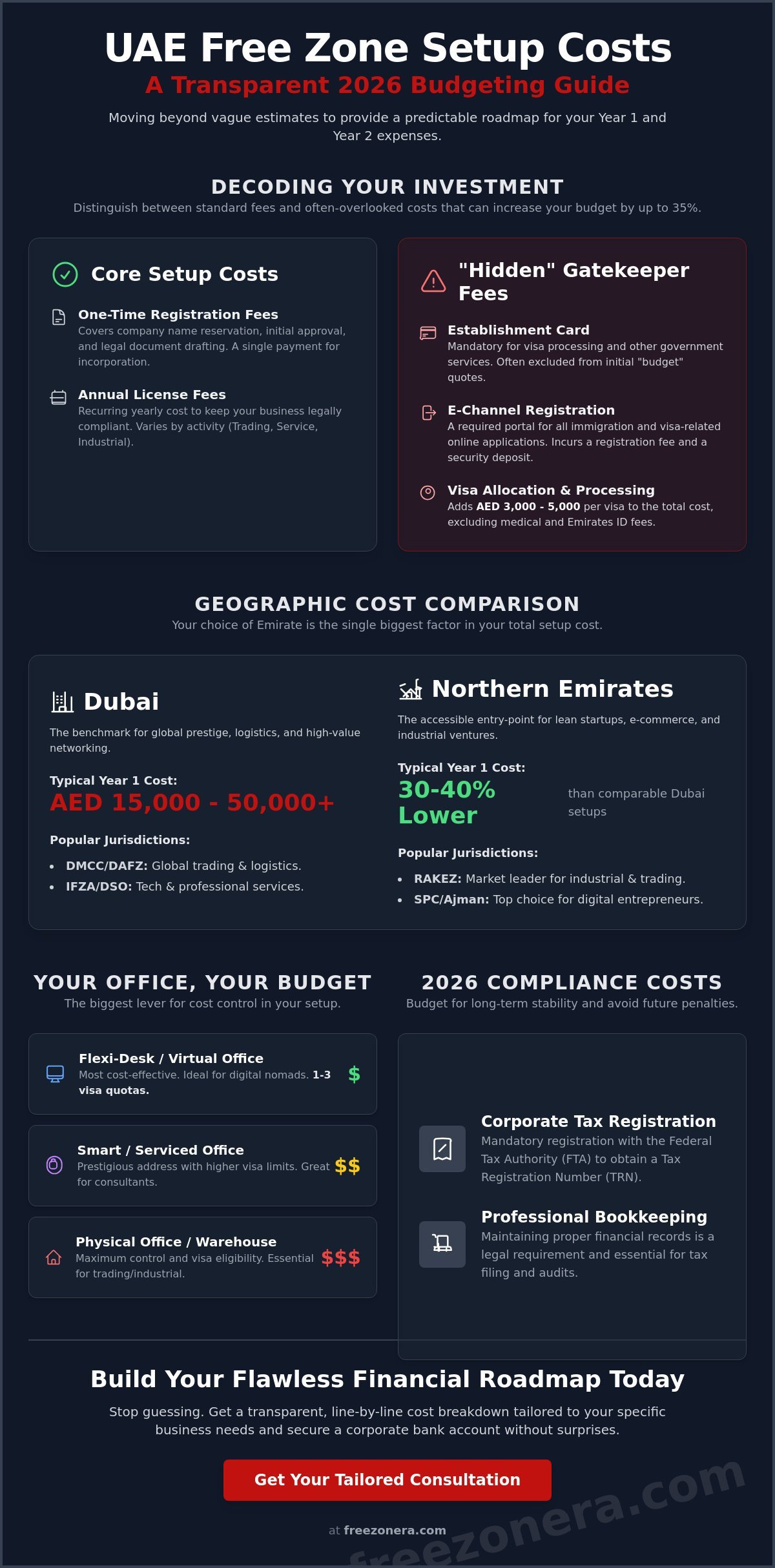
Registration fees are your entry ticket. In 2026, these are strictly one-time payments for the initial incorporation process. License fees are recurring. They vary based on whether you’re in Trading, Service, or Industrial sectors. For a deeper look at long-term planning, consult our UAE Company Setup 2026 guide. Most budget packages exclude visa eligibility. If you need residency for yourself or employees, expect the uae free zone company setup cost to rise by 3,000 AED to 5,000 AED per person for the visa allocation alone.
Facility and Office Requirements
Your office choice is the biggest lever for cost control. Digital nomads often opt for virtual office solutions or flexi-desks. These are the most cost-effective entry points. They usually limit you to 1 to 3 visa quotas. If you require a physical office, your costs will jump. Premium jurisdictions like DMCC offer smart office packages that provide a prestigious address and higher visa limits. Conversely, the List of UAE Free Zones shows that Northern Emirates jurisdictions like Sharjah or Ras Al Khaimah offer more competitive rates for physical space. Choosing the right zone ensures you don’t overpay for facilities you don’t use.
Our team at FreezonEra specializes in simplifying these complex financial layers. We provide clarity and compliance, ensuring your 2026 launch is both strategic and cost-effective. If you’re ready to map out your specific budget, you can reach us for a tailored consultation.
Geographic Cost Comparison: Dubai vs. Northern Emirates
Your choice of location is the single biggest variable in your uae free zone company setup cost. Dubai remains the global benchmark for prestige and logistics, yet Northern Emirates jurisdictions provide a more accessible entry point for lean startups. Success depends on balancing these upfront fees with your daily operational needs and long-term growth targets.
Dubai Free Zone Pricing Tiers
Dubai-based licenses generally fall between AED 15,000 and AED 50,000 for the first year. Premium hubs like DMCC and DAFZ charge higher rates because they offer proximity to major transport links and high-value networking opportunities. Specialized zones like Dubai Internet City or Media City have higher overheads to maintain their niche ecosystems and industry-specific infrastructure. Before committing to a location, view the FZE 2026 guide to understand how specific entity types affect these figures.
- DMCC/DAFZ: Best for global commodities trading and aviation logistics.
- IFZA/DSO: Popular for professional services and tech consultants seeking a Dubai address at a competitive rate.
- Sector-Specific: Higher costs but provides access to specialized talent pools and dedicated facilities.
RAKEZ and Northern Emirate Value Propositions
Ras Al Khaimah Economic Zone (RAKEZ) is a market leader for industrial ventures, frequently costing 30% to 40% less than Dubai for similar trading activities. For digital entrepreneurs and e-commerce brands, Sharjah Publishing City (SPC) and Ajman Free Zone are top choices due to their 24-hour license issuance and simplified administrative processes. The primary trade-off is distance; being further from Dubai’s central business districts can increase travel time for face-to-face meetings and banking appointments.
Sharjah Research Technology and Innovation Park (SRTIP) acts as a strategic bridge. It offers a mid-tier price point with a focus on tech and R&D, making it ideal for startups that need a modern image without the full Dubai price tag. It’s a sophisticated alternative for those who want to stay close to the Dubai border while optimizing their budget.
Logistics and Hidden Costs
Location affects more than just the license fee. If your business handles physical goods, a cheaper license in a remote emirate might lead to higher shipping and fuel costs. Calculating the total uae free zone company setup cost requires looking at the full supply chain. If your business relies on frequent shipping through Jebel Ali Port, the transport fees from a distant northern warehouse might eventually offset your initial licensing savings. We recommend mapping your primary client base and supplier locations before finalising your jurisdiction.
If you’re unsure which jurisdiction fits your 2026 growth strategy, you can connect with our team to get a precise, itemized comparison of these jurisdictions.
The ‘Hidden’ Costs: Visas, Establishment Cards, and E-Channel
Calculating your total uae free zone company setup cost requires looking beyond the initial license fee. Many entrepreneurs focus on the headline price, only to find their budget stretched by mandatory administrative gatekeepers. These secondary costs are essential for operational compliance and residency rights. We prioritize clarity and compliance to ensure you aren’t surprised by these line items mid-process.
The Establishment Card, often called the Company Computer Card, is your first hurdle. This document registers your business with the Federal Authority for Identity, Citizenship, Customs & Port Security (ICP). It acts as the mandatory gatekeeper to the visa system. Without it, you cannot hire staff or secure your own residency. In most jurisdictions, this card costs between AED 4,500 and AED 5,000 for the initial issuance.
E-Channel registration is another recurring expense that frequently catches startups off guard. This digital system streamlines immigration applications. Most free zones in the Northern Emirates require a one-time registration fee of approximately AED 2,200. This is followed by an annual renewal fee of roughly AED 1,100. Skipping these details in your initial forecast can lead to unexpected cash flow gaps during your first year of operations.
Visa and Residency Related Expenses
Residency costs vary based on your role. Investor visas typically involve higher upfront fees but offer longer-term stability without the need for a labor contract. Employee visas require additional deposits and Ministry of Human Resources and Emiratisation (MOHRE) approvals in specific jurisdictions. You must also budget for the status change fee if you are already inside the country, which usually costs around AED 750. For a granular breakdown of these steps, check the Ultimate Setup Checklist for visa step-by-step costs.
Medical fitness tests and Emirates ID biometrics are the final physical hurdles. Government service centers charge roughly AED 300 for a standard medical screening. Emirates ID fees depend on the visa duration, generally ranging from AED 370 to AED 500. Health insurance is also mandatory. Basic Essential Benefits Plans (EBP) in Dubai start at approximately AED 600, while comprehensive coverage for senior partners will increase this figure. We offer structured guidance to help you select plans that balance cost with adequate protection.
Administrative and Legal Overhead
Legal documentation requires absolute precision. Your Memorandum of Association (MOA) must be translated into Arabic by a certified legal translator to be recognized by UAE authorities. If you’re establishing a branch of a foreign company, your corporate documents need attestation from the UAE Embassy in the country of origin and the local Ministry of Foreign Affairs (MOFA). These attestation fees often exceed AED 2,000 per document. Small costs like courier fees for physical document handling and typing center service charges also add up. Our approach focuses on simplifying these complex processes, ensuring your uae free zone company setup cost remains transparent and your growth is future-driven.
Operational and Compliance Costs in the 2026 Tax Landscape
The 2026 financial environment in the UAE is no longer just about the initial license fee. It’s about maintaining a tax-ready status. Since the Ministry of Finance implemented the 9% Corporate Tax in June 2023, every entity must register. Missing the registration deadline carries a fixed penalty of AED 10,000. While many free zone companies still qualify for a 0% rate on qualifying income, the cost of proving this eligibility through professional tax filings is now a standard part of the uae free zone company setup cost.
VAT registration remains mandatory once your taxable turnover exceeds AED 375,000. You’ll need disciplined bookkeeping to handle quarterly filings. Professional accounting services typically range from AED 1,500 to AED 5,000 monthly, depending on your transaction volume. This investment prevents heavy fines from the Federal Tax Authority (FTA) for clerical errors or late submissions.
Mandatory Compliance Filings
Maintaining a ‘Zero Tax’ status isn’t free. Many jurisdictions, including DMCC and ADGM, require annual audited financial statements to renew your license. Audit fees vary based on firm size and complexity. Beyond taxes, Anti-Money Laundering (AML) and Counter-Terrorism Financing (CFT) registrations are vital. If you operate in high-risk sectors like real estate or precious metals, expect to pay for specialized compliance software or consultant fees to manage GoAML filings. You must also maintain an updated Ultimate Beneficial Owner (UBO) declaration. Failure to update UBO data can lead to immediate license suspension and administrative fines.
Banking and Financial Setup
Banking is often the most significant hurdle for new entrepreneurs. Initial deposit requirements have become more stringent. You might need to maintain an average monthly balance ranging from AED 10,000 for basic accounts to AED 500,000 for premium corporate tiers. Some banks also charge monthly maintenance fees if these balances aren’t met.
Choosing a ‘cheap’ free zone can backfire during the banking phase. Banks scrutinize the reputation of the jurisdiction. If a zone lacks strict regulatory oversight, banks may view your company as high risk. This leads to longer onboarding times or outright rejection. A slightly higher uae free zone company setup cost in a reputable zone often saves thousands in lost time and banking hurdles. Explore Business Setup UAE 2026 for banking insights and jurisdictional comparisons.
Don’t let compliance surprises disrupt your growth. Our team provides clarity on every mandatory filing and fee. Consult our compliance experts to secure your corporate future.
Strategic Budgeting: How to Minimize Your Setup Investment
Strategic budgeting isn’t just about finding the lowest entry price. It’s about maximizing the value of every dirham spent on your uae free zone company setup cost. Savvy investors often opt for multi-year license deals. By paying for three years upfront, you can reduce your annual licensing fees by up to 30%. This locks in current rates and protects your business against potential price hikes in 2027 or 2028.
Timing also plays a critical role in cost reduction. UAE free zones frequently launch aggressive promotional campaigns during Ramadan or at the end of the calendar year. These offers often include waived registration fees or significant discounts on “Flexi-desk” rentals. If your launch timeline allows, waiting for these specific windows can save you thousands of dirhams in initial capital.
For solo founders, the ‘Freelancer to Entrepreneur’ path offers a low-risk entry. Starting with a freelance permit allows you to validate your business model with minimal overhead. Once your revenue stabilizes, you can transition to a full corporate structure. This staged approach prevents over-investment during the fragile early months of operation.
While it seems counterintuitive, hiring a professional consultant often lowers your total spend. Errors in documentation lead to re-submission fees, which can range from AED 500 to AED 2,500 depending on the jurisdiction. Experts ensure your application is right the first time, avoiding these avoidable penalties and accelerating your time to market.
Optimization Strategies
One common mistake is overestimating your visa requirements. Each visa allocation carries a cost for the quota, the application, and the mandatory medical insurance. Don’t pay for a five-visa quota if you only plan to hire two people in your first year. You can always increase your quota as you scale. Be cautious with “All-Inclusive” packages. While they simplify the initial payment, they sometimes hide high renewal costs or mandatory service fees that kick in during Year 2. Always ask for a breakdown of recurring costs before signing.
Total Cost of Ownership for a UAE startup is the cumulative sum of initial formation fees, annual license renewals, mandatory compliance audits, and office maintenance costs calculated over a three-year period.
Next Steps with Freezonera
Freezonera provides the fixed-fee transparency you need to eliminate budget surprises. We don’t believe in hidden admin charges or unexpected processing fees. Our 2026 price comparison tool allows you to view real-time costs across RAKEZ, SPC, and various Dubai zones side-by-side. We simplify the decision-making process by providing data-driven insights tailored to your specific industry and growth projections.
Launch Your Future-Driven Business Today
Mastering the uae free zone company setup cost for 2026 involves balancing initial license fees with long-term operational requirements. You’ve learned that choosing between Dubai’s premium positioning and the Northern Emirates’ cost-efficiency is just the first step. Navigating the 9% corporate tax framework established by the Ministry of Finance is now a mandatory part of every entrepreneur’s financial roadmap. By accounting for establishment cards and visa processing early, you’ll avoid the common pitfalls that stall new ventures. It’s about building a foundation that’s both compliant and scalable from day one.
FreezonEra acts as your sophisticated navigator in this evolving landscape. We provide structured guidance across 40+ UAE jurisdictions, ensuring you never face unexpected administrative hurdles. Our fixed-fee guarantee provides the financial predictability your startup needs to thrive. We specialize in 2026 corporate tax compliance, turning complex legal mandates into clear growth strategies. Don’t let the administrative landscape overwhelm your vision; let’s streamline your path to success together.
Request a Transparent 2026 Setup Quote
The UAE market is waiting for your next big idea. We’re here to ensure your transition into this global hub is seamless and rewarding.
Frequently Asked Questions
What is the cheapest free zone in the UAE for 2026?
SHAMS (Sharjah Media City) and RAKEZ (Ras Al Khaimah Economic Zone) remain the most cost-effective hubs entering 2026. These jurisdictions offer basic professional licenses for approximately AED 5,750 to AED 12,000 depending on the current promotion. Entrepreneurs choose these zones because they provide a fast track to market entry without requiring physical office space. This budget-friendly approach ensures your initial uae free zone company setup cost remains manageable while securing a valid trade license.
Are there any hidden fees after I pay for my trade license?
You’ll encounter additional costs beyond the base license fee, specifically for the Establishment Card and E-channel registration. Expect to pay between AED 2,000 and AED 5,000 for these mandatory administrative filings. Other often overlooked expenses include the VAT registration fee if your revenue exceeds AED 375,000 and mandatory medical insurance for employees. These regulatory requirements are essential for maintaining your company’s legal standing and operational compliance within the UAE.
How much does a UAE residence visa cost for a business owner?
A business owner’s residence visa typically costs between AED 3,500 and AED 7,000 for a two-year or three-year term. This figure includes the entry permit, status change, medical fitness test, and Emirates ID processing. Costs vary by jurisdiction, with Northern Emirates free zones often pricing these services lower than Dubai-based entities. Planning for these fees early helps you manage your overall uae free zone company setup cost without facing unexpected financial hurdles during the residency application process.
Do I need to show a minimum bank balance to set up a free zone company?
Most UAE free zones don’t require you to show a minimum bank balance or paid-up capital to register your company. This policy changed for most jurisdictions after the 2015 updates to the Commercial Companies Law. However, local banks often require a minimum monthly average balance ranging from AED 25,000 to AED 50,000 to keep a corporate account active. While setup is accessible, you must prepare for these banking liquidity requirements to ensure smooth financial operations.
What are the recurring annual costs to keep my UAE company active?
Your primary annual costs include the trade license renewal fee and the lease or flexi-desk rental agreement. These fees generally mirror 80% to 100% of your initial setup costs, depending on the jurisdiction’s current rates. You also need to budget for annual audit reports and Economic Substance Regulation (ESR) filings if your business activity falls under specific categories. Maintaining these payments is vital for keeping your company active and avoiding late renewal penalties.
Can I set up a UAE company without visiting the country?
You can set up your UAE company without visiting the country by utilizing digital portals and remote notarization services. Most free zones now accept scanned documents and electronic signatures for the initial incorporation phase. You’ll only need to travel to the UAE for the mandatory medical test and biometrics required for your residency visa. This digital-first approach simplifies the process for international investors looking to establish a presence in the Middle East quickly.
How much should I budget for corporate tax compliance in my first year?
Budget between AED 5,000 and AED 15,000 for professional accounting and tax compliance services in your first year. Since June 2023, the UAE applies a 9% corporate tax on net profits exceeding AED 375,000. Even if your profit is below this threshold, you must register for tax and file an annual return. Hiring a qualified consultant ensures you meet all Federal Tax Authority requirements and avoid the steep fines associated with non-compliance.
What is the difference in cost between a virtual office and a physical office?
A virtual office or flexi-desk costs roughly AED 10,000 to AED 15,000 less per year than a physical office space. Virtual options are ideal for startups that don’t need a permanent physical presence but require a legal address for licensing. However, a physical office is mandatory if you plan to sponsor more than three employees or require specific operational permits. Choosing the right workspace impacts your visa quota and long-term scalability within the free zone.