

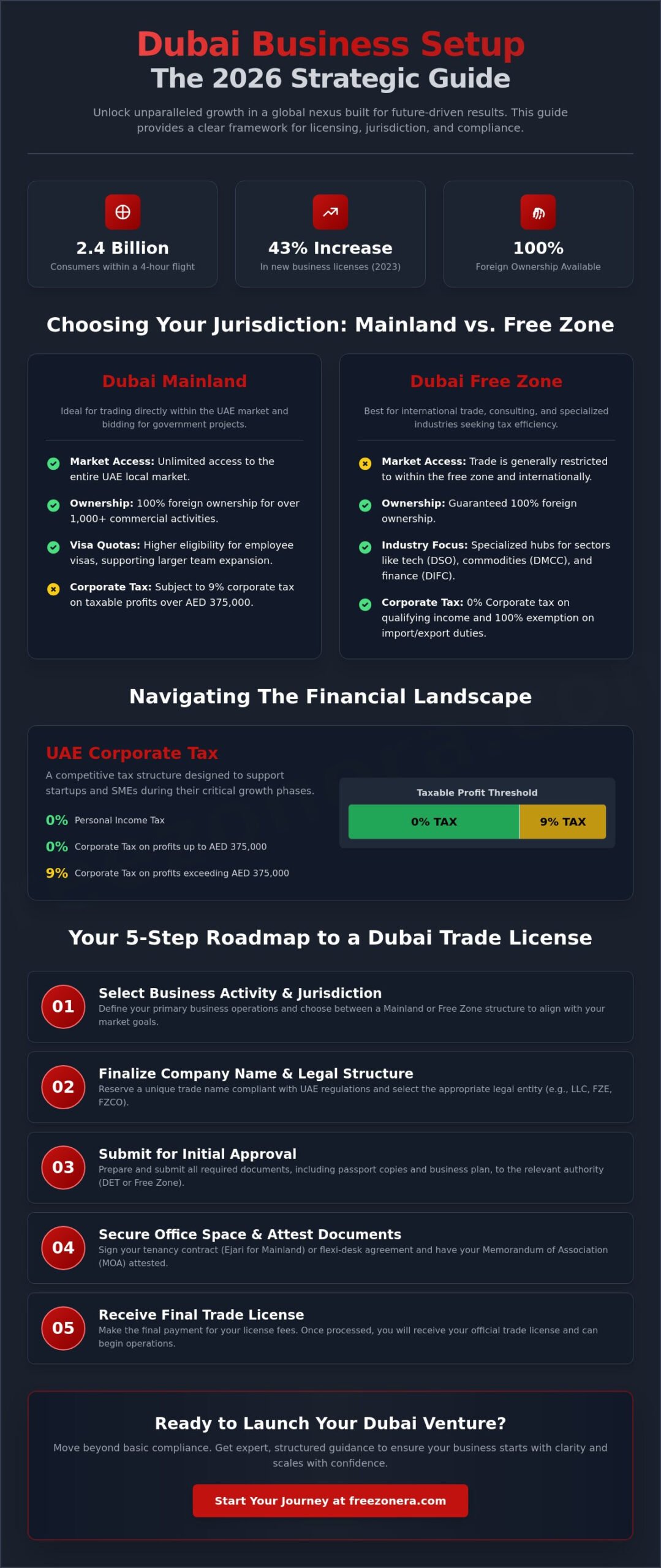
What if your next corporate headquarters provided direct access to 2.4 billion consumers within a four-hour flight? In 2023, the Dubai Department of Economy and Tourism reported a 43% increase in new business licenses, totaling 76,325 registrations. The decision to open business in dubai places your company in an ecosystem built for high-level growth and future-driven results.
It’s common to feel a sense of hesitation when faced with the choice between Mainland and Free Zone jurisdictions or the intricacies of UAE banking compliance. You want the benefits of 100% foreign ownership and a residency visa for your family, but you don’t want to get lost in a sea of hidden government fees. This roadmap simplifies the entire setup process by providing a clear, professional framework for your expansion. We’ll walk through the essential 2026 updates for licensing, jurisdiction selection, and strategic asset management to ensure your venture starts with clarity and compliance.
Key Takeaways
- Understand how the D33 Economic Agenda transforms Dubai into a premier global nexus for future-driven innovation and wealth creation.
- Learn to navigate the critical differences between Mainland and Free Zone structures to align your legal setup with your specific market goals.
- Gain clarity on the evolving regulatory landscape, including the 9% Corporate Tax thresholds and how to manage the true cost of entry.
- Master the essential 5-step roadmap to open business in dubai, from selecting your official activity to securing your final trade license.
- Discover how to move beyond basic compliance by integrating digital marketing strategies that ensure immediate ROI and long-term scaling.
Why Open a Business in Dubai in 2026? The D33 Vision
Dubai is no longer just a regional hub; it’s a global nexus for wealth and innovation. The D33 Economic Agenda, launched in January 2023, serves as the primary roadmap for this transformation. This ambitious plan aims to double the size of the Economy of Dubai by 2033 through 100 transformative projects. For entrepreneurs planning to open business in dubai, 2026 represents a pivotal moment in this ten-year growth cycle. You’re entering a market that’s actively integrating “Smart Manufacturing” and digital-first initiatives into its core DNA to stay ahead of global trends.
The financial incentives remain a cornerstone of the city’s appeal. You’ll benefit from 0% personal income tax, which is a significant draw for high-net-worth individuals and top-tier global talent. While a 9% corporate tax was introduced in June 2023, it only applies to taxable profits exceeding AED 375,000. This structure ensures that startups and small businesses maintain high liquidity during their critical early stages. FreezonEra focuses on simplifying these complex fiscal landscapes, providing the clarity and compliance you need to scale with confidence.
The 100% Foreign Ownership Revolution
A landmark 2021 legal amendment to the Commercial Companies Law fundamentally changed the Mainland business landscape. By removing the requirement for a local Emirati partner to hold a 51% stake, the UAE opened the door for full foreign control. You can now exercise 100% ownership across more than 1,000 commercial and industrial activities. This shift makes it the ideal time to open business in dubai as a solo founder or international entity. This regulatory change has dramatically improved the “Ease of Doing Business” index, making the process of starting a company more transparent and efficient for everyone.
Strategic Geographic and Infrastructure Advantages
Dubai’s location offers a bridge between the East and West. You gain immediate access to billions of consumers across the MENA region, Asia, and Europe. The logistics infrastructure is world-class and built for speed. Jebel Ali Port handles over 14 million containers annually, while Al Maktoum International Airport is being developed to eventually handle 260 million passengers. These aren’t just transport hubs; they’re future-driven ecosystems that allow for rapid scalability. If you want a partner to help you master these jurisdictions, you can reach us for structured guidance and expert assistance.
Choosing Your Legal Structure: Mainland vs. Free Zone vs. Offshore
To successfully open business in dubai, your first strategic decision involves selecting a legal jurisdiction. This choice dictates your market reach, visa eligibility, and long-term scalability. You must align your structure with your operational intent. Are you targeting the UAE’s domestic consumers or looking for a tax-efficient base for global trade? Selecting the right jurisdiction ensures compliance and prevents costly restructuring later. It’s about matching your specific activity to the legal framework that supports it best.
Dubai Mainland: Unlimited Local Market Access
Dubai Mainland companies are regulated by the Department of Economy and Tourism (DET). This structure allows you to trade anywhere in the UAE and bid for lucrative government contracts. Since the 2021 amendment to the Commercial Companies Law, 100% foreign ownership is available for over 1,000 commercial and industrial activities. While a physical office is standard, the “Virtual License” remains a viable entry point for startups. The World Bank’s Doing Business report highlights the UAE’s high ranking in ease of starting a business, largely due to these streamlined mainland processes. Mainland setups also offer the highest visa quotas, which is essential for businesses planning rapid workforce expansion.
Dubai Free Zones: Tax Havens for Specialized Hubs
Free zones function as specialized economic hubs tailored to specific industries. They offer 100% import and export tax exemptions and 0% corporate tax for qualifying income. Choosing between hubs like DMCC for commodities or DIFC for finance depends on your industry niche. When deciding, you’ll need to evaluate FZE vs FZCO structures to determine shareholder requirements. This is a core part of a robust UAE Company Setup 2026 plan. These zones provide world-class infrastructure but restrict your ability to trade directly in the local UAE market without a local distributor or agent.
Offshore Entities: Asset Protection and Privacy
Offshore entities serve as asset protection vehicles rather than operational businesses. They’re ideal for holding companies, managing international investments, or owning property. You can’t trade within the UAE borders with an offshore license. However, they offer high levels of privacy and a structured path for international bank account integration. The process is often faster than other structures, focusing on legal compliance for global wealth management. If you’re unsure which path fits your 2026 goals, you can connect with a specialist to map out your roadmap.
- Mainland: Best for local retail, construction, and government projects.
- Free Zone: Best for tech, media, logistics, and international services.
- Offshore: Best for holding assets and international tax planning.
Navigating the Cost of Entry and Regulatory Compliance
Dubai’s commercial landscape has matured into a sophisticated global hub. While the city remains a magnet for capital, the financial entry requirements involve more than just a basic license fee. To open business in dubai successfully in 2026, you’ve got to account for a regulatory framework that prioritizes transparency through rigorous Know Your Customer (KYC) and Anti-Money Laundering (AML) protocols.
The 9% Corporate Tax, which became effective on June 1, 2023, applies to taxable profits exceeding AED 375,000. Small businesses and startups falling below this threshold benefit from a 0% rate, but registration with the Federal Tax Authority (FTA) is mandatory for everyone. Skipping this step leads to administrative penalties that start at AED 10,000. It’s a critical detail that many first-time founders overlook during the initial excitement of formation.
Utilizing a fixed-fee service model is the most reliable way to prevent budget overruns. Entrepreneurs often face “sticker shock” when initial quotes exclude mandatory items like Dubai Chamber of Commerce membership or the Knowledge and Innovation fees. A transparent, upfront cost structure ensures your capital is preserved for actual growth rather than swallowed by administrative surprises.
Licensing Fees and Government Levies
The Department of Economy and Tourism (DET) sets specific rates for mainland setups. A trade name reservation typically costs AED 620, while initial approval sits at approximately AED 120. However, the final license price fluctuates based on your chosen activity. A general trading license carries higher fees than a specialized consultancy permit because of the broader operational scope. Annual renewals require updated lease agreements (Ejari) and valid insurance. Missing these deadlines results in monthly fines, and a delay of over six months can lead to license suspension.
The Compliance Challenge: KYC and Corporate Banking
Securing a corporate bank account is the most significant hurdle for new owners in the current climate. UAE banks have intensified their scrutiny to meet international FATF standards. You’re required to provide a clear Ultimate Beneficial Owner (UBO) declaration, identifying every individual who holds 25% or more of the company shares. If you’re struggling to organize your documentation for these rigorous banking standards, you can reach us for structured guidance. Providing a comprehensive business plan and verified proof of source of wealth is now a non-negotiable requirement to open business in dubai and maintain active banking channels.
The 5-Step Roadmap to Your Dubai Trade License
Establishing a corporate presence in the UAE requires a methodical approach to satisfy both federal laws and local municipality requirements. When you open business in dubai, you aren’t just filing paperwork; you’re building a legal foundation designed for scalability. This roadmap simplifies the transition from concept to operational entity through five distinct phases.
Step 1-2: Activity Selection and Name Reservation
The Department of Economy and Tourism (DET) and various Free Zone authorities maintain a catalog of over 2,000 permitted business activities. You must align your license with your actual operations to avoid compliance penalties. Once your activity is defined, you’ll submit three name options for approval. UAE naming conventions are strict. You cannot use religious references, political affiliations, or names of existing global brands. Most name reservations are processed within 24 to 48 hours. Following this, you receive an Initial Approval certificate. This document is valid for six months and signals that the UAE government has no objection to your business presence. It allows you to proceed with legal drafting and site selection.
Step 3-4: Documentation and Office Space
Legal documentation transforms your vision into a recognized entity. You’ll draft a Memorandum of Association (MOA) for Mainland companies or Articles of Incorporation for Free Zones. If your shareholders are foreign corporations, your documents require attestation by the UAE Embassy in the country of origin and the Ministry of Foreign Affairs (MOFA) in Dubai. Precision here prevents delays in bank account opening later. Simultaneously, you must secure a physical or virtual address. Free Zones often provide “Flexi-desks” which are cost-effective for startups. Mainland businesses typically require a physical lease agreement (Ejari) for a minimum of 200 square feet. After submitting your lease and signed MOA to the authorities, your trade license is usually issued within 3 to 5 business days.
Step 5: Residency Visas and Emirates ID
The final phase involves securing your legal status as a resident. Your trade license grants you the right to apply for investor visas. This process includes a medical fitness test (blood test and chest X-ray) at a government center and a biometrics appointment for your Emirates ID. For high-net-worth individuals or specialized talents, the Dubai Golden Visa offers a 10-year residency option that provides long-term stability. Once your investor visa is stamped in your passport, you can sponsor your family and domestic staff. This structured path ensures that when you open business in dubai, your professional and personal lives are fully integrated into the city’s ecosystem.
Ready to start your application with expert precision? Contact our consultants today to begin your Dubai setup.
Beyond the License: Scaling Your Presence with Freezonera
Securing a trade license is a significant milestone, yet it’s only the first step in your journey. Many entrepreneurs realize that the physical document is simply an entry ticket into a high-velocity market. To successfully open business in dubai and maintain a competitive edge, you must transition from administrative setup to active market scaling immediately. Freezonera serves as your sophisticated navigator, ensuring your operational foundation supports rapid expansion rather than creating bottlenecks. We specialize in simplifying complex processes, allowing you to focus on high-level strategy while we manage the technicalities of growth.
Digital Marketing and Local SEO Strategy
Your digital footprint determines your ROI in the first 12 months. Local search visibility is paramount, starting with the acquisition of a .ae domain. This extension signals local relevance to search engines and builds immediate trust with UAE consumers. Recent 2024 data shows that the UAE has a 99% internet penetration rate, meaning your customers are searching for you online before they ever visit a physical office. Freezonera helps you integrate these digital essentials during your launch phase. Our approach includes:
- Localized Lead Generation: We help design campaigns tailored to the specific demographics of the 3.6 million residents in Dubai.
- Social Media Trust: With over 9 million active social media users in the country, managing your presence on platforms like LinkedIn and Instagram is vital for brand authority.
- Search Authority: Implementing local SEO tactics ensures you appear in “near me” searches, which drive 45% of local business clicks.
Strategic Consultancy and Future-Driven Results
Scaling requires more than just visibility; it demands rigorous compliance and foresight. Freezonera provides the structured guidance needed to navigate the complexities of international trade and regional logistics. We handle the heavy lifting of administrative renewals and regulatory updates, preventing the common 5% to 10% late-filing penalties that often hinder unguided startups. Our consultancy doesn’t stop at the border. We help you leverage Dubai’s status as a global hub to scale into new jurisdictions with clarity and confidence.
Success in the UAE isn’t a solo endeavor. It’s the result of a partnership that values precision and future-driven results. By aligning with experts who understand the nuances of the local financial and legal landscape, you turn a standard business setup into a long-term commercial legacy. Reach out to Freezonera for a structured guidance session to begin your transformation from a new entity to a market leader.
Build Your Future in the World’s Most Dynamic Economy
Dubai’s D33 Economic Agenda isn’t just a policy; it’s a roadmap to double the city’s economy by 2033. For entrepreneurs, this means unprecedented access to global markets and a regulatory environment designed for rapid scaling. Success depends on selecting the right jurisdiction among more than 40 UAE free zones and ensuring your legal structure aligns with your long-term goals. When you choose to open business in dubai, you aren’t just launching a company; you’re entering a future-driven ecosystem built for innovation.
Freezonera provides the clarity and compliance you need to navigate this journey. Our team offers expertise across 40+ UAE Free Zones and provides fixed-fee licensing to ensure there are no hidden costs. We go beyond the trade license by offering comprehensive digital marketing and SEO support to help your brand dominate the digital landscape from day one. You don’t have to manage the complexities of UAE bureaucracy alone.
Simplify your UAE business setup with Freezonera today. Your vision deserves a partner that values precision and results. We’re ready to help you turn your entrepreneurial ideas into a thriving Dubai reality.
Frequently Asked Questions
How much does it cost to open a business in Dubai as a foreigner?
Starting a company typically requires an initial investment between AED 12,500 and AED 35,000 depending on your chosen jurisdiction. This figure covers the trade license and initial registration fees but excludes office rent or visa costs. Free zone packages often provide the most cost-effective entry point for solo entrepreneurs. You’ll need to budget for additional mandatory expenses like the UAE’s Knowledge and Innovation fees.
Can I own 100% of my company in Dubai Mainland?
You can maintain 100% foreign ownership of your mainland company across more than 1,000 commercial and industrial activities. This legal shift, implemented via Federal Decree Law No. 26 of 2020, eliminated the previous requirement for a local Emirati partner to hold 51% of shares. It’s a strategic move that simplifies the process to open business in dubai for international investors. Certain strategic sectors like oil and gas still require local participation.
What is the difference between a Free Zone and a Mainland license?
A mainland license allows you to trade directly with the local UAE market and take on government contracts without restrictions. Free zone licenses restrict your physical operations to the specific zone’s boundaries but offer 100% import and export tax exemptions. Choosing between them depends on your target audience. Mainland entities provide more flexibility for retail and construction, while free zones suit international consulting and logistics.
Do I need a physical office to get a business license in Dubai?
You don’t always need a traditional physical office because many free zones offer flexi-desk or smart office solutions. These virtual arrangements satisfy the legal requirement for a registered business address at a lower cost. However, mainland licenses typically require a physical lease agreement, known as an Ejari, of at least 200 square feet. This requirement ensures compliance with the Department of Economy and Tourism regulations for operational businesses.
How long does the business setup process take in 2026?
The timeline for business setup ranges from 24 hours to 15 working days. Digital platforms like Invest in Dubai allow for instant license issuance for specific mainland activities. Free zone registrations typically take 3 to 7 days depending on the specific authority’s internal vetting. You’ll need to account for an additional 10 to 14 days for the subsequent residency visa and corporate bank account opening procedures.
Is a local sponsor still required for business setup in the UAE?
A local sponsor is no longer a requirement for the majority of commercial and professional activities in the UAE. Since the 2020 regulatory updates, foreign entrepreneurs can hold full control without a local partner. You might still require a Local Service Agent for certain professional licenses to manage government interactions. This agent doesn’t hold equity in your company and charges a fixed annual service fee instead of a profit share.
What are the tax implications for a new company in Dubai?
New companies are subject to a 9% federal corporate tax on taxable profits exceeding AED 375,000 as of June 2023. Profits below this threshold remain taxed at 0% to support small businesses and startups. You must also register for 5% Value Added Tax if your annual taxable supplies exceed AED 375,000. These regulations maintain Dubai’s reputation for clarity and compliance while aligning with global financial standards.
Can I get a residency visa if I open a business in Dubai?
You’re eligible for a residency visa once you open business in dubai as an investor or shareholder. This visa is typically valid for 2 years and is renewable indefinitely as long as the company remains active. You can also sponsor your immediate family members and domestic staff under this residency status. The process involves a medical fitness test and an Emirates ID application, providing you with a stable base for long-term growth.