

What if the biggest barrier to your global expansion isn’t the capital you raise, but the jurisdiction you choose? By 2026, the UAE business landscape will demand more than just an idea; it will require a precise understanding of new regulatory frameworks. You likely recognize that the Middle East is the world’s fastest-growing hub, and you want to start a company in dubai to capture that momentum. However, the choice between Mainland and Free Zone structures often creates more questions than answers. It’s common to feel a sense of urgency regarding the 9% corporate tax compliance or the specific documentation needed for banking approvals.
We are here to provide a steady hand. This guide empowers you to master the complexities of formation with total confidence by simplifying complex legal requirements into actionable steps. You’ll gain a mastery of the latest 100% foreign ownership rules while avoiding the hidden government fees that often catch entrepreneurs off guard. We’ve structured this roadmap as a definitive 6-step checklist to ensure your setup is both compliant and future-driven. From selecting your license to securing your first corporate account, we provide the expert-led clarity you need for a seamless transition into the Dubai market.
Key Takeaways
- Understand how the Dubai Economic Agenda (D33) is driving unprecedented stability and infrastructure for new market entrants in 2026.
- Compare Mainland, Free Zone, and Offshore jurisdictions to determine the most tax-efficient legal structure for your specific business goals.
- Master the essential 6-step roadmap to start a company in dubai, from initial activity selection to securing your trade name.
- Gain clarity on 2026 corporate tax compliance and residency visa requirements to protect your assets and long-term residency.
- Discover how to leverage professional guidance and digital marketing services to scale your brand immediately after setup.
The 2026 Landscape: Why Start a Company in Dubai Now?
Dubai’s transformation into a global powerhouse is no longer a future projection. In 2026, the city represents the ultimate intersection of economic stability and digital innovation. Choosing to start a company in dubai today means tapping into a mature ecosystem designed for rapid scaling and global reach. The “Dubai Advantage” is defined by a unique combination of 0% personal income tax and a world-class logistics network that connects 2.4 billion people within a four-hour flight.
The D33 Agenda and Your Business Future
The Dubai Economic Agenda, known as D33, launched in 2023 with the specific goal of doubling the size of the Economy of Dubai by 2033. By 2026, this roadmap has already triggered massive government investments in infrastructure and digital transformation. The Department of Economy and Tourism (DET) now operates as a centralized hub, offering streamlined digital licensing that simplifies complex setup processes for international founders.
Growth in 2026 is concentrated in four high-value sectors:
- AI and Robotics: Massive integration of automation across logistics and retail.
- Green Energy: Incentives for startups focusing on sustainability and carbon neutrality.
- Fintech: A robust regulatory environment for digital assets and decentralized finance.
- Smart Manufacturing: Local production driven by 3D printing and advanced tech.
These sectors benefit from specific government grants and simplified regulatory sandboxes, making it easier than ever to start a company in dubai with a focus on future-driven technology.
Debunking the Local Sponsor Myth
The most significant change for modern entrepreneurs is the total removal of the mandatory local sponsor requirement for most activities. Since the landmark 2021 amendment to the Commercial Companies Law, foreign investors enjoy 100% ownership of mainland companies. This shift eliminated the old requirement where a UAE national had to hold a 51% stake in the business. It’s a game-changer that has fundamentally lowered the entry barrier for entrepreneurs from the US and Europe.
While strategic sectors like oil and gas or defense still require local partnership, over 1,000 industrial and commercial activities are now open for full foreign control. This provides the legal clarity and operational security needed to build long-term value. It’s about direct control and total transparency. If you’re ready to secure your position in this market, you can reach out to our team for a detailed compliance check to ensure your specific activity qualifies for full ownership.
Mainland vs. Free Zone vs. Offshore: Choosing Your Jurisdiction
Your choice of jurisdiction defines your operational boundaries and tax obligations. When you plan to start a company in dubai, you must align your legal structure with your long term commercial goals. The UAE offers three distinct paths: Mainland, Free Zone, and Offshore. Each serves a specific strategic purpose. Free Zones are designed for international trade, offering 100% import and export tax exemptions. They allow for full foreign ownership without a local partner. This Forbes guide to UAE company formation explains how these jurisdictions cater to global entrepreneurs seeking a tax efficient gateway to the Middle East. Mainland entities provide the broadest reach, allowing you to trade anywhere in the UAE and bid for lucrative government contracts. Offshore companies function primarily as holding entities; they provide robust asset protection for international investments without requiring a physical presence in the country.
Evaluating the Top Dubai Free Zones
Dubai’s free zones are specialized ecosystems. Certain jurisdictions remain the premier global hubs for commodities and high end professional services, offering a prestigious address and access to world class trading infrastructure. For those focused on digital growth, RAKEZ and the Sharjah Publishing City (SPC) offer cost effective alternatives. These zones are particularly popular with e-commerce startups and freelancers due to their fast processing times and flexible office solutions. Selecting the right environment is vital for operational efficiency. You can explore more details in our guide on How to Choose the Right UAE Free Zone to ensure your setup matches your industry needs.
When to Choose a Mainland License
A mainland license is essential if your primary goal is to start a company in dubai that services the local retail or construction sectors. The introduction of the Dubai Unified License (DUL) has simplified the process significantly. This digital initiative provides a single identity for your business, making it easier to trade across different emirates and interact with government entities. In 2026, mainland companies are required to maintain a physical office space that meets updated sustainability and compliance standards. However, the trade off is total flexibility. You can operate anywhere in the UAE without the need for a branch office or a local distributor. This structure is the gold standard for businesses aiming for large scale expansion within the domestic market. If you’re unsure which path fits your 2026 growth plan, you might want to connect with a specialist to review your specific requirements.
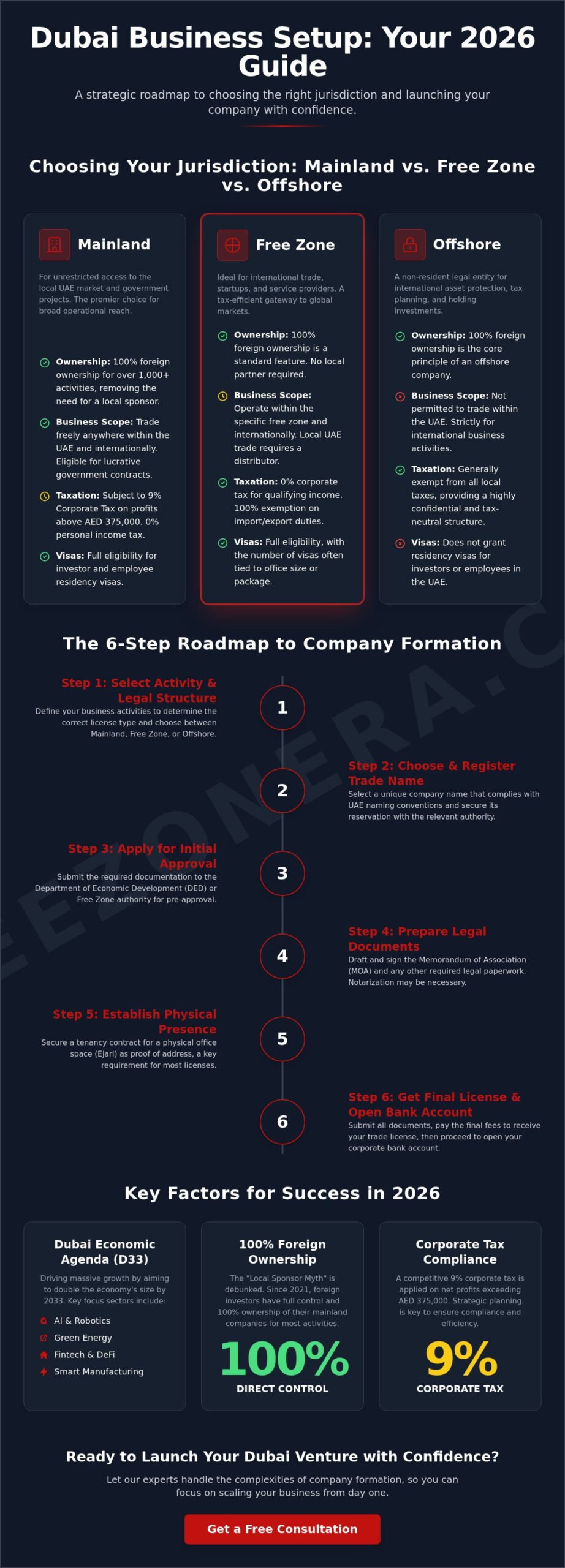
How to Start a Company in Dubai: The 6-Step Roadmap
Establishing a business in the UAE requires a methodical approach to meet strict regulatory standards. To start a company in dubai, you must follow a structured sequence that balances legal compliance with operational readiness. This 2026 roadmap outlines the essential milestones for a successful launch. For a deeper dive into each stage of this process, our comprehensive guide on how to open business in Dubai covers the full spectrum of licensing, jurisdiction selection, and strategic asset management.
- Step 1: Determine your business activity. You must select your specific operations from the 2,000 plus activities listed by the Department of Economy and Tourism (DET) or your chosen Free Zone authority.
- Step 2: Select a legal structure and trade name. Decide between a Limited Liability Company (LLC) or a Sole Establishment while ensuring your trade name meets UAE naming conventions.
- Step 3: Apply for Initial Approval. This is the “no objection” stage where the government verifies your business concept before you commit to a lease.
- Step 4: Draft the Memorandum of Association (MOA) and lease agreements. For mainland setups, an Ejari (registered lease) is mandatory. Free zones require a signed office lease or flexi-desk agreement.
- Step 5: Submit documents and pay license fees. Once you pay the finalized invoice, the authorities issue your trade license, often within 24 hours for “Instant License” categories.
- Step 6: Finalize visa processing and corporate bank account applications. This final stage involves medical tests and biometrics for your residency visa and a rigorous KYC process for your business account.
Document Preparation and Legalization
Precision is your greatest asset during document collection. You’ll need clear passport copies, a detailed business plan for certain jurisdictions, and proof of residential address for all shareholders. If you’re using a foreign corporate entity as a shareholder, documents must be attested by the UAE Embassy in the country of origin and the Ministry of Foreign Affairs (MOFA) within the UAE. Accurate activity coding is vital. Selecting the wrong code can trigger licensing audits or restrict your ability to import specific goods later. FreezonEra experts provide the clarity needed to align your documents with 2026 compliance standards.
Navigating the Trade Name Reservation
The UAE has specific restrictions on corporate titles. You cannot use names that reference religions, political groups, or global brands. Prohibited words also include “Global” or “International” unless the company meets high capital requirements. A reserved trade name typically costs between AED 600 and AED 1,000 and is valid for six months. It’s wise to ensure your chosen name is available as a digital domain before paying the reservation fee. This alignment protects your brand identity across both physical and digital markets. If you’re ready to secure your name, you can reach us to check availability and start the reservation process today.
Following this roadmap minimizes delays and prevents common administrative errors. While the process is streamlined, the complexity of banking and visa regulations makes professional guidance a strategic advantage for any entrepreneur looking to start a company in dubai with confidence.
Post-Setup Essentials: Visas, Banking, and 2026 Compliance
Obtaining your trade license is only the first milestone. By 2026, the regulatory environment for those who start a company in dubai has shifted into a more sophisticated, tax-active landscape. You must transition from “setup mode” to “compliance mode” immediately to protect your investment. Success in the UAE now requires a proactive approach to residency, taxation, and financial infrastructure.
Corporate Tax and VAT Registration
The UAE Federal Tax Authority (FTA) requires every new entity to register for Corporate Tax, regardless of whether they expect to pay it. Since the 2023 rollout, a 9% rate applies to taxable profits exceeding AED 375,000. Free Zone entities can often maintain a 0% tax status, but this isn’t automatic. You must generate “Qualifying Income” and maintain adequate substance within the zone to qualify for these exemptions. VAT registration is mandatory once your taxable turnover exceeds AED 375,000, though voluntary registration is available at AED 187,500. It’s a structured system that rewards transparency and requires precise accounting from day one.
Opening a Business Bank Account
The “Corporate Bank Account” challenge is often the most time-consuming part of the journey. Local banks have intensified their Know Your Customer (KYC) protocols to meet international standards. Banks frequently require a physical office or a dedicated “flexi-desk,” especially for activities deemed high-risk by the Central Bank. You’ll need to present a comprehensive file to the bank, including:
- A valid trade license and Memorandum of Association (MOA).
- Six months of personal bank statements from your home country.
- A detailed business plan and proof of potential clients.
- Shareholder CVs and proof of residency.
Experienced consultants are vital during this stage. We act as a professional bridge, ensuring your business profile matches the specific risk appetite of local financial institutions. This strategic alignment reduces the likelihood of application rejection and accelerates your operational start date. By preparing a robust compliance file, you position your company as a reliable entity in the eyes of UAE regulators.
Simplifying Your UAE Market Entry with Freezonera
One primary risk of a DIY approach is the “hidden cost” trap. Many founders encounter unexpected 15% to 20% increases in their initial budget due to misunderstood regulatory fees or document attestation requirements. We eliminate this uncertainty through fixed-fee transparency. You receive a clear roadmap of your investment from day one. This straightforward financial approach allows you to allocate resources toward what actually matters: your market entry and product development.
Our Structured Guidance System
We manage your entire timeline with precision. Our process tracks every milestone from your initial idea to the moment you open an operational bank account. Efficiency is our priority. We leverage a deep network of preferred partners including RAKEZ, SPC, and Ajman Free Zone to find the jurisdiction that fits your specific business activity. This targeted selection ensures you don’t overpay for features your business won’t use.
Success in the UAE depends on making data-backed decisions before you sign a single contract. To help you prepare, our consultants provide tailored insights into the current regulatory environment. You can connect with our experts today for a personalized feasibility study that examines your specific business model against local requirements.
Digital Growth for New Dubai Entities
Beyond digital visibility, establishing a presence in Dubai often involves connecting with the city’s cultural heart. For entrepreneurs looking to foster creativity within their new teams or explore the local art scene, you can learn more about Art Therapy and their corporate workshop offerings. Furthermore, for those seeking a professional base of operations, a coworking space downtown dubai offers the ideal environment for business incubation and growth.
The results of this integrated approach are measurable. In a 2025 case study, we supported a tech startup by aligning their corporate setup with a localized SEO strategy. By the end of their first six months, they achieved 300% growth in organic lead generation compared to competitors who delayed their digital rollout. We don’t just help you start a company in dubai; we help you scale it. Our team builds ideas driven by the future. Book a consultation today to secure your place in the UAE’s thriving economy.
Build Your Future in the UAE Market
The 2026 landscape offers unprecedented growth for entrepreneurs ready to start a company in dubai. Success depends on selecting the right jurisdiction, whether it’s the 100% ownership of a Free Zone or the local market access of the Mainland. By following our 6-step roadmap, you’ll navigate the complexities of documentation and 2026 compliance standards with precision. It’s about more than just paperwork; it’s about establishing a strategic foundation in a global trade hub that connects the East and West. You don’t have to face these administrative hurdles alone.
Freezonera brings over 5 years of UAE market entry expertise to your project. As official partners with major hubs like RAKEZ and SPC, we offer a fixed-fee guarantee that eliminates hidden government charges. We simplify the setup process so you can focus on scaling your vision while we handle the technical details. Start your Dubai journey today with Freezonera’s expert guidance and secure your place in the world’s most dynamic economy. Your success story in the UAE is ready to begin.
Frequently Asked Questions
How much does it cost to start a company in Dubai in 2026?
The cost to start a company in Dubai starts at approximately AED 12,900 for a basic Free Zone license without visas. These costs fluctuate based on your specific business activity and the jurisdiction you choose. For instance, a Mainland license through the Department of Economy and Tourism typically requires a budget starting at AED 15,000. You’ll also need to account for mandatory fees such as name reservation and initial approval costs.
Can I start a company in Dubai without a physical office?
You don’t need a traditional brick-and-mortar office to launch your business. Most Free Zones provide “Flexi-desk” or “Smart Office” solutions that satisfy the legal requirement for a registered business address. Additionally, the Mainland “Instant License” allows entrepreneurs to operate without a physical lease for the first 12 months. This flexibility reduces initial overhead while ensuring you remain in full compliance with local regulations.
Is 100% foreign ownership available for all business types in Dubai?
100% foreign ownership is now available for more than 1,000 commercial and industrial activities across the UAE. Since the 2021 amendment to the Commercial Companies Law, the requirement for a local Emirati partner has been removed for most sectors. However, specific strategic activities like oil and gas, telecommunications, and defense still require local participation. We provide structured guidance to help you navigate these specific jurisdictional requirements with precision.
How long does the company formation process take in a Dubai Free Zone?
The company formation process in a Dubai Free Zone typically takes between 3 and 10 working days. Digital-first jurisdictions like IFZA or Meydan Free Zone often issue licenses within 48 hours if your documentation is complete and accurate. If your business activity requires external approvals from bodies like the Dubai Health Authority, the timeline might extend to 15 days. Efficiency depends on having a clear, organized application strategy.
What are the main differences between a Mainland and a Free Zone license?
The primary difference lies in your operational reach and geographic trading rights. A Mainland license allows you to trade directly within the local UAE market and bid for government contracts without any restrictions. Conversely, a Free Zone license is optimized for international trade and offers 100% customs tax exemptions. While Free Zone entities usually require a local distributor to sell goods on the Mainland, they offer simpler setup procedures.
Do I need a residency visa to own a company in Dubai?
You don’t need a residency visa to hold shares or own a company in the UAE. Many international investors manage their Dubai entities from their home countries without ever relocating. However, if you intend to live in Dubai, open a personal bank account, or hire staff, you’ll need to apply for an investor visa. This visa is typically valid for 2 years and grants you an Emirates ID card.
What is the corporate tax rate for new Dubai companies in 2026?
The standard corporate tax rate is 9% for taxable profits exceeding AED 375,000. This tax regime, which began in June 2023, applies to most businesses operating in the UAE. Small businesses with a turnover below AED 3 million may qualify for Small Business Relief, potentially reducing their tax rate to 0% until December 2026. Qualifying Free Zone Persons may also benefit from a 0% rate on specific eligible income.
Can I open a corporate bank account remotely for my Dubai company?
You can start a company in Dubai and begin the banking application remotely, but most banks require a physical meeting for final verification. Digital banking platforms like Wio or Mashreq NeoBiz offer streamlined, tech-driven applications that are much faster than traditional routes. However, standard banks still follow strict “Know Your Customer” protocols that usually mandate at least one face-to-face interaction with a relationship manager to finalize the account.